
What is good about Pomodoro Technique?
What Is Good About the Pomodoro Technique?
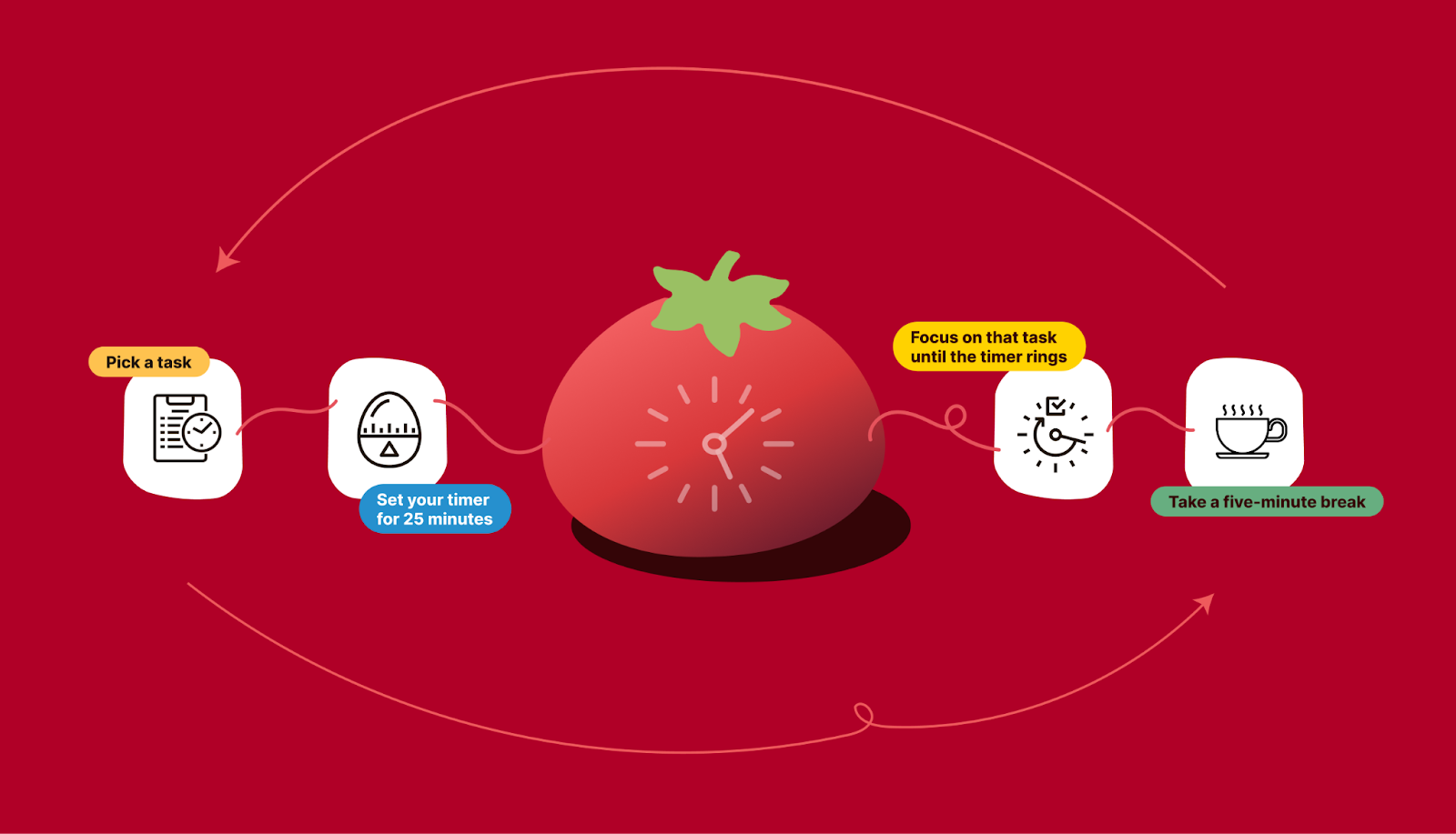
The Pomodoro Technique is widely regarded as one of the most practical and sustainable productivity methods available. Developed in the late 1980s by Francesco Cirillo, the method is based on a simple principle: work in focused intervals (traditionally 25 minutes), followed by short breaks. While the structure appears basic, its psychological and cognitive benefits are substantial.
This article examines what makes the Pomodoro Technique effective, why it works from a behavioral and neurological standpoint, and how it improves productivity, focus, and mental endurance.
1. It Reduces Mental Resistance to Starting
One of the most powerful aspects of the Pomodoro Technique is its ability to lower activation energy—the psychological barrier that prevents you from starting a task.
Large projects often trigger overwhelm:
-
“This will take all day.”
-
“I don’t have enough energy.”
-
“I’m not in the mood.”
A 25-minute commitment feels manageable. The brain interprets it as a limited demand rather than an open-ended obligation. This reduces avoidance behavior and makes task initiation significantly easier.
In behavioral psychology terms, the technique shrinks perceived effort, increasing the probability of action.
2. It Improves Focus Through Time Constraints
Parkinson’s Law states that work expands to fill the time available for its completion. When you give yourself unlimited time, focus becomes diffuse.
The Pomodoro Technique introduces:
-
A defined start
-
A defined end
-
A visible countdown
This creates urgency without panic. Time pressure, when controlled and brief, sharpens cognitive engagement. You are less likely to drift into:
-
Checking social media
-
Email grazing
-
Passive multitasking
Instead, attention narrows to the task at hand. The timer becomes a cognitive boundary.
3. It Trains Deep Work Capacity
Sustained attention is a skill, not a fixed trait. Many people struggle with deep work because they rarely practice uninterrupted focus.
Pomodoro intervals function as attention training sessions. Each 25-minute block strengthens:
-
Cognitive endurance
-
Resistance to distraction
-
Task immersion
-
Mental discipline
Over time, users often find they can extend their sessions beyond 25 minutes because their attention stamina improves. The technique builds concentration the same way interval training builds physical endurance.
4. It Prevents Burnout Through Structured Breaks
Continuous work without breaks leads to diminishing returns. Mental fatigue reduces:
-
Decision-making quality
-
Memory retention
-
Creativity
-
Motivation
The Pomodoro Technique embeds recovery periods into the workflow:
-
5-minute breaks after each session
-
Longer breaks after 4 sessions
These intervals allow the prefrontal cortex to reset. From a cognitive science perspective, brief detachment:
-
Restores attentional control
-
Reduces cognitive overload
-
Improves long-term output quality
The structure prevents overexertion while maintaining momentum.
5. It Makes Productivity Measurable
Many productivity systems rely on vague metrics like “worked all day.” Pomodoro introduces quantification.
Instead of saying:
-
“I worked on the report.”
You can say:
-
“I completed 6 Pomodoros on the report.”
This transforms productivity into a measurable unit of effort.
Tracking Pomodoros over time provides:
-
Workload visibility
-
Performance patterns
-
Accurate time estimation
-
Objective output tracking
Measurement increases accountability and helps refine planning accuracy.
6. It Combats Procrastination
Procrastination often stems from emotional discomfort rather than laziness. Tasks that are complex, ambiguous, or boring trigger avoidance.
The Pomodoro Technique helps by:
-
Breaking large tasks into intervals
-
Encouraging progress over perfection
-
Limiting commitment to short bursts
When you tell yourself, “Just one Pomodoro,” you bypass emotional resistance. Once started, momentum usually carries forward into additional sessions.
In this way, the method addresses both cognitive and emotional components of procrastination.
7. It Encourages Single-Tasking
Multitasking fragments attention and reduces cognitive efficiency. Research consistently shows that task-switching:
-
Increases error rates
-
Slows completion time
-
Reduces comprehension
The Pomodoro Technique requires singular focus during each interval. You commit to one task and postpone all others.
This structure:
-
Minimizes context switching
-
Increases task completion speed
-
Enhances output quality
By enforcing monotasking, the technique strengthens disciplined workflow habits.
8. It Builds Momentum Through Completion Cycles
The human brain responds positively to completion. Each finished Pomodoro acts as a micro-win.
This creates:
-
Dopamine reinforcement
-
A sense of progress
-
Increased motivation to continue
Instead of waiting hours for a large milestone, you experience small accomplishments every 25 minutes. Frequent progress signals sustain engagement and reduce discouragement.
9. It Improves Time Awareness
Many people underestimate how long tasks take. This leads to:
-
Overcommitment
-
Deadline stress
-
Ineffective planning
By tracking how many Pomodoros tasks require, you develop accurate time estimation skills.
For example:
-
Writing a blog post may take 5 Pomodoros.
-
Reviewing lecture notes may take 2.
-
Cleaning email inbox may take 1.
Over time, you gain predictive control over your schedule, improving planning reliability.
10. It Reduces Perfectionism
Perfectionism often causes overworking and analysis paralysis. The timer introduces a boundary that limits endless refinement.
You must:
-
Produce within a timeframe
-
Move forward after the session ends
-
Accept incremental progress
This fosters iteration over overthinking. Instead of polishing endlessly, you return for another Pomodoro if needed.
Timeboxing limits obsessive rework and supports balanced execution.
11. It Encourages Intentional Break Usage
Short breaks are not random scrolling sessions. Ideally, breaks are:
-
Physical (stretching, walking)
-
Visual (looking away from screens)
-
Cognitive (mental detachment)
When used properly, breaks enhance recovery rather than fragment attention. The method teaches structured rest instead of reactive distraction.
This distinction is crucial: planned breaks restore energy; unplanned distractions deplete it.
12. It Is Simple and Low Barrier
One of the greatest strengths of the Pomodoro Technique is its simplicity.
You need:
-
A timer
-
A task
-
A willingness to focus
No complex software, no elaborate systems, no extensive setup. Because the barrier to entry is low, adoption is easy.
Simplicity increases compliance.
13. It Works Across Contexts
The technique is versatile. It applies to:
Students
-
Studying for exams
-
Reading textbooks
-
Writing essays
Professionals
-
Coding
-
Report writing
-
Strategic planning
-
Administrative tasks
Creatives
-
Drafting content
-
Designing
-
Brainstorming
Because it structures attention rather than content, it adapts to most cognitive work.
14. It Enhances Work-Life Boundaries
When you track focused sessions, you become more aware of your work duration. Instead of working endlessly, you can define:
-
“I will complete 8 Pomodoros today.”
-
“After 12 sessions, I stop.”
This makes output goal-oriented rather than time-drift oriented.
It supports sustainable productivity instead of overextension.
15. It Strengthens Discipline Over Time
The Pomodoro Technique is not just a timer; it is a behavioral conditioning framework.
Repeated practice builds:
-
Delayed gratification
-
Attention control
-
Task completion habits
-
Structured workflow thinking
Like physical training, consistency compounds results. What begins as forced focus becomes natural concentration.
16. It Makes Large Projects Manageable
Large projects feel intimidating because they appear undefined.
Breaking them into Pomodoros:
-
Converts ambiguity into units
-
Provides visible progress
-
Reduces cognitive overwhelm
Instead of “Write research paper,” you have:
-
1 Pomodoro: outline
-
2 Pomodoros: research
-
3 Pomodoros: draft section 1
-
etc.
Complexity becomes operational.
17. It Encourages Reflection and Adjustment
After several sessions, you can evaluate:
-
Was the task too large?
-
Was the time underestimated?
-
Were interruptions frequent?
This reflection enables process improvement. The technique supports not just productivity, but productivity analysis.
18. It Reduces Decision Fatigue
The timer dictates when to:
-
Start
-
Stop
-
Take a break
This removes micro-decisions like:
-
“Should I keep going?”
-
“Is this enough?”
-
“When do I rest?”
Fewer decisions mean less mental depletion. Structured rhythm conserves cognitive energy.
19. It Supports Attention Recovery in the Digital Age
Modern work environments are saturated with interruptions:
-
Notifications
-
Emails
-
Messaging apps
-
Social media
The Pomodoro Technique creates a protected cognitive zone. During a session, distractions are postponed.
This practice retrains the brain to resist impulsive attention shifts.
20. It Promotes Sustainable Productivity
Perhaps the most important benefit is sustainability.
High-intensity productivity without structure leads to burnout. Low-intensity scattered work leads to stagnation.
The Pomodoro Technique balances:
-
Intensity (focused work)
-
Recovery (short breaks)
-
Reflection (tracking and adjustment)
It provides a repeatable cycle that can be maintained long-term.
Final Evaluation: Why It Works
The Pomodoro Technique is effective because it aligns with core principles of human cognition:
-
The brain performs best in limited focus bursts.
-
Motivation increases with visible progress.
-
Clear constraints improve execution.
-
Structured breaks prevent fatigue.
-
Small commitments reduce procrastination.
It is not magical. It does not eliminate difficult work. What it does is create an environment where focus becomes easier, progress becomes visible, and burnout becomes less likely.
For individuals struggling with distraction, procrastination, or inconsistent workflow, the Pomodoro Technique offers a highly practical, psychologically grounded framework.
Its greatest strength lies not in complexity—but in disciplined simplicity.
- Arts
- Business
- Computers
- Oyunlar
- Health
- Home
- Kids and Teens
- Money
- News
- Personal Development
- Recreation
- Regional
- Reference
- Science
- Shopping
- Society
- Sports
- Бизнес
- Деньги
- Дом
- Досуг
- Здоровье
- Игры
- Искусство
- Источники информации
- Компьютеры
- Личное развитие
- Наука
- Новости и СМИ
- Общество
- Покупки
- Спорт
- Страны и регионы
- World

 English
 Russian
 French
 Spanish
 Portuguese
 Deutsch
 Dutch
Dutch
 Italiano
 Arabic
 Romaian
 Portuguese (Brazil)
 Greek
Greek