
What Is the Difference Between IaaS, PaaS, and SaaS?
Cloud computing has a branding problem.
Ask ten executives to explain Infrastructure as a Service (IaaS), Platform as a Service (PaaS), and Software as a Service (SaaS), and you'll often receive ten different answers. Some describe them as layers. Others treat them as competing technologies. A few use the terms interchangeably, which is a bit like confusing a highway with a car and a destination.
The confusion is understandable.
The cloud industry has spent years creating acronyms and remarkably little time explaining why they matter in practical terms.
Yet understanding the difference between IaaS, PaaS, and SaaS has become increasingly important because these models influence everything from IT budgets and software development to innovation strategies and competitive advantage.
At first glance, they appear closely related.
They are.
But they solve fundamentally different problems.
The distinction becomes clearer when viewed through a simple question:
How much technology do you want to manage yourself?
The answer determines whether IaaS, PaaS, or SaaS is the right fit.
The Cloud Service Stack Explained
Imagine building a restaurant.
You could purchase land, construct the building, install utilities, buy kitchen equipment, hire staff, and manage every operational detail.
Or you could lease a fully equipped kitchen and focus exclusively on cooking.
Or you could skip ownership entirely and simply order food from an existing restaurant.
Each approach delivers food.
The amount of responsibility changes dramatically.
Cloud services work in much the same way.
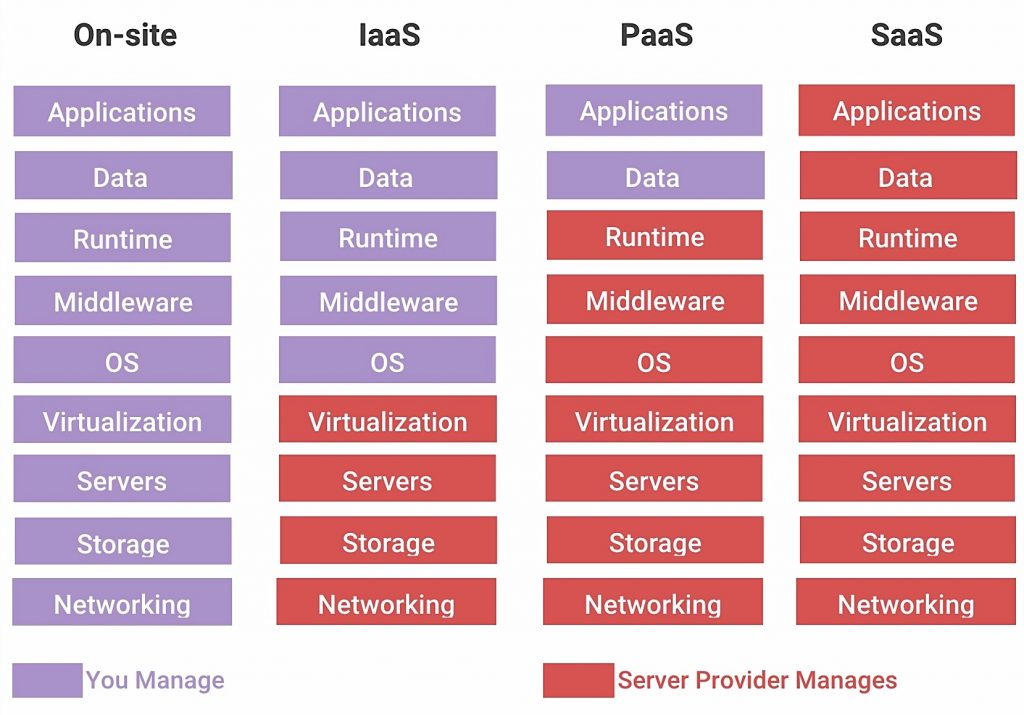
IaaS provides the infrastructure.
PaaS provides the development platform.
SaaS provides the finished application.
The further you move from infrastructure toward software, the less you manage and the more the provider handles on your behalf.
That progression is the foundation of modern cloud computing.
What Is IaaS?
Infrastructure as a Service: Maximum Control
Infrastructure as a Service represents the most flexible cloud model.
With IaaS, a cloud provider supplies core computing resources such as:
- Virtual servers
- Storage
- Networking
- Security infrastructure
- Data center facilities
The customer remains responsible for operating systems, applications, middleware, runtime environments, and data management.
Think of IaaS as renting an empty but fully functional building.
The plumbing works. The electricity is connected. The structure exists.
What happens inside remains largely your responsibility.
Why Organizations Choose IaaS
Businesses often select IaaS when they need:
- Extensive customization
- Full control over environments
- Legacy application support
- Flexible infrastructure scaling
- Advanced security configurations
Development teams appreciate the freedom.
IT departments appreciate the control.
Finance teams often appreciate avoiding large capital expenditures.
The trade-off, of course, is complexity.
More control usually means more responsibility.
What Is PaaS?
Platform as a Service: The Middle Ground
Platform as a Service occupies an intriguing position between infrastructure and software.
Rather than providing raw computing resources, PaaS delivers a managed platform where developers can build, test, deploy, and maintain applications.
The cloud provider manages:
- Infrastructure
- Operating systems
- Runtime environments
- Middleware
- Development frameworks
Developers focus primarily on writing code.
That distinction matters.
A great deal of software development effort historically had little to do with software itself. Teams spent countless hours configuring servers, patching operating systems, troubleshooting environments, and managing dependencies.
PaaS removes much of that operational burden.
Why Developers Gravitate Toward PaaS
Speed.
More specifically, the elimination of infrastructure friction.
When developers can deploy applications without worrying about server maintenance, projects move faster.
Experimentation becomes easier.
Updates become more predictable.
Organizations adopting PaaS frequently discover that development teams spend less time maintaining environments and more time creating products.
That shift is difficult to quantify yet impossible to ignore.
What Is SaaS?
Software as a Service: The Finished Product
Software as a Service is the cloud model most people interact with every day, whether they realize it or not.
Instead of managing infrastructure or development platforms, users simply access software through a web browser or application interface.
The provider manages everything:
- Infrastructure
- Security updates
- Software maintenance
- Availability
- Performance optimization
- Feature enhancements
Customers consume the software without worrying about the underlying technology stack.
The relationship resembles renting an apartment rather than owning a building.
You use the space.
Someone else handles the maintenance.
Why SaaS Dominates Modern Business Software
Convenience is part of the answer.
Predictability is another.
Organizations can deploy software quickly without investing in hardware, installation projects, or ongoing maintenance.
For many businesses, SaaS dramatically reduces technical complexity.
That simplicity explains why cloud-based productivity suites, customer relationship management platforms, communication tools, and collaboration applications have become so widespread.
The value proposition is straightforward:
Use the software. Skip the infrastructure.
The Core Difference: Responsibility
The easiest way to understand these models is to examine who manages what.
As cloud services evolve from IaaS to SaaS, responsibility shifts steadily from customer to provider.
That transition influences costs, flexibility, customization, security responsibilities, and operational workload.
The technology changes.
More importantly, accountability changes.
IaaS vs PaaS vs SaaS: A Detailed Comparison
| Feature | IaaS | PaaS | SaaS |
|---|---|---|---|
| Primary Purpose | Infrastructure delivery | Application development | Software consumption |
| User Manages | Applications, OS, middleware, data | Applications and data | Data and user settings |
| Provider Manages | Physical infrastructure | Infrastructure, OS, middleware | Entire technology stack |
| Customization Level | Very high | Moderate to high | Limited |
| Technical Expertise Required | High | Moderate | Low |
| Deployment Speed | Fast | Faster | Immediate |
| Scalability | Highly flexible | Highly flexible | Provider-managed |
| Maintenance Responsibility | Mostly customer | Shared | Mostly provider |
| Typical Users | IT teams, system administrators | Developers, software engineers | Business users |
| Cost Structure | Pay for infrastructure usage | Pay for platform usage | Subscription-based |
| Development Freedom | Maximum | Significant | Minimal |
| Time to Value | Moderate | Fast | Very fast |
The table highlights an important reality.
None of these models is inherently superior.
Each simply optimizes for different priorities.
A Lesson Learned About Cloud Strategy
Several years ago, I observed a growing company struggling with its technology roadmap.
The leadership team initially believed SaaS would solve every challenge. Why maintain infrastructure when software subscriptions seemed easier?
For a while, that approach worked.
Then the organization began developing proprietary applications. Suddenly, off-the-shelf software became restrictive. Custom workflows required more flexibility than SaaS solutions could provide.
The company shifted toward PaaS.
Later, as requirements became increasingly specialized, portions of the environment migrated to IaaS.
The lesson was revealing.
Cloud maturity is rarely a straight line.
Organizations often use all three models simultaneously.
The debate is not IaaS versus PaaS versus SaaS.
The more useful question is where each model creates the most value.
When Should You Choose IaaS?
IaaS makes sense when flexibility outweighs simplicity.
It is particularly useful for organizations that:
- Require customized environments
- Need control over infrastructure configurations
- Operate legacy systems
- Manage complex security requirements
- Run highly specialized workloads
Businesses pursuing infrastructure flexibility often find IaaS indispensable.
The trade-off is operational complexity.
Control always has a price.
When Should You Choose PaaS?
PaaS is often the preferred option for development-focused organizations.
It works particularly well when:
- Rapid application development is a priority
- Teams want to avoid infrastructure management
- Continuous deployment is important
- Development resources are limited
- Innovation speed matters
PaaS removes much of the operational burden that traditionally slowed software projects.
For many development teams, that efficiency is transformative.
When Should You Choose SaaS?
SaaS is ideal when software functionality matters more than technical customization.
Organizations typically choose SaaS when they want:
- Rapid deployment
- Predictable costs
- Minimal maintenance
- Easy scalability
- Simplified user management
The appeal is obvious.
Businesses acquire capabilities rather than technology responsibilities.
In many cases, that distinction creates substantial operational advantages.
Why Most Businesses Use All Three
One of the biggest misconceptions surrounding cloud computing is the assumption that companies must choose a single model.
Reality looks very different.
A modern organization might use:
- SaaS for collaboration and customer management
- PaaS for internal application development
- IaaS for specialized infrastructure workloads
The three models often complement one another rather than compete.
Think of them as layers within a broader cloud strategy.
Different business requirements demand different levels of control.
Different levels of control require different cloud services.
The result is a hybrid ecosystem rather than a single solution.
The Strategic Question Few Organizations Ask
Technology discussions often focus on features.
Storage capacity.
Processing power.
Deployment speed.
Subscription pricing.
Important considerations, certainly.
Yet the most strategic question is frequently overlooked:
What responsibilities should your organization retain?
That question sits at the heart of the IaaS, PaaS, and SaaS conversation.
Every cloud model represents a trade-off between control and convenience.
More control creates greater flexibility.
More convenience reduces operational burden.
Neither approach is universally correct.
The optimal choice depends on business objectives, technical expertise, regulatory requirements, and growth ambitions.
Conclusion: The Difference Is Not Technology—It's Ownership
At first glance, IaaS, PaaS, and SaaS appear to describe technology products.
In reality, they describe different philosophies of ownership.
IaaS says: manage almost everything yourself.
PaaS says: focus on development and let someone else manage the platform.
SaaS says: use the software and leave the rest to the provider.
The distinctions may seem subtle on paper.
They are anything but subtle in practice.
They influence budgets, hiring decisions, innovation cycles, risk management strategies, and competitive positioning.
Perhaps that is why the conversation continues to matter.
The future of cloud computing is not about choosing a single service model. It is about understanding precisely how much responsibility your organization wants to carry—and how much it is willing to let go.
- Arts
- Business
- Computers
- Games
- Health
- Home
- Kids and Teens
- Money
- News
- Personal Development
- Recreation
- Regional
- Reference
- Science
- Shopping
- Society
- Sports
- Бизнес
- Деньги
- Дом
- Досуг
- Здоровье
- Игры
- Искусство
- Источники информации
- Компьютеры
- Личное развитие
- Наука
- Новости и СМИ
- Общество
- Покупки
- Спорт
- Страны и регионы
- World

 Russian
 French
 Spanish
 Portuguese
 Deutsch
 Turkish
 Dutch
Dutch
 Italiano
 Arabic
 Romaian
 Portuguese (Brazil)
 Greek
Greek