
What Is Omnichannel Retail? The Strategy Behind Seamless Customer Experiences
The customer standing in a store aisle is not just a customer standing in a store aisle.
They may be comparing prices on a phone.
Reading reviews from strangers.
Checking whether another location has inventory.
Looking at a brand’s social media.
Adding an item to a digital cart they started three days earlier.
The physical store is only one moment in a much longer relationship.
That realization is at the center of omnichannel retail.
For years, retailers treated physical stores and digital channels as separate businesses. The store had its own inventory. The website had its own marketing strategy. Mobile apps existed somewhere in between, often managed by different teams with different goals.
Customers never saw those boundaries.
They simply saw one brand.
That disconnect created the need for a different approach.
Omnichannel retail is not about adding more channels.
It is about removing the walls between them.
The objective is simple to describe and difficult to execute:
Create one connected customer experience across every interaction point.
That means a customer can discover a product online, test it in a store, purchase it through an app, return it through another channel, and receive support without feeling like they are moving between separate companies.
The technology behind omnichannel retail can be complex.
The customer expectation behind it is surprisingly straightforward.
People want convenience.
They want recognition.
They want brands to remember the relationship.
Understanding Omnichannel Retail
Omnichannel retail is a business strategy that integrates all customer touchpoints—physical stores, websites, mobile applications, marketplaces, social media, customer service channels, and other digital platforms—into a unified shopping experience.
The key word is integrated.
Many retailers operate across multiple channels.
That does not automatically make them omnichannel.
A company with a website, physical stores, and a mobile app may still operate a fragmented retail model if those channels function independently.
For example:
A customer buys a product online.
The local store cannot see the purchase history.
Customer service cannot access the order details.
Returns require a separate process.
The customer experiences multiple systems.
Omnichannel retail aims to create one continuous journey.
Omnichannel vs Multichannel Retail: The Difference Matters
The terms are often confused.
They describe different approaches.
| Feature | Multichannel Retail | Omnichannel Retail |
|---|---|---|
| Channel Strategy | Multiple independent channels | Connected customer ecosystem |
| Customer Data | Often separated | Unified across channels |
| Inventory Visibility | Channel-specific | Shared inventory view |
| Customer Experience | Different experiences by channel | Consistent experience everywhere |
| Marketing | Channel-focused campaigns | Customer-focused journeys |
| Technology | Separate systems | Integrated platforms |
| Example | Website and store operate independently | Buy online, pick up in store, return anywhere |
The difference is philosophical.
Multichannel asks:
“How can we sell through more places?”
Omnichannel asks:
“How can we better serve the customer regardless of where they interact with us?”
That shift changes everything.
Why Omnichannel Retail Became Essential
Retail has always been about convenience.
The difference is that convenience now has multiple dimensions.
Customers expect:
- Speed
- Choice
- Personalization
- Transparency
- Flexibility
A shopper may want to browse online but purchase in person.
Another may want to visit a store but complete the transaction digitally.
Someone else may prefer automatic subscriptions and never enter a store at all.
The modern customer journey rarely follows a straight line.
Retailers that design for a single path create unnecessary friction.
Omnichannel strategies recognize that customers move unpredictably.
The experience must move with them.
Core Components of Omnichannel Retail
1. Unified Customer Data
At the center of omnichannel retail is information.
A retailer needs a complete understanding of customer interactions.
That includes:
- Purchase history
- Preferences
- Loyalty activity
- Customer service interactions
- Browsing behavior
Without connected data, personalization becomes guesswork.
A customer should not have to explain their relationship with a brand every time they switch channels.
2. Integrated Inventory Management
Inventory visibility is one of the most important operational challenges.
Customers increasingly expect options such as:
- Buy online, pick up in store
- Ship from store
- Return online purchases locally
- Check real-time availability
These services require inventory systems that communicate across locations and channels.
A product sitting in a warehouse, store, or distribution center is not useful if the customer cannot access it.
3. Consistent Brand Experience
Omnichannel retail does not mean every channel must look identical.
A mobile app and physical store should not feel like copies.
They should feel connected.
The brand voice.
The customer expectations.
The service standards.
Those elements should remain consistent.
4. Personalized Marketing
Traditional retail marketing often focused on campaigns.
Omnichannel marketing focuses on relationships.
Instead of sending the same promotion to everyone, retailers use customer data to deliver more relevant experiences.
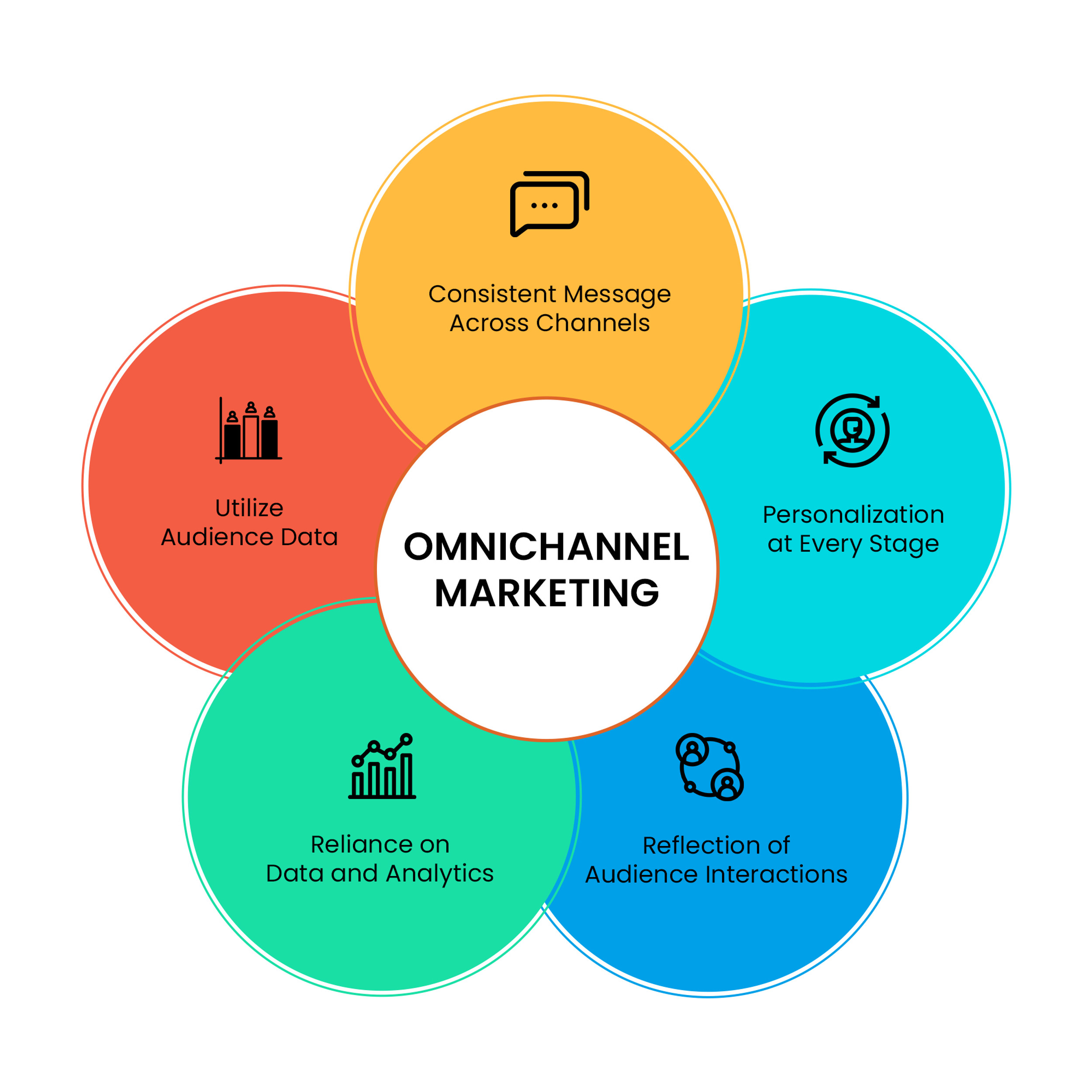
Examples include:
- Personalized recommendations
- Location-based offers
- Loyalty rewards
- Product reminders
The objective is not simply more communication.
It is more meaningful communication.
Omnichannel Retail Examples
Starbucks: Connecting Digital and Physical Experiences
Starbucks is frequently recognized for connecting mobile ordering, loyalty programs, and physical locations.
Customers can order through the app, earn rewards, customize purchases, and interact with stores through a connected ecosystem.
The value is not the app alone.
The value is the relationship created around the app.
Walmart: Combining Scale With Convenience
Walmart has invested heavily in connecting digital commerce with its physical store network.
Services such as pickup and delivery rely on integration between inventory, stores, logistics, and online ordering.
The store becomes more than a place to shop.
It becomes part of a broader fulfillment network.
Nike: Building Direct Customer Relationships
Nike has focused on connecting digital experiences, membership programs, retail locations, and personalized recommendations.
The strategy reflects a broader retail shift.
Brands increasingly want direct relationships with customers rather than relying entirely on third-party sellers.
Omnichannel Retail Technologies
Successful omnichannel strategies depend on technology.
Common systems include:
| Technology | Role in Omnichannel Retail |
|---|---|
| Customer Relationship Management (CRM) | Stores customer information and interactions |
| Enterprise Resource Planning (ERP) | Connects business operations |
| Inventory Management Systems | Tracks products across locations |
| Customer Data Platforms | Creates unified customer profiles |
| Mobile Apps | Provides personalized shopping experiences |
| Artificial Intelligence | Supports recommendations and forecasting |
| Marketing Automation | Delivers targeted communication |
Technology enables omnichannel retail.
But technology alone does not create it.
The strategy must come first.
Benefits of Omnichannel Retail
Higher Customer Loyalty
Customers tend to stay with brands that reduce friction.
When shopping feels simple, relationships become stronger.
Increased Sales Opportunities
More connected channels create more opportunities for purchases.
A customer who discovers a product online may complete the purchase in a store.
A customer visiting a store may later purchase through an app.
Better Customer Insights
Connected data provides a clearer picture of customer behavior.
Retailers can understand:
- What customers want
- When they buy
- Which channels influence decisions
Improved Operational Efficiency
Integrated systems reduce duplicated work.
Inventory becomes easier to manage.
Customer service becomes more informed.
Marketing becomes more precise.
Challenges of Building an Omnichannel Strategy
Omnichannel retail sounds straightforward.
Implementation is not.
Legacy Technology
Many retailers operate on older systems that were not designed to communicate with each other.
Connecting these systems requires investment.
Organizational Silos
Technology is only part of the challenge.
Departments must collaborate.
Marketing, operations, customer service, and technology teams need shared goals.
Data Privacy
More customer information creates greater responsibility.
Retailers must protect customer data and use it responsibly.
Cost and Complexity
Building an omnichannel ecosystem requires:
- Technology investments
- Employee training
- Process redesign
- Continuous optimization
The benefits can be significant.
But the transformation requires commitment.
A Lesson Learned From a Retail Transformation
I once worked with a retailer that had built a successful physical business over many years.
The company had loyal customers.
Strong products.
Excellent store teams.
Yet leadership became concerned because digital competitors were changing customer expectations.
The first instinct was to build an online store quickly.
The assumption was simple:
“We need e-commerce.”
But after studying customer behavior, the company discovered a different problem.
Customers did not want another shopping channel.
They wanted fewer obstacles.
They wanted to know whether products were available before visiting stores.
They wanted easier returns.
They wanted their loyalty benefits recognized everywhere.
The company shifted its focus from adding channels to connecting experiences.
The result was not simply higher online sales.
It was a stronger customer relationship.
That lesson applies beyond retail.
Customers rarely think about channels.
Businesses do.
Customers think about experiences.
The Future of Omnichannel Retail
The future of retail will likely become even more connected.
Emerging trends include:
- AI-driven personalization
- Automated inventory decisions
- Voice commerce
- Augmented reality shopping experiences
- Predictive customer service
- Faster fulfillment networks
But the fundamental principle will remain unchanged.
Customers do not want to navigate a company’s internal structure.
They do not care which department owns a channel.
They care whether the experience works.
The Real Meaning of Omnichannel Retail
The easiest way to misunderstand omnichannel retail is to view it as a technology project.
It is not.
It is a customer relationship strategy.
The best retailers are not winning because they have more channels.
They are winning because those channels disappear from the customer’s perspective.
A shopper does not think:
“I am moving from mobile commerce to physical retail.”
They think:
“I am shopping.”
That distinction reveals the entire purpose of omnichannel retail.
The goal is not to create more places for customers to interact with brands.
The goal is to create one relationship that works everywhere.
And the retailers that understand that difference will define the next era of commerce.
- Arts
- Business
- Computers
- الألعاب
- Health
- الرئيسية
- Kids and Teens
- مال
- News
- Personal Development
- Recreation
- Regional
- Reference
- Science
- Shopping
- Society
- Sports
- Бизнес
- Деньги
- Дом
- Досуг
- Здоровье
- Игры
- Искусство
- Источники информации
- Компьютеры
- Личное развитие
- Наука
- Новости и СМИ
- Общество
- Покупки
- Спорт
- Страны и регионы
- World

 English
 Russian
 French
 Spanish
 Portuguese
 Deutsch
 Turkish
 Dutch
Dutch
 Italiano
 Romaian
 Portuguese (Brazil)
 Greek
Greek