
What Is the Difference Between Traditional and Digital Billboards?
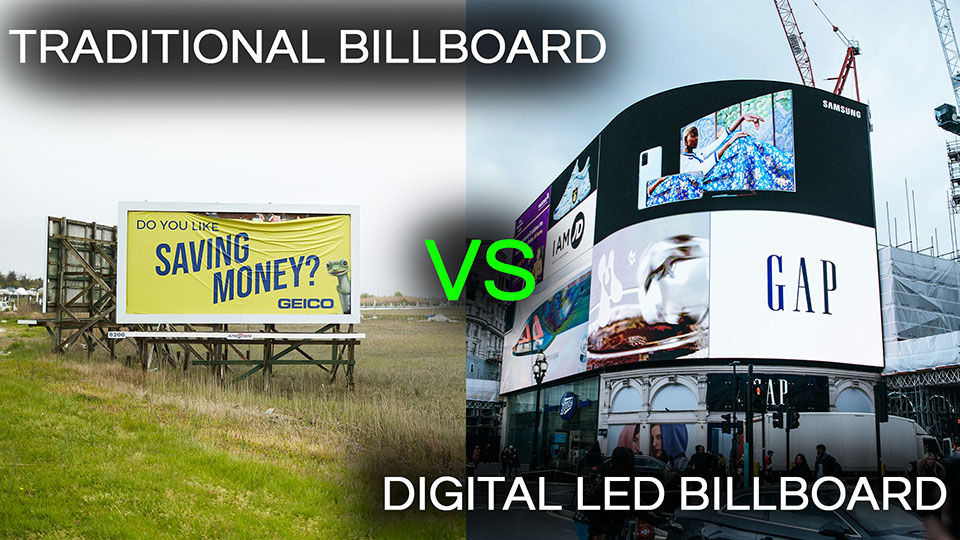
Billboard advertising has evolved significantly over the past several decades. What was once limited to printed posters mounted along highways has expanded into dynamic, screen-based displays capable of rotating messages in real time. Today, advertisers choosing outdoor advertising must decide between traditional (static) billboards and digital billboards.
While both formats serve the same core purpose—delivering high-visibility messages to large audiences—their capabilities, costs, creative requirements, and measurement options differ substantially. Understanding these differences is critical for selecting the right format for your marketing goals, budget, and audience.
This article explains how traditional and digital billboards differ, their respective advantages and limitations, and how advertisers should choose between them.
What Are Traditional (Static) Billboards?
Definition of Traditional Billboards
Traditional billboards, also called static billboards, are physical outdoor advertisements printed on vinyl, paper, or similar materials. Once installed, the ad remains unchanged for the duration of the campaign.
They have been used for decades and remain widely deployed.
Common Formats of Traditional Billboards
Static billboards include:
-
Bulletins (large highway billboards)
-
Posters (smaller urban billboards)
-
Wallscapes
-
Junior posters
Each format serves different environments.
How Traditional Billboards Work
The process involves:
-
Designing creative artwork
-
Printing the ad
-
Physically installing it on the billboard
The message stays visible 24/7.
What Are Digital Billboards?
Definition of Digital Billboards
Digital billboards use LED screens to display advertising content electronically. Ads rotate among multiple advertisers and can change automatically based on a preset schedule.
They represent a modern evolution of outdoor advertising.
Where Digital Billboards Are Found
Digital billboards are commonly placed:
-
Along major highways
-
In urban centers
-
Near shopping districts
-
In transit hubs
Their brightness and movement attract attention.
How Digital Billboards Operate
Digital billboard ads are:
-
Uploaded digitally
-
Scheduled in time slots
-
Displayed for a few seconds per rotation
No physical printing is required.
Core Differences Between Traditional and Digital Billboards
Static vs Dynamic Content
Traditional billboards:
-
Display one unchanging message
Digital billboards:
-
Rotate multiple messages
-
Allow animation and transitions
This difference affects creative strategy.
Message Duration
Static billboards:
-
Show your ad continuously
Digital billboards:
-
Show ads intermittently
-
Share space with other advertisers
Exposure frequency differs.
Creative Flexibility
Traditional billboards:
-
Require reprinting for changes
Digital billboards:
-
Allow instant updates
-
Support multiple creatives
Flexibility favors digital formats.
Cost Differences Between Traditional and Digital Billboards
Upfront Costs
Traditional billboards include:
-
Printing costs
-
Installation costs
Digital billboards:
-
Eliminate printing costs
However, digital placement often costs more.
Ongoing Costs
Static billboards:
-
Typically cheaper per month
-
Best for long campaigns
Digital billboards:
-
Higher monthly rates
-
Ideal for shorter campaigns
Cost structure influences format choice.
Campaign Duration Considerations
Long-Term Campaigns
Traditional billboards work best for:
-
Long-term branding
-
Continuous presence
-
Consistent messaging
They build familiarity over time.
Short-Term or Time-Sensitive Campaigns
Digital billboards excel for:
-
Events
-
Promotions
-
Seasonal offers
Their flexibility is valuable.
Creative Design Differences
Static Billboard Design
Static billboard creative must:
-
Be timeless
-
Avoid references to changing details
-
Remain relevant throughout the campaign
Mistakes are costly to fix.
Digital Billboard Design
Digital creative can:
-
Rotate messages
-
Change based on time of day
-
Include subtle motion
Design can evolve during the campaign.
Visibility and Attention
Brightness and Movement
Digital billboards:
-
Use brightness and motion to attract attention
Static billboards:
-
Rely on size, placement, and contrast
Each captures attention differently.
Nighttime Visibility
Digital billboards:
-
Are highly visible at night
-
Automatically adjust brightness
Static billboards depend on external lighting.
Audience Experience
Viewer Perception of Static Billboards
Static billboards feel:
-
Familiar
-
Less intrusive
-
More permanent
They blend into the environment.
Viewer Perception of Digital Billboards
Digital billboards feel:
-
More modern
-
More noticeable
-
Sometimes more distracting
Perception varies by location.
Regulatory Differences
Regulations for Traditional Billboards
Static billboards are regulated by:
-
Zoning laws
-
Size restrictions
-
Placement rules
These vary by jurisdiction.
Additional Regulations for Digital Billboards
Digital billboards often face:
-
Brightness limits
-
Animation restrictions
-
Ad rotation rules
They are more heavily regulated.
Measurement and Tracking Capabilities
Measuring Traditional Billboard Performance
Static billboards rely on:
-
Impression estimates
-
Brand lift studies
-
Indirect response tracking
Measurement is more inferential.
Measuring Digital Billboard Performance
Digital billboards allow:
-
Time-based analytics
-
Creative rotation testing
-
Location-based attribution
Measurement options are stronger.
Targeting Capabilities
Geographic Targeting
Both formats offer:
-
Location-based targeting
Placement defines the audience.
Time-Based Targeting
Only digital billboards allow:
-
Dayparting
-
Hour-specific messaging
This supports strategic timing.
Creative Testing and Optimization
Testing With Static Billboards
Static billboards:
-
Are expensive to test
-
Require full creative replacement
Testing is limited.
Testing With Digital Billboards
Digital billboards allow:
-
A/B testing
-
Rapid iteration
-
Performance comparison
Optimization is easier.
Environmental and Operational Factors
Maintenance and Reliability
Static billboards:
-
Require physical upkeep
-
Can be damaged by weather
Digital billboards:
-
Require technical maintenance
-
Depend on power and systems
Both have operational considerations.
Suitability by Industry
Industries Favoring Traditional Billboards
Traditional billboards are popular with:
-
Real estate
-
Legal services
-
Long-term branding campaigns
Consistency matters.
Industries Favoring Digital Billboards
Digital billboards work well for:
-
Entertainment
-
Retail promotions
-
Events
Flexibility matters.
Budget Considerations for Advertisers
Small Business Budget Constraints
Small businesses often choose:
-
Static posters
-
Short digital campaigns
Cost efficiency drives decisions.
Large Brand Campaigns
Large brands often use:
-
A mix of static and digital
-
Multi-location strategies
Scale enables flexibility.
Combining Traditional and Digital Billboards
Integrated Outdoor Strategies
Many campaigns use:
-
Static billboards for consistency
-
Digital billboards for flexibility
Combined strategies improve reach.
Message Reinforcement
Using both formats:
-
Reinforces messaging
-
Increases frequency
Consistency builds recall.
Common Misconceptions
“Digital Billboards Are Always Better”
Digital billboards are not always superior.
Static billboards often:
-
Deliver better value
-
Build stronger long-term presence
Effectiveness depends on goals.
“Static Billboards Are Outdated”
Static billboards remain:
-
Widely used
-
Highly effective
Their simplicity is a strength.
Choosing the Right Format for Your Campaign
Ask:
-
What is my goal?
-
How long will the campaign run?
-
Do I need flexibility?
-
What is my budget?
Answers guide the decision.
The Future of Billboard Advertising Formats
The future includes:
-
More digital adoption
-
Continued use of static formats
-
Hybrid outdoor strategies
Both formats will coexist.
Conclusion
Traditional and digital billboards each offer unique advantages. Traditional billboards provide continuous, cost-effective exposure ideal for long-term branding, while digital billboards offer flexibility, dynamic creative options, and enhanced measurement capabilities suited for short-term or time-sensitive campaigns.
The choice between the two should be guided by campaign objectives, budget, creative needs, and desired flexibility. In many cases, the most effective outdoor advertising strategies combine both formats, leveraging the strengths of each to maximize visibility and impact.
- Arts
- Business
- Computers
- Giochi
- Health
- Home
- Kids and Teens
- Money
- News
- Personal Development
- Recreation
- Regional
- Reference
- Science
- Shopping
- Society
- Sports
- Бизнес
- Деньги
- Дом
- Досуг
- Здоровье
- Игры
- Искусство
- Источники информации
- Компьютеры
- Личное развитие
- Наука
- Новости и СМИ
- Общество
- Покупки
- Спорт
- Страны и регионы
- World

 English
 Russian
 French
 Spanish
 Portuguese
 Deutsch
 Turkish
 Dutch
Dutch
 Arabic
 Romaian
 Portuguese (Brazil)
 Greek
Greek