
How to make habits easier?
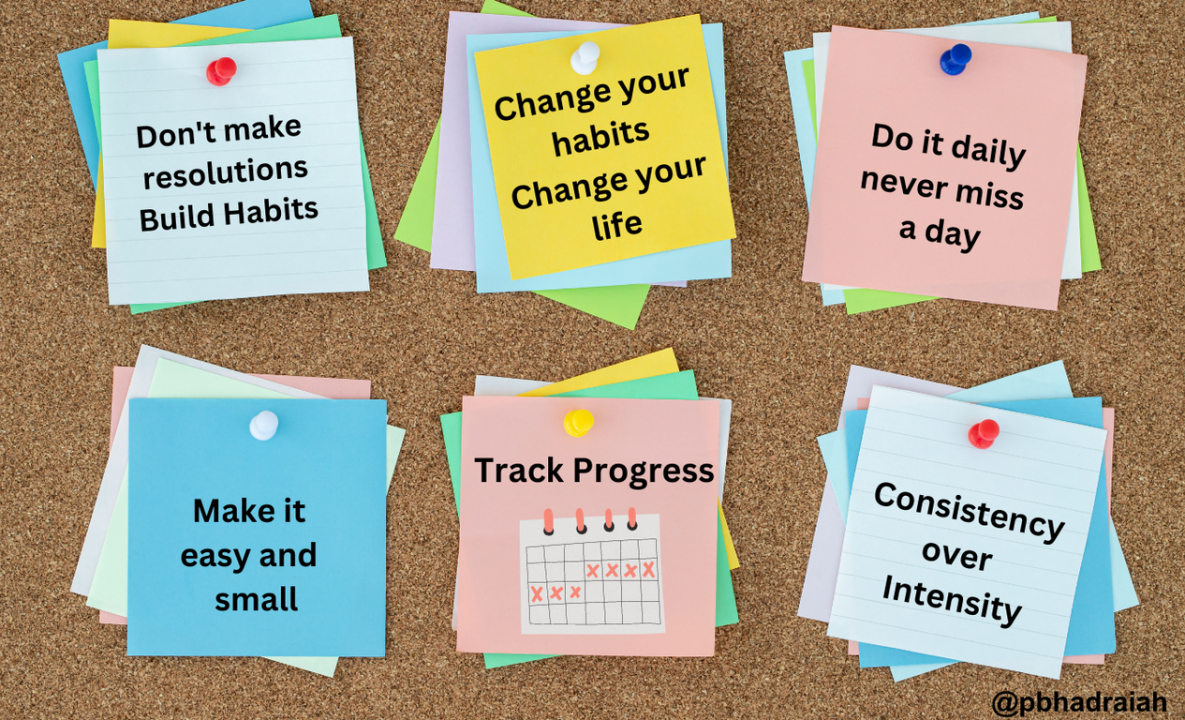
How to Make Habits Easier?
Most habit problems are not motivation problems.
They are friction problems.
People assume they fail because they lack discipline, but in most cases, the behavior is simply too expensive to start, too complex to maintain, or too mentally demanding to repeat under normal conditions.
If a habit feels hard, the issue is rarely you.
It is usually the structure around the behavior.
So the real goal is not to increase willpower.
It is to reduce friction until the habit requires almost no negotiation at all.
The Core Principle: Reduce the Cost of Starting
Every habit has an initiation cost:
-
time to begin
-
mental effort to switch contexts
-
setup requirements
-
decision-making overhead
And this initiation phase is where most habits fail.
\text{High Friction} \rightarrow \text{Lower Execution Probability}
If starting feels heavy, the brain will defer it.
Not because of laziness—but because energy is conserved for higher-priority demands.
So making habits easier begins with shrinking the “start moment” until it becomes almost automatic.
Step 1: Shrink the Habit Until It Feels Absurdly Small
One of the most effective ways to reduce friction is scale reduction.
Instead of:
-
“work out for 45 minutes”
Start with:
-
“put on workout clothes”
Instead of:
-
“read for an hour”
Start with:
-
“read one page”
Instead of:
-
“write a full report”
Start with:
-
“write one sentence”
Small actions bypass resistance because they do not trigger the same psychological weight as larger commitments.
\text{Small Action} \rightarrow \text{Lower Resistance} \rightarrow \text{Higher Consistency}
Once the habit starts, continuation becomes easier than initiation.
Step 2: Remove Setup Steps Entirely
Setup friction is one of the most underestimated barriers to habits.
Examples:
-
needing to search for tools
-
preparing a workspace
-
deciding what to do first
-
organizing materials
Each step adds delay.
And delay creates exit points.
Making habits easier often means pre-loading the environment:
-
leave tools visible
-
keep workspace ready
-
open documents in advance
-
remove unnecessary preparation steps
If the habit is always “ready to go,” execution becomes far more likely.
Step 3: Use Environmental Design Instead of Willpower
Willpower is unreliable because it fluctuates with:
-
sleep
-
stress
-
workload
-
emotional state
Environment is more stable.
So instead of relying on internal control, shape external conditions:
-
place reminders in visible locations
-
reduce distractions in key areas
-
make desired actions easier to access than alternatives
\text{Supportive Environment} \rightarrow \text{Lower Decision Load} \rightarrow \text{Easier Habit Execution}
When the environment does the prompting, the mind does not need to.
Step 4: Eliminate Decisions Before They Appear
Every decision introduces friction:
-
Should I do this now?
-
Where should I start?
-
How long should I do it?
Even small decisions accumulate cognitive load.
Making habits easier means pre-deciding everything:
-
when it happens
-
where it happens
-
what the first step is
-
how long it lasts
If nothing needs to be decided in the moment, nothing can be delayed.
Step 5: Attach Habits to Existing Behaviors
New habits are easier when they are not independent.
Instead of creating new triggers, attach them to existing routines:
\text{Existing Habit} \rightarrow \text{New Habit}
Examples:
-
after coffee → start writing
-
after brushing teeth → read
-
after sitting at desk → open task list
This works because existing habits already require no effort to initiate.
You are borrowing their automation.
Step 6: Reduce Cognitive Load During Execution
Some habits fail not at starting—but during execution.
Cognitive overload happens when:
-
steps are unclear
-
goals are too broad
-
next action is ambiguous
To make habits easier, define the next step in advance:
-
not “study” → but “solve one problem”
-
not “clean room” → but “clear desk surface”
-
not “work on project” → but “open file and write header”
Clarity reduces mental friction.
And reduced friction increases completion probability.
Step 7: Make Bad Alternatives Slightly Less Convenient
Habits compete with alternatives:
-
scrolling
-
procrastination
-
passive consumption
-
avoidance behaviors
If these are significantly easier, they win by default.
You don’t need to eliminate them entirely.
You only need to slightly increase their friction:
-
log out of distracting apps
-
remove shortcuts
-
keep devices out of immediate reach
Small friction shifts can change behavioral defaults.
Step 8: Design for “Start-Only” Success
One of the most powerful reframes is separating starting from completing.
Most people think:
“I need to finish the habit”
But consistency is built on:
“Can I start the habit easily?”
\text{Easy Start} \rightarrow \text{Increased Habit Frequency}
Once started, momentum often carries the behavior forward.
So success should be defined by initiation, not perfection.
A Personal Observation on Habit Difficulty
At one point, I tried improving habits by increasing discipline and effort.
That approach worked inconsistently.
What actually changed outcomes was not effort—but redesigning friction:
-
reducing setup steps
-
simplifying starting actions
-
removing decisions
-
attaching behaviors to existing routines
Once initiation became easy, consistency stopped being something I had to force.
It started happening automatically in small, repeatable increments.
The Structural Formula of Easier Habits
At a systems level, habit ease depends on:
-
low initiation friction
-
clear cues
-
reduced decision-making
-
supportive environment
-
minimal cognitive load
-
stable triggers
\text{Low Friction + Clear Cue + Simple Action} \rightarrow \text{Easier Habit Execution}
When these conditions are met, habits stop feeling like tasks.
They become defaults.
Conclusion: Easier Habits Are Designed, Not Forced
Making habits easier is not about increasing discipline or motivation.
It is about removing the structural barriers that make behavior hard to start or sustain.
The key shift is this:
Stop asking how to push harder.
Start asking what makes the habit harder than it needs to be.
Because once friction is reduced enough, consistency is no longer something you have to manufacture.
It becomes the natural outcome of a system designed to support it.
- Arts
- Business
- Computers
- الألعاب
- Health
- الرئيسية
- Kids and Teens
- مال
- News
- Personal Development
- Recreation
- Regional
- Reference
- Science
- Shopping
- Society
- Sports
- Бизнес
- Деньги
- Дом
- Досуг
- Здоровье
- Игры
- Искусство
- Источники информации
- Компьютеры
- Личное развитие
- Наука
- Новости и СМИ
- Общество
- Покупки
- Спорт
- Страны и регионы
- World

 English
 Russian
 French
 Spanish
 Portuguese
 Deutsch
 Turkish
 Dutch
Dutch
 Italiano
 Romaian
 Portuguese (Brazil)
 Greek
Greek
