
Why do I keep failing at habits?
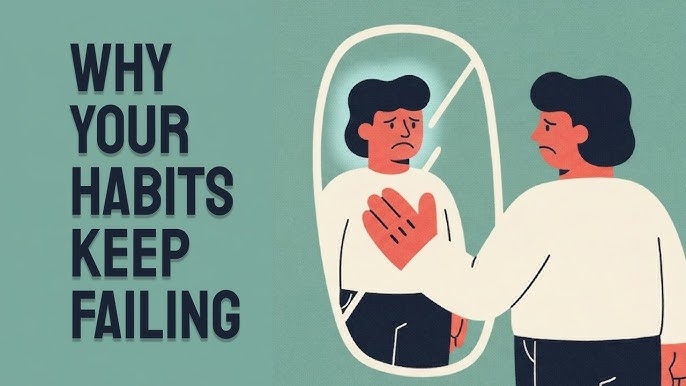
Why Do I Keep Failing at Habits?
Most people interpret repeated habit failure as a personal flaw.
They assume:
-
“I’m inconsistent”
-
“I lack discipline”
-
“I can’t stick to anything”
But that framing is usually inaccurate.
Habit failure is rarely an identity problem. It is a system mismatch between what you are trying to do and the conditions you are trying to do it in.
If a behavior keeps collapsing, the issue is not persistence alone. It is that the structure supporting the behavior is too fragile to survive normal variation in energy, emotion, and environment.
Habits Don’t Fail at Peak Motivation — They Fail in Normal Conditions
Most habits are built during high motivation periods:
-
New Year resolutions
-
sudden inspiration
-
emotional resets
-
productivity spikes
During those moments, behavior feels easy.
But habits are not tested there.
They are tested on:
-
low energy days
-
stress periods
-
distractions
-
emotional instability
-
schedule disruption
\text{High Motivation} \neq \text{Long-Term Consistency}
If a habit only works when motivation is high, it is not a habit yet.
It is a temporary behavior.
The System Is Usually Too Complex
One of the most common reasons for failure is unnecessary complexity:
-
too many steps
-
too many rules
-
too many conditions
-
too many decisions
Every added step increases friction.
And friction compounds quickly.
\text{More Steps} = \text{Lower Execution Probability}
A habit that requires preparation, planning, and decision-making will eventually collapse under normal cognitive load.
Simplicity is not optional.
It is structural stability.
You’re Relying on Motivation Instead of Structure
Motivation is variable:
-
it rises and falls
-
it responds to emotion
-
it reacts to environment
Structure is stable:
-
cues
-
routines
-
environment
-
repetition
Most habit failure happens because people try to replace structure with motivation.
But motivation is not designed to be reliable.
\text{Motivation-Based Behavior} = \text{Low Stability}
If your habits depend on how you feel, inconsistency is inevitable.
The Cue Is Weak or Inconsistent
Habits begin with cues:
-
time
-
location
-
preceding action
-
emotional state
-
environmental signal
If the cue is inconsistent, the habit cannot stabilize.
For example:
-
sometimes you study in the morning, sometimes at night
-
sometimes you work in your room, sometimes elsewhere
-
sometimes you work after breakfast, sometimes after scrolling
The brain never locks onto a stable trigger.
So the habit never becomes automatic.
The Reward Is Too Delayed or Too Small
A habit survives because something reinforces it:
-
relief
-
satisfaction
-
progress
-
clarity
-
emotional reward
If the reward is:
-
delayed
-
unclear
-
weak
-
inconsistent
the behavior loses reinforcement strength.
\text{Weak Reward Signal} = \text{Low Habit Retention}
This is why habits that feel immediately rewarding are easier to sustain than those that only pay off later.
The Environment Is Working Against You
Even strong intentions fail in weak environments:
-
distractions within reach
-
notifications constantly active
-
tools not prepared
-
conflicting routines
If the environment makes the bad option easier than the good one, the system will repeatedly default to the easier path.
Environment is not background context.
It is active behavior design.
You’re Trying to Change Too Much at Once
Another major failure pattern is stacking multiple new habits simultaneously:
-
workout
-
reading
-
waking early
-
diet changes
-
productivity systems
Each habit competes for:
-
attention
-
energy
-
decision-making capacity
\text{Too Many Simultaneous Changes} = \text{System Overload}
When everything changes at once, nothing stabilizes.
Single-habit focus is often more effective than multi-habit ambition.
You Don’t Have a Recovery System
Most people assume success means never failing.
But real habit systems include recovery:
-
missed day → reset
-
disruption → restart quickly
-
inconsistency → re-anchor cue
Without recovery mechanisms, one lapse becomes a full collapse.
\text{Slip} + \text{No Recovery System} = \text{Habit Breakdown}
The difference between success and failure is often how quickly you return after disruption.
The Habit Was Too Big to Survive Real Life
A habit that only works under ideal conditions is fragile:
-
perfect schedule
-
perfect energy
-
perfect environment
But real life is inconsistent.
So the habit must be designed for:
-
low energy days
-
interruptions
-
emotional fluctuations
-
time constraints
If it cannot survive normal variability, it will not survive long-term.
Identity Has Not Caught Up Yet
Habits stabilize faster when identity supports them:
-
“I try to work out” → fragile
-
“I should read more” → unstable
-
“I am someone who does this” → stable
Without identity alignment, every repetition requires negotiation.
\text{Aligned Identity} = \text{Reduced Behavioral Resistance}
If your identity and your habit conflict, the habit loses repeatedly.
A Personal Observation on Habit Failure
At one point, I assumed habit failure meant I was not trying hard enough.
So I responded with more effort:
-
stricter rules
-
higher expectations
-
longer sessions
-
more discipline
But the pattern stayed the same:
-
short-term success
-
long-term collapse
What actually changed things was reducing the system complexity:
-
smaller actions
-
clearer cues
-
fewer decisions
-
more stable repetition
Once the habits stopped relying on ideal conditions, they stopped collapsing so frequently.
The Structural Reason Habits Keep Failing
At a systems level, habits fail when one or more of the following is weak:
-
cue consistency
-
environmental support
-
reward clarity
-
friction level
-
simplicity of execution
-
recovery mechanism
-
identity alignment
\text{Weak System Component} = \text{Habit Instability}
Most habit failure is not caused by one dramatic issue.
It is caused by multiple small weaknesses stacking together.
Conclusion: You’re Not Failing Habits — You’re Building Them Without Stability
Habit failure is rarely about lack of effort.
It is usually about lack of structure.
When habits collapse repeatedly, it is not because you cannot change.
It is because the system supporting the behavior is not designed to withstand normal life conditions.
The solution is not to try harder.
It is to simplify, stabilize, and redesign the system so that the behavior can survive:
-
low motivation
-
interruptions
-
stress
-
distraction
-
inconsistency
Because once the structure is strong enough, consistency stops being something you force.
It becomes something that happens by default.
- Arts
- Business
- Computers
- Παιχνίδια
- Health
- Κεντρική Σελίδα
- Kids and Teens
- Money
- News
- Personal Development
- Recreation
- Regional
- Reference
- Science
- Shopping
- Society
- Sports
- Бизнес
- Деньги
- Дом
- Досуг
- Здоровье
- Игры
- Искусство
- Источники информации
- Компьютеры
- Личное развитие
- Наука
- Новости и СМИ
- Общество
- Покупки
- Спорт
- Страны и регионы
- World

 English
 Russian
 French
 Spanish
 Portuguese
 Deutsch
 Turkish
 Dutch
Dutch
 Italiano
 Arabic
 Romaian
 Portuguese (Brazil)
