
What Does B2C Mean? It Means Selling to People Whose Decisions Are Emotional, Immediate, and Constantly Influenced by Context
A teenager buys a $7 iced coffee because the cup looks good in photos.
Someone orders running shoes at 11:43 p.m. after promising themselves they’ll “start over Monday.”
A woman standing in a grocery aisle pays extra for olive oil packaged in matte glass because it somehow feels more trustworthy than the cheaper bottle beside it.
None of these purchases are irrational exactly.
They are human.
And that’s the real starting point for understanding B2C — business-to-consumer commerce — because the term sounds deceptively clinical for something so psychologically messy.
Most definitions describe B2C simply:
a business sells products or services directly to consumers.
Technically correct.
Also incomplete.
Because B2C is not merely a transaction model.
It is an environment where businesses compete for:
- attention
- emotional relevance
- convenience
- habit
- identity
- trust
often within seconds.
Consumers do not move through the world like procurement departments.
They do not always compare spreadsheets.
They do not necessarily deliberate methodically.
Sometimes they buy because they’re excited.
Or stressed.
Or lonely.
Or aspirational.
Or tired enough to choose familiarity over logic.
That complexity explains why B2C businesses can grow explosively one year and disappear quietly the next.
Consumer attention shifts fast.
Consumer loyalty shifts faster.
And companies misunderstanding those emotional dynamics usually mistake visibility for durability.
What Does B2C Actually Stand For?
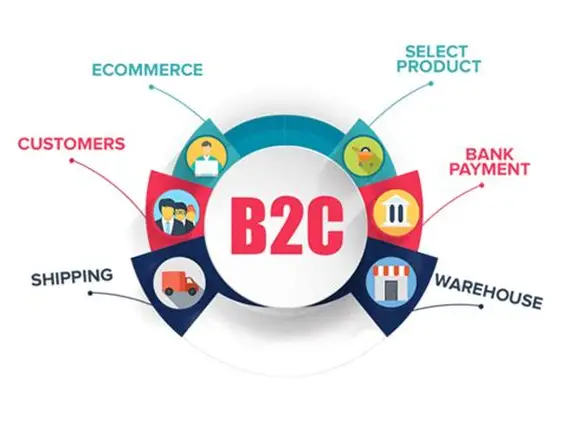
B2C means business-to-consumer.
It describes companies that sell directly to individual customers for personal use.
Common examples include:
- clothing brands
- streaming platforms
- restaurants
- beauty companies
- fitness apps
- electronics retailers
- grocery delivery services
The key distinction is the buyer.
In B2C, the customer is typically purchasing for themselves or their household rather than on behalf of an organization.
That changes:
- decision speed
- marketing psychology
- pricing sensitivity
- branding strategy
- customer behavior
A consumer buying sneakers operates differently from a corporation purchasing cybersecurity software.
One may buy impulsively during lunch.
The other may require:
- procurement approval
- legal review
- executive sign-off
- budget allocation
B2C generally moves faster because the emotional and operational stakes feel lower.
But faster does not necessarily mean simpler.
B2C Runs on Emotion More Than Businesses Like to Admit
Many companies still speak about consumers as though purchasing decisions emerge from pure logic.
Reality says otherwise.
People routinely buy products because they want to feel:
- healthier
- more organized
- more attractive
- more successful
- less anxious
- more connected
The product becomes symbolic.
A skincare routine can represent control.
A luxury watch can represent achievement.
Meal delivery can represent relief from exhaustion.
Years ago, I worked with a consumer subscription brand convinced their retention problems stemmed from pricing.
The leadership team spent months debating discount structures.
Customer interviews eventually revealed something entirely different.
Subscribers weren’t leaving because the service felt expensive.
They were leaving because the onboarding experience felt emotionally cold.
The company communicated efficiently.
Not warmly.
That distinction changed everything.
Retention improved once communication felt more human and less transactional.
Because consumers evaluate emotional experience constantly — even when businesses assume they’re evaluating functionality alone.
Why B2C Buying Decisions Happen Faster
Consumer purchases often involve lower perceived risk.
If someone buys:
- disappointing headphones
- average coffee
- shoes they later regret
the consequences remain manageable.
That lower risk compresses decision-making dramatically.
Consumers can:
- discover a product
- feel emotionally interested
- purchase immediately
within minutes.
This creates enormous opportunities for B2C businesses.
Also enormous pressure.
Because speed cuts both ways.
Consumers abandon brands quickly too.
A frustrating checkout experience.
A delayed shipment.
A disappointing interaction.
Sometimes that’s enough to permanently weaken loyalty.
A Comparison: B2C vs. B2B
| B2C | B2B |
|---|---|
| Individual consumers | Organizational buyers |
| Faster purchasing decisions | Longer sales cycles |
| Emotion-heavy decision-making | Risk-heavy evaluation |
| High transaction volume | Higher contract values |
| Brand identity matters deeply | Operational reliability prioritized |
| Shorter buying journeys | Multi-stage approval processes |
| Convenience drives conversions | Integration drives conversions |
| Lower switching costs | Higher switching complexity |
| Immediate gratification important | Long-term ROI important |
| Marketing often consumer-facing | Sales often relationship-driven |
Both models require trust.
But the mechanics of that trust differ dramatically.
Branding Matters More in B2C Because Identity Is Involved
This part gets underestimated constantly.
Consumers buy products partly to reinforce personal identity.
People ask themselves subconsciously:
- “Does this fit who I think I am?”
- “Would someone like me buy this?”
- “How will this make me feel?”
That’s why branding carries enormous weight in consumer markets.
The:
- typography
- packaging
- tone of voice
- colors
- photography
all communicate emotional positioning.
A coffee brand does not merely sell caffeine.
It may sell:
- productivity
- sophistication
- calmness
- rebellion
- wellness
depending on how the brand frames itself culturally.
This explains why two products with similar functionality can perform radically differently commercially.
Consumers rarely purchase utility alone.
They purchase meaning layered around utility.
Convenience Is One of the Strongest Forces in B2C
Consumers are overwhelmed constantly:
- notifications
- advertisements
- streaming content
- emails
- social media
- subscription management
Attention becomes fragmented quickly.
Which means convenience gains extraordinary commercial value.
Consumers repeatedly choose businesses that:
- reduce effort
- simplify decisions
- remove friction
- save time
The strongest B2C companies understand this deeply.
Ease itself becomes a product feature.
That’s why:
- one-click purchasing matters
- fast delivery matters
- intuitive design matters
- smooth onboarding matters
Friction kills consumer momentum surprisingly fast.
Especially when alternatives remain immediately accessible.
My Most Important Lesson About B2C Came From Watching Consumers Ignore Better Products
Years ago, I worked alongside a retail company obsessed with technical superiority.
Leadership focused relentlessly on:
- materials
- manufacturing quality
- performance comparisons
Their competitor had weaker specifications objectively.
But consumers preferred the competitor emotionally.
Why?
The competitor created a stronger lifestyle association.
The brand felt more culturally relevant.
Customers connected emotionally before they evaluated functionality rationally.
At first, leadership resisted this explanation because it sounded irrational.
But consumer behavior often is emotionally weighted first and logically justified second.
That realization permanently changed how I think about B2C strategy.
The best product does not automatically win.
The product consumers feel connected to often does.
Social Proof Shapes Consumer Behavior Constantly
Consumers rely heavily on:
- reviews
- ratings
- influencer recommendations
- social trends
- friend referrals
Because modern consumer markets contain overwhelming choice abundance.
Social proof reduces decision fatigue.
A stranger’s review may influence behavior more effectively than expensive advertising because peer experiences feel more trustworthy emotionally.
This becomes especially powerful in industries tied closely to identity:
- beauty
- wellness
- fashion
- travel
- fitness
- technology
Consumers often seek reassurance before purchasing because abundance creates uncertainty.
Why Retention Is Hard in B2C
Customer acquisition can happen quickly in consumer markets.
Retention is harder because switching costs remain low.
A consumer can replace:
- a streaming service
- a skincare brand
- a food delivery app
- a clothing retailer
almost instantly.
This creates relentless pressure around:
- customer experience
- emotional relevance
- pricing perception
- convenience
- consistency
The strongest B2C companies focus heavily on habit formation.
Because habitual purchasing creates stability in markets otherwise dominated by volatility.
AI Will Transform B2C — But Human Emotion Still Controls Purchasing
Artificial intelligence already influences:
- personalized recommendations
- customer support
- advertising targeting
- shopping predictions
This increases efficiency dramatically.
But despite automation advances, emotional psychology still shapes consumer behavior underneath.
People continue purchasing because they want to feel:
- reassured
- rewarded
- confident
- included
- inspired
- comforted
Technology may improve targeting precision.
It does not eliminate emotional motivation.
And companies forgetting that often create highly optimized marketing systems with surprisingly weak consumer loyalty.
Why Attention Became the Real Battleground
Modern consumers encounter commercial messaging constantly.
Thousands of signals compete daily for emotional space:
- ads
- videos
- influencer content
- brand partnerships
- product placements
This changes how B2C companies operate.
The challenge is no longer simply creating products.
It is sustaining relevance long enough for consumers to care.
Brands capable of:
- creating emotional resonance
- simplifying decisions
- reducing cognitive overload
often outperform brands focused exclusively on technical excellence.
Because attention scarcity changes purchasing behavior profoundly.
Conclusion: B2C Means Selling to Human Emotion Under Conditions of Constant Distraction
The formal definition of B2C sounds straightforward:
business-to-consumer.
But the reality underneath is far more psychologically layered.
B2C companies do not simply sell products.
They sell:
- convenience
- aspiration
- reassurance
- identity
- belonging
- emotional relief
sometimes all at once.
Consumers buy while:
- distracted
- stressed
- hopeful
- overwhelmed
- impulsive
- aspirational
Which means successful B2C businesses understand something many organizations miss:
people rarely purchase based purely on logic.
They purchase based on what feels:
- trustworthy
- emotionally compatible
- easy
- familiar
- rewarding
And those emotional perceptions form quickly.
That’s why B2C can feel simultaneously thrilling and unstable.
Consumer loyalty shifts rapidly.
Trends evolve unpredictably.
Attention fragments continuously.
But businesses capable of understanding real human behavior beneath the transaction itself tend to build stronger brands over time.
Because ultimately, B2C is not just commerce between companies and customers.
It is the ongoing relationship between human emotion and consumer choice happening millions of times every day — often faster, messier, and more psychologically revealing than businesses initially expect.
- Arts
- Business
- Computers
- Jogos
- Health
- Início
- Kids and Teens
- Money
- News
- Personal Development
- Recreation
- Regional
- Reference
- Science
- Shopping
- Society
- Sports
- Бизнес
- Деньги
- Дом
- Досуг
- Здоровье
- Игры
- Искусство
- Источники информации
- Компьютеры
- Личное развитие
- Наука
- Новости и СМИ
- Общество
- Покупки
- Спорт
- Страны и регионы
- World

 English
 Russian
 French
 Spanish
 Portuguese
 Deutsch
 Turkish
 Dutch
Dutch
 Italiano
 Arabic
 Romaian
 Greek
Greek
