
What is prospect theory?
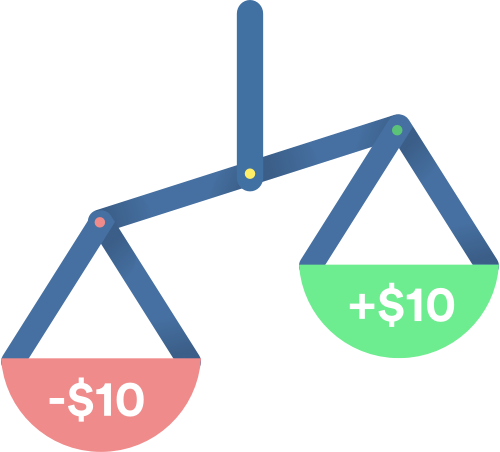
What Is Prospect Theory?
The Moment Where Economic Theory Meets Human Behavior
A person is offered two choices:
-
A guaranteed gain of $500
-
A 50% chance to gain $1,000, and a 50% chance to gain nothing
Most people choose the guaranteed $500.
Now reverse the framing:
-
A guaranteed loss of $500
-
A 50% chance to lose $1,000, and a 50% chance to lose nothing
Now most people choose the gamble.
Nothing about the expected value has changed. The numbers are symmetric. The probabilities are identical in structure.
Yet behavior shifts.
This is the kind of pattern that traditional economic theory struggles to accommodate cleanly. If people were purely rational agents maximizing expected utility, framing should not matter in this way.
But it does.
This inconsistency is not random.
It is systematic.
And it is exactly what prospect theory was built to explain.
The Origins of Prospect Theory
Daniel Kahneman and Amos Tversky developed prospect theory in the 1970s as a response to observed deviations from classical decision theory.
At the time, expected utility theory dominated economics. It assumed that people evaluate risky options by calculating expected outcomes and choosing the option with the highest utility.
But experimental evidence kept contradicting this assumption.
People did not behave like consistent utility maximizers.
They behaved in ways that depended on framing, reference points, and perceived gains or losses.
Prospect theory was an attempt to formalize those deviations—not dismiss them.
The Core Idea: We Evaluate Changes, Not Final States
At the center of prospect theory is a shift in perspective:
People do not evaluate outcomes in absolute terms.
They evaluate them relative to a reference point.
This reference point is typically the current state—what one already has, expects, or considers normal.
From there, outcomes are interpreted as:
-
Gains
-
Losses
Not final wealth levels.
This seemingly small shift has large consequences.
It means that identical outcomes can feel different depending on how they are framed.
A $100 gain feels like a gain from zero.
A $100 loss feels like a loss from a reference point of possession.
The psychological impact is not symmetric.
Loss Aversion: The Asymmetry at the Heart of Behavior
One of the most important components of prospect theory is loss aversion.
Losses hurt more than equivalent gains feel good.
Losing $100 feels more intense than gaining $100 feels pleasurable.
This asymmetry is not a preference in the traditional sense.
It is a psychological weighting.
It explains a wide range of behaviors:
-
Reluctance to sell losing investments
-
Preference for insurance against unlikely risks
-
Resistance to change even when change is beneficial
Loss aversion introduces a curvature into decision-making that classical models do not predict.
It also explains why framing matters so much.
A situation framed as a loss is treated more emotionally than the same situation framed as a gain.
The Value Function: How People Actually Perceive Outcomes
Prospect theory replaces the smooth utility curve of classical economics with a value function that has three key properties:
-
Concave for gains (diminishing sensitivity to increasing gains)
-
Convex for losses (increasing sensitivity to losses)
-
Steeper for losses than for gains (loss aversion)
This creates an asymmetric curve centered around the reference point.
What matters is not total wealth, but changes relative to that reference point.
Small gains and losses feel more significant than equivalent changes at higher levels.
The psychological response is nonlinear.
Why People Prefer Certain Gains but Risk Losses
The opening example reveals a key insight:
In the domain of gains, people are risk-averse.
They prefer certainty over a gamble with equal expected value.
But in the domain of losses, people become risk-seeking.
They prefer a gamble over a certain loss.
This reversal is one of the most distinctive predictions of prospect theory.
It arises directly from the shape of the value function:
-
Gains: diminishing sensitivity encourages safety
-
Losses: convexity encourages risk-taking to avoid sure loss
This explains why people often behave inconsistently depending on whether outcomes are framed positively or negatively.
Reference Points: The Hidden Variable in Every Decision
A crucial but often invisible element in prospect theory is the reference point.
What counts as a gain or loss depends entirely on what is considered the baseline.
Reference points can be shaped by:
-
Expectations
-
Past experiences
-
Social comparison
-
Default options
This makes decision-making context-dependent.
Two people facing the same outcome may evaluate it differently depending on their internal reference points.
Even the same person may evaluate it differently at different times.
This introduces variability into choices that classical theory assumes should be stable.
Framing Effects: When Language Changes Behavior
Because decisions depend on reference points, the way options are described matters.
Consider:
-
“90% survival rate”
-
“10% mortality rate”
These are mathematically equivalent.
But psychologically distinct.
One emphasizes gains (survival). The other emphasizes losses (mortality).
Prospect theory predicts—and experiments confirm—that people respond more strongly to loss-framed descriptions.
This is not a logical error.
It is a consequence of how outcomes are mentally encoded.
The Role of Probability Weighting
Prospect theory also modifies how people perceive probabilities.
People do not treat probabilities linearly.
Instead:
-
Small probabilities are overweighted
-
Moderate to high probabilities are underweighted
This explains why:
-
People buy lottery tickets despite low odds
-
People over-insure against rare risks
-
People avoid moderate-risk investments even when favorable
Probability is not processed as a precise number.
It is processed as psychological intensity.
A Simple Illustration of Behavioral Distortion
Consider two scenarios:
-
A 1% chance of winning $10,000
-
A 1% chance of losing $10,000
Even though the probabilities are identical, emotional reactions differ significantly.
The positive version feels like hope.
The negative version feels like threat.
Prospect theory captures this asymmetry by combining loss aversion with nonlinear probability weighting.
The result is a model that predicts real behavior more accurately than expected utility theory in many contexts.
Why Prospect Theory Matters
Prospect theory is important not because it replaces classical economics, but because it corrects its blind spots.
It explains why:
-
People buy insurance and lottery tickets simultaneously
-
Investors hold losing stocks too long
-
Consumers respond strongly to framing
-
Risk preferences change depending on context
It provides a descriptive model of choice under uncertainty that aligns more closely with observed behavior.
This has influenced:
-
Behavioral economics
-
Finance
-
Public policy design
-
Marketing
-
Risk analysis
It also changed the way economists think about rationality itself.
A Personal Reflection on Reference Points
At one point, while observing decision patterns in everyday life, I noticed how often outcomes were judged not by their absolute value, but by comparison to expectations.
A small bonus felt significant when unexpected.
The same bonus felt trivial when anticipated.
A minor loss felt severe when it violated expectations.
The same loss felt acceptable when it was already “priced in.”
The underlying mechanism was not numerical.
It was psychological anchoring to a reference point that constantly shifted.
That experience made prospect theory feel less like a theory and more like a description of ordinary perception.
Conclusion: A Theory of Relative Experience
Prospect theory changes the fundamental question of decision-making.
Instead of asking how people evaluate final outcomes, it asks how they evaluate changes.
Instead of assuming stable preferences, it models reference-dependent perception.
Instead of treating probability as objective input, it treats it as psychologically weighted experience.
The result is a more realistic—but also more complex—view of human choice.
At its core, prospect theory suggests something simple and unsettling:
People do not respond to outcomes as they are.
They respond to outcomes as they are felt relative to where they stand.
And that reference point quietly shapes almost every decision.
- Arts
- Business
- Computers
- Jogos
- Health
- Início
- Kids and Teens
- Money
- News
- Personal Development
- Recreation
- Regional
- Reference
- Science
- Shopping
- Society
- Sports
- Бизнес
- Деньги
- Дом
- Досуг
- Здоровье
- Игры
- Искусство
- Источники информации
- Компьютеры
- Личное развитие
- Наука
- Новости и СМИ
- Общество
- Покупки
- Спорт
- Страны и регионы
- World

 English
 Russian
 French
 Spanish
 Portuguese
 Deutsch
 Turkish
 Dutch
Dutch
 Italiano
 Arabic
 Romaian
 Greek
Greek