
Is Licensing Better Than Franchising?
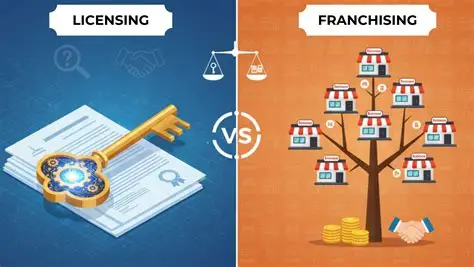
Business leaders love definitive answers.
Which strategy grows faster?
Which structure generates more profit?
Which model reduces risk?
Which path creates the strongest competitive advantage?
The problem is that business rarely rewards simplistic questions.
And almost never rewards simplistic answers.
Consider two companies.
One licenses its intellectual property across dozens of countries, scales rapidly, and generates substantial revenue with relatively modest operational involvement.
The other builds a franchise network, maintains rigorous standards, protects customer experience, and creates a globally recognized brand worth billions.
Both succeed.
Both expand.
Both create value.
Yet they arrive there through fundamentally different routes.
This is why the question "Is licensing better than franchising?" can be surprisingly misleading.
Because the answer depends less on the structure itself and more on what a company is actually trying to achieve.
Licensing is not inherently better.
Franchising is not inherently better.
Each model optimizes for different priorities.
The real challenge is understanding which priorities matter most.
That is where the conversation becomes interesting.
Why Businesses Compare Licensing and Franchising
The comparison emerges naturally.
Both models allow expansion without directly owning every location, operation, or market presence.
Both rely on intellectual property.
Both involve third-party operators.
Both create revenue streams beyond traditional sales.
From a strategic perspective, they appear to solve similar problems.
How can a company grow without shouldering all the operational burden itself?
Yet the similarities are deceptive.
The mechanics differ.
The economics differ.
The risks differ.
Most importantly, the level of control differs dramatically.
That difference often determines whether licensing or franchising becomes the superior choice.
The Core Strength of Licensing
Licensing excels at one thing.
Efficiency.
A company grants permission to use intellectual property.
The licensee pays for that right.
The relationship often remains relatively straightforward.
The licensor focuses on the asset.
The licensee focuses on the business.
This separation creates remarkable scalability.
Growth becomes less dependent on operational oversight.
Expansion becomes less resource-intensive.
Management complexity remains comparatively low.
For organizations seeking rapid market penetration, these advantages can be extraordinarily attractive.
Why Licensing Appeals to Growth-Oriented Companies
Licensing often provides:
- Faster expansion
- Lower administrative burden
- Reduced operational involvement
- Lower support requirements
- Greater flexibility
The model works particularly well when intellectual property itself creates most of the value.
Software companies understand this.
Entertainment companies understand this.
Consumer product brands understand this.
The asset becomes the engine.
The system becomes secondary.
The Core Strength of Franchising
Franchising optimizes for something entirely different.
Consistency.
A franchise system attempts to replicate a proven business model repeatedly.
Not merely a trademark.
Not merely a logo.
An experience.
A process.
A method.
Customers expect familiarity.
Franchise systems exist to deliver it.
This objective requires structure.
And structure requires oversight.
Franchising therefore demands greater involvement from the parent organization.
More support.
More training.
More monitoring.
More governance.
The rewards can be substantial.
So can the obligations.
Licensing Prioritizes Freedom
Freedom is one of licensing's greatest advantages.
Licensees often maintain significant autonomy.
They make local decisions.
They adapt to regional conditions.
They innovate independently.
This flexibility can accelerate growth.
Particularly in diverse markets.
A licensing model allows partners to leverage local knowledge in ways that highly structured systems sometimes cannot.
Yet freedom creates variability.
Variability introduces uncertainty.
The same licensed brand may appear differently across markets.
Quality may fluctuate.
Customer experiences may differ.
Licensing accepts this reality.
In many cases, it embraces it.
Franchising Prioritizes Control
Control is frequently viewed negatively.
In franchising, it is often a competitive advantage.
Brand consistency rarely emerges spontaneously.
It requires discipline.
Procedures.
Training.
Standards.
Enforcement.
A franchise system can protect brand integrity because it maintains influence over how operations function.
Customers benefit from predictability.
Brands benefit from trust.
Trust drives repeat business.
Repeat business drives growth.
Control is costly.
But inconsistency can be even more expensive.
Comparing Licensing and Franchising
| Factor | Licensing | Franchising |
|---|---|---|
| Expansion Speed | Often faster | Usually slower |
| Operational Control | Lower | Higher |
| Startup Complexity | Lower | Higher |
| Ongoing Support | Limited | Extensive |
| Brand Consistency | Variable | Stronger |
| Legal Requirements | Generally simpler | More extensive |
| Resource Requirements | Lower | Higher |
| Scalability | High | Moderate to High |
| Local Flexibility | Significant | Limited |
| Customer Experience Control | Limited | Strong |
The table highlights a crucial reality.
Each model optimizes different outcomes.
The question is not which is superior.
The question is which outcome matters most.
When Licensing Is Better
There are situations where licensing clearly possesses advantages.
Intellectual Property Is the Primary Asset
If the company's value resides mainly in intellectual property, licensing often becomes highly attractive.
Examples include:
- Software
- Entertainment properties
- Patented technologies
- Character brands
- Creative works
The asset itself drives demand.
Operational replication becomes less important.
Speed Matters
Licensing often supports rapid expansion.
Markets can be entered quickly.
Partnerships can be established efficiently.
Administrative requirements remain manageable.
Limited Management Resources
Organizations with lean operational structures may prefer licensing because it minimizes oversight obligations.
The business scales without proportional increases in complexity.
This is a powerful advantage.
When Franchising Is Better
Other situations strongly favor franchising.
Customer Experience Defines Value
Consider restaurants.
Hotels.
Fitness centers.
Service businesses.
The customer experience often represents the product.
Not merely the brand.
A trademark alone cannot guarantee consistency.
Operational systems become essential.
Brand Reputation Requires Uniformity
Some brands cannot tolerate wide variation.
Small inconsistencies create meaningful reputational risk.
Franchising provides tools to mitigate that risk.
Long-Term Brand Equity Matters
Organizations seeking to preserve a highly specific market identity often benefit from stronger oversight.
Franchising supports that objective.
The Hidden Cost of Licensing
Licensing appears inexpensive.
Often it is.
Yet lower cost sometimes conceals hidden tradeoffs.
Less control creates greater dependence on partners.
Partner decisions influence brand perception.
Partner performance affects reputation.
Partner mistakes can become your mistakes.
The more valuable a brand becomes, the more these risks matter.
Licensing offers efficiency.
Efficiency sometimes reduces visibility.
And reduced visibility can create surprises.
The Hidden Cost of Franchising
Franchising carries its own challenges.
Oversight is expensive.
Training requires investment.
Support systems require investment.
Compliance monitoring requires investment.
Legal obligations increase.
Administrative complexity expands.
Many organizations underestimate these realities.
The franchise relationship extends far beyond intellectual property.
It becomes an ongoing operational commitment.
Growth occurs.
Responsibility grows alongside it.
A Lesson I Learned Watching Two Expansion Strategies Unfold
Several years ago, I observed two companies entering new markets.
One pursued a licensing strategy.
The other adopted a franchise model.
Initially, the licensing company appeared to be winning.
Expansion occurred rapidly.
Costs remained relatively low.
New partnerships emerged quickly.
The franchise organization moved more cautiously.
Growth seemed slower.
The contrast was striking.
Several years later, the picture looked different.
The licensing company faced challenges maintaining consistency across markets.
Brand perception varied significantly.
Some partners excelled.
Others struggled.
Meanwhile, the franchise organization had expanded more gradually but maintained remarkable consistency.
Neither strategy had failed.
Neither strategy had succeeded universally.
Each reflected different priorities.
That experience reinforced an important lesson.
Expansion models do not determine success.
Alignment determines success.
The strategy must fit the business.
Not the other way around.
Why Industry Context Matters
Industry characteristics often influence the decision.
Industries That Frequently Favor Licensing
- Software
- Publishing
- Entertainment
- Technology
- Consumer products
These sectors often derive value from intellectual property itself.
Industries That Frequently Favor Franchising
- Restaurants
- Hospitality
- Fitness
- Retail
- Professional services
These sectors often derive value from execution and experience.
The distinction is not absolute.
But it is useful.
Business models should align with value creation mechanisms.
Revenue Considerations
Financial discussions often dominate comparisons.
Understandably.
Revenue matters.
Yet the revenue question is more nuanced than it first appears.
Licensing can generate highly attractive margins.
Lower operational costs support profitability.
Franchising can generate substantial recurring revenue through royalties and support structures.
The superior model depends on:
- Scale
- Industry
- Brand strength
- Operational requirements
- Strategic objectives
Financial outcomes emerge from execution.
Not merely structure.
The Strategic Question Most Leaders Miss
Many executives ask:
"Which model grows faster?"
A more useful question might be:
"What exactly are we trying to scale?"
This question changes everything.
If the answer is intellectual property, licensing often shines.
If the answer is customer experience, franchising frequently excels.
Growth should amplify strengths.
Not dilute them.
The strongest expansion strategy is the one that protects the source of value while extending its reach.
That source varies dramatically from business to business.
The Future of Licensing and Franchising
Technology continues transforming expansion models.
Digital platforms reduce geographic barriers.
Global markets become increasingly accessible.
Intellectual property grows more valuable.
Brand experiences become more important.
These trends support both licensing and franchising.
Neither model appears likely to disappear.
Both solve meaningful business challenges.
Both provide viable paths to growth.
The distinction between them may become increasingly strategic as competition intensifies.
Because expansion itself is no longer unusual.
Effective expansion is.
Conclusion: Better for What?
The question "Is licensing better than franchising?" sounds straightforward.
It isn't.
It resembles asking whether speed is better than precision.
Whether flexibility is better than consistency.
Whether freedom is better than control.
The answer depends entirely on the objective.
Licensing excels when intellectual property drives value and rapid scalability matters.
Franchising excels when customer experience drives value and consistency matters.
Neither model wins universally.
Neither model loses universally.
They optimize different priorities.
And that may be the most important insight of all.
Business growth is rarely about finding the universally superior strategy.
It is about finding the strategy that aligns most closely with how value is created.
Because the best expansion model is not the one that grows fastest.
Or the one that costs least.
Or the one that appears most attractive on paper.
It is the one that protects what made the business successful in the first place.
Everything else is merely execution.
- Arts
- Business
- Computers
- Games
- Health
- Home
- Kids and Teens
- Money
- News
- Personal Development
- Recreation
- Regional
- Reference
- Science
- Shopping
- Society
- Sports
- Бизнес
- Деньги
- Дом
- Досуг
- Здоровье
- Игры
- Искусство
- Источники информации
- Компьютеры
- Личное развитие
- Наука
- Новости и СМИ
- Общество
- Покупки
- Спорт
- Страны и регионы
- World

 Russian
 French
 Spanish
 Portuguese
 Deutsch
 Turkish
 Dutch
Dutch
 Italiano
 Arabic
 Romaian
 Portuguese (Brazil)
 Greek
Greek