
What Are Commission-Based Marketplaces?
A transaction completes.
A customer receives a product.
A seller earns revenue.
And somewhere in the middle—quietly, invisibly—a platform takes a small slice of that exchange.
No negotiation at checkout.
No separate invoice for the fee.
No interruption to the buyer’s experience.
The marketplace simply earns its share.
This is the essence of a commission-based marketplace.
It is a model built not on ownership, but on participation.
Not on inventory, but on flow.
And not on selling products directly, but on enabling others to sell them.
At first glance, it looks simple.
A percentage of every sale.
But beneath that simplicity sits a complex economic structure that has reshaped modern commerce.
The Core Idea: A Fee for Facilitating Exchange
A commission-based marketplace charges sellers a percentage of each completed transaction.
That percentage is the platform’s revenue.
Nothing moves through the system without the marketplace taking its cut.
Three Core Participants
Every commission-based marketplace depends on:
- Buyers who want products or services
- Sellers who supply them
- A platform that connects both sides
The marketplace does not typically own the goods.
It does not set most prices.
It does not fulfill most orders.
Instead, it enables the environment where exchange happens—and monetizes that facilitation.
The Transaction Is the Product
In this model, the transaction itself becomes the unit of value.
Not the inventory.
Not the listing.
The completed exchange.
If nothing sells, nothing is earned.
That alignment shapes every strategic decision a commission-based marketplace makes.
Why the Commission Model Became So Dominant
The commission structure is not accidental.
It is structurally efficient.
Alignment of Incentives
The marketplace earns more when sellers earn more.
That alignment creates a shared goal:
- More transactions
- Higher transaction values
- Better user experience
Everyone benefits when the system works well.
Low Barrier to Entry
Sellers often do not pay upfront costs.
They only pay when revenue is generated.
This reduces friction and attracts supply.
Scalability Without Inventory Risk
Traditional retail requires capital investment in stock.
Commission-based marketplaces avoid that entirely.
They scale by increasing participation, not physical assets.
How Commission-Based Marketplaces Generate Revenue
While the concept is simple, implementation varies.
Percentage-Based Fees
The most common structure:
- A fixed percentage of each sale
- Varies by category or product type
For example:
- Digital goods may have lower commissions
- Services may have higher ones
The platform’s revenue scales with total transaction volume.
Tiered Commission Structures
Some marketplaces adjust rates based on:
- Seller performance
- Sales volume
- Subscription level
High-performing sellers may receive lower fees.
Fixed + Percentage Hybrid Models
In some cases:
- A small fixed fee applies per transaction
- Plus a percentage of sale value
This ensures minimum revenue per transaction.
The Marketplace as a Silent Partner
Commission-based platforms occupy a unique position.
They are present in every transaction—but not visible in the product itself.
They Influence Without Owning
They may affect:
- Visibility in search
- Ranking in listings
- Trust signals like ratings
Yet they rarely touch the physical or digital product.
They Shape Behavior Through Design
Small changes in platform design can influence:
- Seller pricing strategies
- Buyer decision-making
- Product availability
The marketplace becomes an invisible architect of commerce.
Comparing Commission Models With Other Marketplace Structures
| Model Type | How Revenue Is Earned | Strengths | Weaknesses |
|---|---|---|---|
| Commission-Based | % of each transaction | Strong alignment, scalable | Dependent on sales volume |
| Subscription-Based | Recurring fees | Predictable revenue | Requires constant value delivery |
| Listing Fees | Paid per item listed | Early monetization | Can discourage supply |
| Advertising Model | Paid visibility | High margins | Risk of trust erosion |
| Hybrid Models | Mixed revenue streams | Diversified income | Operational complexity |
Commission models remain dominant because they align most naturally with marketplace growth.
Network Effects Drive Commission Economics
Commission-based marketplaces thrive on compounding activity.
More Sellers Attract More Buyers
A larger selection improves:
- Choice
- Price competition
- Availability
Buyers are more likely to engage.
More Buyers Attract More Sellers
Increased demand creates:
- Higher revenue potential
- Greater seller motivation
- Stronger marketplace participation
Each side reinforces the other.
Commission revenue grows as both sides expand.
The Role of Trust in Commission-Based Marketplaces
Trust is not optional.
It is foundational.
Buyers Need Confidence
Customers must believe:
- Products are authentic
- Payments are secure
- Sellers are reliable
Without trust, transactions collapse.
Sellers Need Platform Stability
Sellers must believe:
- They will be paid
- Rules are consistent
- Traffic is real and valuable
Without trust, supply disappears.
Commission models only work when trust is established on both sides.
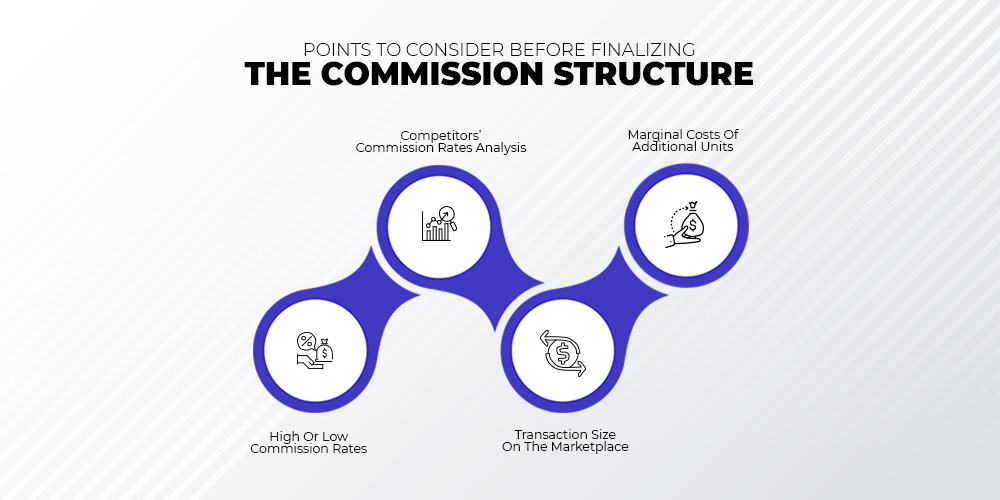
Commission Rates Shape Marketplace Behavior
Even small changes in commission percentage can influence outcomes.
High Commissions Can Reduce Supply
If fees are too high:
- Sellers may raise prices
- Some may leave the platform
- Others may reduce activity
Low Commissions Can Limit Revenue
If fees are too low:
- Platform sustainability suffers
- Investment in growth declines
Finding equilibrium is critical.
A Lesson I Learned Observing a Commission-Based Marketplace
A few years ago, I studied a marketplace that was growing quickly in traffic but struggling with profitability.
On paper, everything looked healthy.
User growth was strong.
Transaction volume was increasing.
But revenue lagged behind expectations.
Leadership responded with a straightforward solution:
Increase commission rates.
The assumption was logical.
Higher percentage equals higher revenue.
But something unexpected happened.
Sellers began adjusting behavior.
Some increased prices.
Some reduced listings.
Others experimented with competing platforms offering lower fees.
Transaction volume slowed.
Then something more subtle emerged.
Buyer engagement dipped slightly—not dramatically, but enough to affect liquidity.
The marketplace recalibrated.
Instead of increasing rates, they introduced value-added services:
- Better analytics for sellers
- Improved search visibility tools
- Optional promotional placements
Commission rates remained stable.
But sellers began earning more through improved performance.
Transactions increased.
Revenue followed.
That experience reinforced a critical insight.
Commission models do not succeed by extracting more per transaction.
They succeed by increasing the number of successful transactions.
Commission-Based Marketplaces and Pricing Power
One of the most powerful advantages of this model is pricing flexibility.
Value-Based Scaling
As marketplaces grow:
- Trust increases
- Liquidity improves
- Seller demand rises
This can allow moderate commission increases over time.
But only if value scales alongside fees.
Competitive Pressure Limits Excessive Fees
Marketplaces rarely operate in isolation.
Sellers often have alternatives.
This constrains pricing power and encourages innovation.
The Cold Start Problem in Commission Models
Every marketplace begins with zero transactions.
Which means:
- Zero revenue
- Zero data
- Zero liquidity
Subsidization Is Often Necessary
Early-stage platforms frequently:
- Reduce commission rates
- Offer incentives to sellers
- Invest heavily in acquisition
Growth comes before monetization.
Why Sellers Accept Commission Fees
On the surface, paying a percentage of revenue might seem restrictive.
But sellers gain value in return.
Access to Demand
Marketplaces provide:
- Ready-made audiences
- Built-in traffic
- Search visibility
Infrastructure Without Overhead
Sellers avoid:
- Marketing systems
- Payment processing complexity
- Customer acquisition costs
Commission becomes a trade-off for access.
The Hidden Economics of Commission Models
Beyond visible fees, commission-based marketplaces influence broader economic behavior.
Price Normalization
Marketplaces often standardize pricing expectations.
Competition Compression
Sellers compete within shared ecosystems, which can increase efficiency but reduce differentiation.
Demand Aggregation
Fragmented demand becomes centralized.
That aggregation is often the real value.
Risks of Commission-Based Marketplaces
Despite their strengths, the model is not without challenges.
Dependency on Transaction Volume
Revenue is directly tied to activity levels.
Margin Pressure
Low-margin industries can struggle under commission fees.
Platform Disintermediation
Sellers may attempt to move transactions off-platform to avoid fees.
The Future of Commission-Based Marketplaces
The model is evolving rather than disappearing.
AI-Driven Matching
Better matching systems improve conversion rates, increasing commission revenue without increasing fees.
Embedded Financial Services
Some platforms expand into:
- Payments
- Lending
- Insurance
Creating additional revenue layers.
Dynamic Commissioning
Future systems may adjust fees based on:
- Demand conditions
- Seller performance
- Market saturation
Conclusion: Commission Is Not a Fee—It Is a Reflection of Flow
It is easy to describe commission-based marketplaces in simple terms.
A percentage taken from each transaction.
But that explanation misses the deeper mechanism.
Commission is not just a fee.
It is a reflection of movement within a system.
When goods flow efficiently between buyers and sellers, the marketplace earns.
When friction increases, it earns less.
That alignment is what makes the model so powerful—and so sensitive.
Because commission-based marketplaces do not merely participate in commerce.
They depend entirely on it.
And in that dependency lies both their greatest strength and their most fundamental constraint.
They succeed only when the ecosystem they facilitate succeeds first.
- Arts
- Business
- Computers
- Spellen
- Health
- Home
- Kids and Teens
- Money
- News
- Personal Development
- Recreation
- Regional
- Reference
- Science
- Shopping
- Society
- Sports
- Бизнес
- Деньги
- Дом
- Досуг
- Здоровье
- Игры
- Искусство
- Источники информации
- Компьютеры
- Личное развитие
- Наука
- Новости и СМИ
- Общество
- Покупки
- Спорт
- Страны и регионы
- World

 English
 Russian
 French
 Spanish
 Portuguese
 Deutsch
 Turkish
 Italiano
 Arabic
 Romaian
 Portuguese (Brazil)
 Greek
Greek