
What is design thinking?
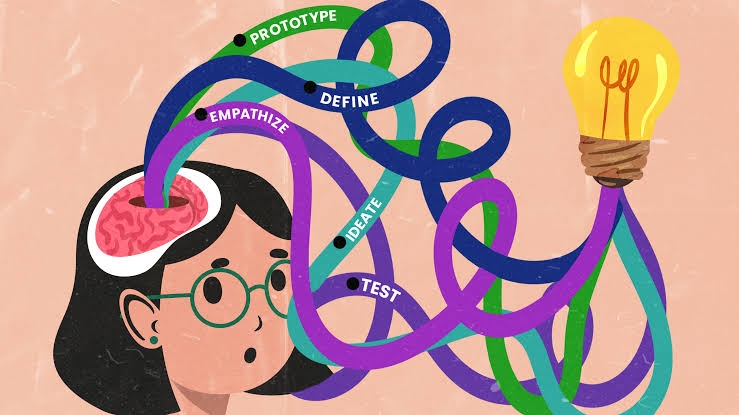
What Is Design Thinking?
Most people assume great ideas begin with inspiration.
A flash of insight.
A moment of brilliance.
A creative breakthrough arriving fully formed.
Reality tends to be less dramatic.
And far more interesting.
The best solutions often begin with confusion.
A frustrating experience.
A problem nobody understands clearly.
An observation that doesn't fit expectations.
Someone notices a disconnect between what people need and what currently exists.
Then something important happens.
Instead of immediately searching for answers, they become curious.
They observe.
Listen.
Question.
Experiment.
Revise.
Learn.
This process sits at the heart of design thinking.
Not a formula.
Not a checklist.
Not a magical pathway to innovation.
A way of approaching problems.
A mindset built around understanding people before creating solutions.
And that single shift changes everything.
Because most organizations begin with what they want to build.
Design thinking begins with who they want to serve.
The distinction sounds small.
Its consequences are enormous.
Design Thinking Is a Way of Solving Problems
At its core, design thinking is a human-centered approach to innovation.
It focuses on understanding people's needs, behaviors, frustrations, and motivations before attempting to create solutions.
Traditional problem-solving often starts with assumptions.
Design thinking starts with observation.
The process asks questions such as:
What are people actually experiencing?
What problems are they encountering?
What needs remain unmet?
What frustrations have become invisible because everyone accepts them as normal?
These questions guide the search for insight.
Insight guides creativity.
Creativity guides innovation.
Design thinking connects all three.
The Origin of Design Thinking
Although the term gained widespread attention through the work of organizations such as IDEO and institutions like Stanford d.school, the underlying principles existed long before they received a formal label.
Designers had been approaching problems differently for decades.
Instead of asking:
How do we improve this product?
They often asked:
How do people experience this product?
The focus shifted.
The problem expanded.
Unexpected opportunities emerged.
Eventually, businesses recognized that this way of thinking extended beyond design itself.
It could improve services.
Processes.
Customer experiences.
Organizational challenges.
Even public policy.
Design thinking evolved from a design methodology into a broader innovation framework.
Why Traditional Problem-Solving Sometimes Fails
Many organizations approach challenges with remarkable efficiency.
A problem appears.
A solution is proposed.
Implementation begins.
The process moves quickly.
Sometimes too quickly.
Speed creates a hidden risk.
Teams may solve the wrong problem exceptionally well.
This happens more often than people realize.
Assumptions enter the process unnoticed.
Customers remain misunderstood.
Context gets ignored.
The resulting solution appears logical.
Yet it fails because the original understanding was incomplete.
Design thinking slows down the beginning of the process.
Not to delay progress.
To improve accuracy.
It prioritizes understanding before action.
Empathy: The Foundation of Design Thinking
If design thinking has a single defining characteristic, it is empathy.
Not sympathy.
Not agreement.
Understanding.
Empathy involves seeing situations through another person's perspective.
Observing behavior.
Listening carefully.
Identifying needs people may struggle to articulate themselves.
This sounds straightforward.
It rarely is.
People often say one thing and do another.
Surveys reveal opinions.
Observation reveals behavior.
Design thinking values both.
The goal is deeper understanding.
Because meaningful innovation often emerges from insights hidden beneath the surface.
The Five Stages of Design Thinking
Different organizations describe the process differently.
The most widely recognized framework includes five stages.
Importantly, these stages are not strictly linear.
Teams frequently move back and forth between them.
Empathize
Understand the people involved.
Observe.
Interview.
Listen.
Learn.
The goal is insight.
Not assumptions.
Define
Clarify the problem.
What challenge truly needs solving?
A well-defined problem often creates better solutions than a poorly defined one.
Ideate
Generate possibilities.
Explore alternatives.
Challenge assumptions.
Quantity matters during this stage.
Evaluation comes later.
Prototype
Build something tangible.
A model.
A mockup.
A draft.
A simplified version of the idea.
The purpose is learning.
Not perfection.
Test
Observe how people interact with the solution.
Gather feedback.
Identify weaknesses.
Improve.
Repeat.
The cycle continues until understanding deepens and the solution evolves.
Why Design Thinking Feels Different
Most business processes reward certainty.
Design thinking embraces uncertainty.
This can feel uncomfortable initially.
People want answers.
Design thinking encourages exploration.
People want efficiency.
Design thinking encourages discovery.
People want predictable outcomes.
Design thinking accepts ambiguity.
This difference explains both its power and its challenges.
Design thinking does not attempt to eliminate uncertainty immediately.
It attempts to learn from it.
Creativity and Design Thinking
Creativity plays a central role within design thinking.
Yet creativity alone is insufficient.
A wildly original idea may fail to solve a meaningful problem.
Design thinking introduces direction.
Creativity generates possibilities.
Empathy identifies needs.
Testing provides feedback.
The process creates balance.
Imagination remains essential.
Reality remains equally important.
This combination often produces stronger outcomes than relying exclusively on either creativity or analysis.
A Lesson I Learned About Design Thinking
Several years ago, I observed a team working to improve a customer experience.
The group consisted of intelligent people.
Experienced professionals.
They quickly proposed solutions.
The ideas sounded impressive.
Then something unexpected happened.
Someone suggested observing actual customers before making decisions.
The team agreed.
What they discovered changed everything.
The customers weren't struggling with the issue everyone assumed was most important.
They were struggling with something else entirely.
A smaller problem.
An overlooked detail.
Yet that detail created most of the frustration.
Months of assumptions disappeared within a few hours of observation.
The lesson stayed with me.
People are often experts on their challenges.
Organizations are not always experts on understanding them.
Design thinking closes that gap.
Why Prototypes Matter
Many people misunderstand prototypes.
They imagine unfinished products.
Early models.
Draft versions.
All true.
Yet prototypes serve a deeper purpose.
They accelerate learning.
Instead of debating possibilities endlessly, teams create something tangible.
People interact with it.
Feedback appears.
Insights emerge.
Questions receive answers.
The prototype becomes a conversation.
A bridge between ideas and reality.
Design thinking values prototypes because learning occurs faster through interaction than speculation.
Comparison Table: Traditional Thinking vs. Design Thinking
| Dimension | Traditional Problem-Solving | Design Thinking |
|---|---|---|
| Starting Point | Existing assumptions | Human needs and experiences |
| Primary Focus | Efficiency and solutions | Understanding and discovery |
| Approach to Problems | Linear | Iterative |
| Role of Users | Often consulted later | Involved from the beginning |
| Attitude Toward Failure | Avoidance | Learning opportunity |
| Creativity | Secondary consideration | Central component |
| Decision-Making | Analysis-driven | Insight-driven and analytical |
| Testing | Often occurs late | Happens continuously |
| Innovation Potential | Incremental improvement | Breakthrough possibilities |
| Learning Style | Predictive | Experimental |
The comparison reveals why design thinking has gained influence across industries.
It changes not merely the solution.
It changes the process itself.
Why Design Thinking Encourages Innovation
Innovation depends on identifying opportunities others overlook.
Design thinking excels at uncovering those opportunities.
By studying behavior closely, teams often discover:
-
Hidden frustrations
-
Unmet needs
-
Inefficient processes
-
Unexpected motivations
-
Emerging opportunities
These discoveries become fuel for innovation.
Many breakthrough ideas appear obvious in hindsight.
Before they existed, someone needed to notice what others ignored.
Design thinking improves the likelihood of that observation occurring.
The Importance of Asking Better Questions
Design thinking emphasizes questions over conclusions.
Not indefinitely.
Initially.
The quality of solutions often reflects the quality of questions.
Consider the difference:
How do we sell more products?
Versus:
Why aren't customers achieving the outcomes they want?
The first question focuses on business objectives.
The second explores human experience.
Both matter.
The second often produces more insightful answers.
Design thinking encourages teams to investigate before deciding.
Why Design Thinking Works Across Industries
Some people assume design thinking belongs exclusively to product design.
The reality is much broader.
Healthcare organizations use it to improve patient experiences.
Schools use it to redesign learning environments.
Governments apply it to public services.
Technology companies use it to develop products.
Retailers use it to improve customer journeys.
The versatility exists because design thinking addresses a universal challenge.
Understanding people.
Every industry depends on that capability.
The Role of Collaboration
Design thinking thrives in collaborative environments.
Different perspectives create richer insights.
Designers observe one thing.
Engineers notice another.
Marketers recognize something else.
Customers reveal additional information.
The combination produces depth.
Complex problems rarely respond well to isolated thinking.
Design thinking embraces collective intelligence.
Not because consensus guarantees success.
Because diverse perspectives expand understanding.
Common Misconceptions About Design Thinking
Several myths continue to surround the concept.
Myth 1: Design Thinking Is Only for Designers
False.
Anyone solving problems can apply its principles.
Myth 2: Design Thinking Replaces Analysis
False.
Analysis remains important.
Design thinking expands the process rather than replacing existing tools.
Myth 3: Design Thinking Guarantees Innovation
False.
It increases the likelihood of meaningful innovation.
No framework guarantees outcomes.
Myth 4: Design Thinking Is Just Brainstorming
False.
Brainstorming represents only one component.
The broader process includes observation, testing, learning, and refinement.
Why Organizations Struggle With Design Thinking
The challenges are understandable.
Design thinking requires patience.
Observation.
Experimentation.
Iteration.
These behaviors sometimes conflict with organizational habits.
Many businesses prioritize certainty.
Design thinking embraces discovery.
Many businesses value immediate answers.
Design thinking values better questions.
The tension can create resistance.
Yet organizations willing to tolerate initial uncertainty often uncover deeper insights.
Design Thinking and the Future of Problem-Solving
The world continues becoming more complex.
Customer expectations evolve.
Technological possibilities expand.
Traditional approaches remain valuable.
Increasing complexity demands additional tools.
Design thinking provides one of them.
Not because it is revolutionary.
Because it is fundamentally human.
It begins where meaningful innovation often begins.
With understanding.
The Real Meaning of Design Thinking
When people ask what design thinking is, they are often searching for a definition.
The definition matters.
The mindset matters more.
Design thinking is not a sequence of workshops.
Not a collection of sticky notes.
Not a corporate trend.
At its best, it represents a commitment.
A commitment to understanding before assuming.
Observing before concluding.
Learning before deciding.
Creating before perfecting.
The most successful innovations rarely emerge because someone had the smartest answer immediately.
They emerge because someone became curious enough to understand the problem deeply.
That curiosity revealed an opportunity.
The opportunity inspired creativity.
Creativity generated possibilities.
Experimentation refined them.
Innovation followed.
Design thinking exists within that journey.
Not as a shortcut.
As a guide.
A reminder that the most valuable solutions often begin not with technology, strategy, or expertise.
But with people.
Their frustrations.
Their behaviors.
Their needs.
And the willingness to pay close enough attention to notice what everyone else has missed.
- Arts
- Business
- Computers
- Oyunlar
- Health
- Home
- Kids and Teens
- Money
- News
- Personal Development
- Recreation
- Regional
- Reference
- Science
- Shopping
- Society
- Sports
- Бизнес
- Деньги
- Дом
- Досуг
- Здоровье
- Игры
- Искусство
- Источники информации
- Компьютеры
- Личное развитие
- Наука
- Новости и СМИ
- Общество
- Покупки
- Спорт
- Страны и регионы
- World

 English
 Russian
 French
 Spanish
 Portuguese
 Deutsch
 Dutch
Dutch
 Italiano
 Arabic
 Romaian
 Portuguese (Brazil)
 Greek
Greek