
Critical thinking vs analytical thinking
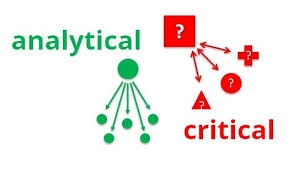
The Dissection of the Ghost
A machine can take a clock apart.
It can separate the brass gears from the silver springs, lay them out on a clean white cloth, measure the diameter of each tooth down to the micron, and catalog the weight of the balance wheel in a pristine digital ledger. The machine understands the mechanics of the timing loop perfectly. Every measurement is flawless. Every calculation is verified.
But the machine does not know why the room goes quiet when the clock stops ticking.
We live in a culture that has mistaken the scale for the substance. We have built massive institutions that train individuals to look at the world through a microscope, to chop reality into tiny, measurable fragments, and to assume that because they can name the pieces, they understand the truth of the whole event. We call this analytical skill, and we worship it like an ancient god.
But analysis is only half the breath.
   [ THE COMPLETE PHENOMENON ] (The Living Event / The Unbroken Sound)
                 │
                 ├──────────────────────────────┐
                 ▼                              ▼
     [ THE ANALYTICAL SHIFT ]        [ THE CRITICAL FILTER ]
    (Deconstructs the mechanics)    (Interrogates the purpose)
                 │                              │
                 ▼                              ▼
     [ THE COMPONENT PIECES ]        [ THE UNDERLYING FREQUENCY ]
                 │                              │
                 └──────────────┬───────────────┘
                                ▼
                    [ THE SOVEREIGN WITNESS ]
To separate analytical thinking from critical thinking is to observe the difference between a knife that dissects an organism and a lens that asks why the organism was built in the first place. The analytical mind asks: How does this thing work? The critical mind asks: What is this thing hiding, and who benefits from me believing in its design?
If you navigate life with only the knife, you will spend your years living in a desert of beautiful, perfectly categorized ash.
The Topography of the Two Channels
The movements of these two faculties have entirely different weights, different speeds, and different reactions to human pressure. They are not enemies, but they inhabit different chambers of the self.
The Analytical Machinery (The Separation of Form)
The analytical impulse is a systematic reduction. It views a complex problem as an overgrown forest that must be cleared by breaking it down into individual trees, branches, and leaves. It is linear, metronomic, and cold.
-
The decomposition of the density: Taking a massive corporate financial statement, an intricate musical arrangement, or a complex piece of software, and separating it into its foundational modules.
-
The tracing of the sequence: Following the chain of cause and effect with absolute fidelity. It tracks how a shift in variable $A$ forces a reaction in variable $B$, completely unconcerned with whether that reaction is moral, beautiful, or true.
-
The optimization of the grid: Finding the friction points within an existing blueprint. It looks for ways to make the gear turn ten percent faster or to extract five percent more juice from the fruit.
The Critical Interrogation (The Search for Essence)
The critical mind operates at a right angle to the grid. It does not accept the blueprint as a given fact; it treats the entire system as a temporary historical artifact. It does not look at the gears; it looks at the hands of the clockmaker.
-
The contextual suspension: Stepping completely outside the boundaries of the immediate system. It looks at a highly profitable business model and asks: What internal human decay is this profit mechanism generating five years from now?
-
The deconstruction of the metric: Refusing to measure success by the rules provided by the house. When an academy or an industry declares that an object has achieved excellence based on a specific score, the critical thinker audits the motivation of the committee that wrote the scorecard.
-
The embracing of the invisible: Recognizing that the most powerful elements of an event—the trust in a room, the shadow of an unexamined fear, the unvarnished frequency of truth—cannot be captured by a digital meter.
A Lesson from the Over-Isolated Track
In the early two-thousands, I sat in a state-of-the-art studio in Los Angeles with a legendary engineer who was famous for his mathematical approach to sound. He looked at audio files the way an architect looks at a structural blueprint. He was surrounded by digital screens showing real-time frequency analyzers, phase correlation meters, and wave alignment software.
He was working on a vocal track for a folk singer whose raw, unvarnished style had built a fiercely loyal following.
The engineer spent three days analyzing the recording. He identified every micro-tonal deviation from the equal-tempered scale. He found three places where the singer’s intake of breath caused a minor spike at $2.5 \text{ kHz}$. He noticed that the resonance of the acoustic guitar body was bleeding into the vocal microphone, creating a slight cloudiness in the lower mid-range.
[ Analytical Optimization ] ──► Notch Filters ──► Grid Alignment ──► Clean Frequencies ──► The Perfect Plastic
[ Critical Intervention ]    ──► Bypass Processing ──► Restore Bleed ──► Accept Flaw       ──► The Living Ghost
He used his software with the precision of a brain surgeon. He notched out the resonances, aligned the timing of the words to the absolute grid, and digitally removed every single breath between the phrases. It was a masterpiece of analytical optimization. The file was completely clean. There was no noise, no phase interference, and no structural imperfection.
He played the result for me. It was technically immaculate, and it felt like a corpse sitting in a refrigerator.
The singer's presence had completely vanished from the speaker. The song, which was meant to be a confession about the loss of a child, now sounded like a corporate ringtone. The engineer had used his immense analytical intelligence to solve fifty small mechanical problems, and in doing so, he had accidentally killed the only thing that made the song valuable.
"Look at the graphs," he said, pointing at his screens with genuine pride. "The frequency curve is perfectly flat now. The dynamic range is optimized for modern broadcast formats. There is zero distortion."
"The graphs are beautiful," I told him. "But you have cured the disease by executing the patient. You have removed the dirt to save the floor."
I reached over to the workstation and hit the global bypass switch, turning off every digital filter, time-alignment plugin, and noise-reduction algorithm he had spent seventy-two hours programming. I turned off the computer monitors entirely, leaving us in the dim amber light of the analog desk.
"Now listen to the room," I said.
The raw track played. It was jarring at first. You could hear the acoustic guitar bleeding into the vocal microphone, creating an unpredictable, swirling acoustic space. You could hear that she was slightly sharp on the high notes because her throat was tightening with real emotion. You could hear the heavy, ragged intake of her breath before the chorus—the physical proof that she was running out of air because she was telling a story that broke her heart.
The engineer sat there in the dark, staring at the dead screens. His mouth was slightly open. He didn't say a word for five minutes.
He had to confront the reality that his analytical training—his learned definition of "clean audio"—had made him completely deaf to the actual event occurring in the air. He had let his technical metrics blind him to the truth of the performance. He had to unlearn his formulas to hear the music. The intervention wasn't about finding a better analytical method; it was about introducing a critical filter that asked whether the metric itself was an enemy of the feeling.
The Landscape of Personal Calibration
The navigation of reality requires a constant, conscious awareness of which tool you have in your hand. It is a systematic sorting of internal awareness.
| The Arena | The Analytical Reflex | The Critical Filter | The Sovereign Resolution |
| Problem Formulation | Breaking the visible issue into smaller, logical fragments within the existing rules. | Asking who made the rules, why the problem exists now, and what the system is hiding. | The realization that most walls are just collections of small stones piled up by tired people. |
| Information Processing | Measuring the volume, velocity, and statistical variance of the incoming data stream. | Interrogating the source, the historical context, and the emotional intent of the broadcast. | Freedom from the professional architects of collective human panic. |
| System Interaction | Optimizing your performance to score higher on the institutional metric or scorecard. | Auditing whether the scorecard itself is designed to turn you into a compliant machine. | The ability to step away from a game that is rigged to destroy your spirit. |
| Personal Relations | Calculating the literal balance of favors, text response times, and behavioral transactions. | Tracking the deep psychological lineages, unstated griefs, and unexamined fears in the room. | The transition from cheap, transactional scorekeeping to heavy, useful compassion. |
The Void of the Sterile Scalpel
There is an elegant, freezing destination that waits for those who master the skills of analytical reduction but refuse to develop the critical lens. They turn into high-functioning servants of the machine.
They can optimize any engine, balance any budget, streamline any supply chain, and maximize the efficiency of any corporate initiative with terrifying precision. They pride themselves on their absolute objectivity, their immunity to emotion, and their refusal to be swayed by rhetoric. They believe they are free because they operate with pure, cold logic.
But they are the ultimate prisoners.
   [ THE ANALYTICAL BUTCHER ] ──► Optimizes the machine ──► Asks "How?" ──► The Void of Iron
   [ THE CRITICAL REBEL ]     ──► Interrogates the target──► Asks "Why?" ──► The Friction of Ash
   [ THE SOVEREIGN WITNESS ]   ──► Integrates the sight  ──► Asks "What is true?" ──► The Living Ground
If you only ask how to make a system work faster, you are entirely at the mercy of the person who owns the system. You are a mercenary with a calculator. You can spend your life using your brilliant analytical mind to optimize a weapon, a prison, or an algorithm designed to strip human beings of their attention span, secure in your belief that your work is "neutral."
No work is neutral.
If your intelligence does not eventually force you to stand up from your desk, look at the entire structure you are serving, and ask whether it deserves to exist, then your intellect is just a sophisticated form of cowardice. You are using your technical virtuosity to protect yourself from the terrifying responsibility of your own sovereignty.
The Reclaiming of the Lens
We do not manufacture the signal. We merely clean the soot off the window so it can enter the room.
The world is already saturated with brilliant technicians who can write flawless code, build immaculate spreadsheets, and dissect any complex problem until it is just a collection of lifeless components. They hold prestigious titles, they speak in the clean vocabulary of the academy, and their work carries no heat. They leave the room exactly as cold and predictable as they found it.
The choice to practice critical thought on top of analysis is a quiet act of sabotage against this mechanical drift.
It is the decision to walk into a room and turn off the monitor that records the consensus of the market. It is the choice to lay down your credentials at the edge of the woods, to leave the circle that requires a password before you are allowed to see the sky, and to stand in the quiet until you can hear the difference between the voice of the grid and the voice of your own heart. Trust the stark, unvarnished testimony of your own direct experience, welcome the sharp wind of your own isolation, and let the real world speak first.
- Arts
- Business
- Computers
- Spellen
- Health
- Home
- Kids and Teens
- Money
- News
- Personal Development
- Recreation
- Regional
- Reference
- Science
- Shopping
- Society
- Sports
- Бизнес
- Деньги
- Дом
- Досуг
- Здоровье
- Игры
- Искусство
- Источники информации
- Компьютеры
- Личное развитие
- Наука
- Новости и СМИ
- Общество
- Покупки
- Спорт
- Страны и регионы
- World

 English
 Russian
 French
 Spanish
 Portuguese
 Deutsch
 Turkish
 Italiano
 Arabic
 Romaian
 Portuguese (Brazil)
 Greek
Greek