
How do emotions affect decision making?
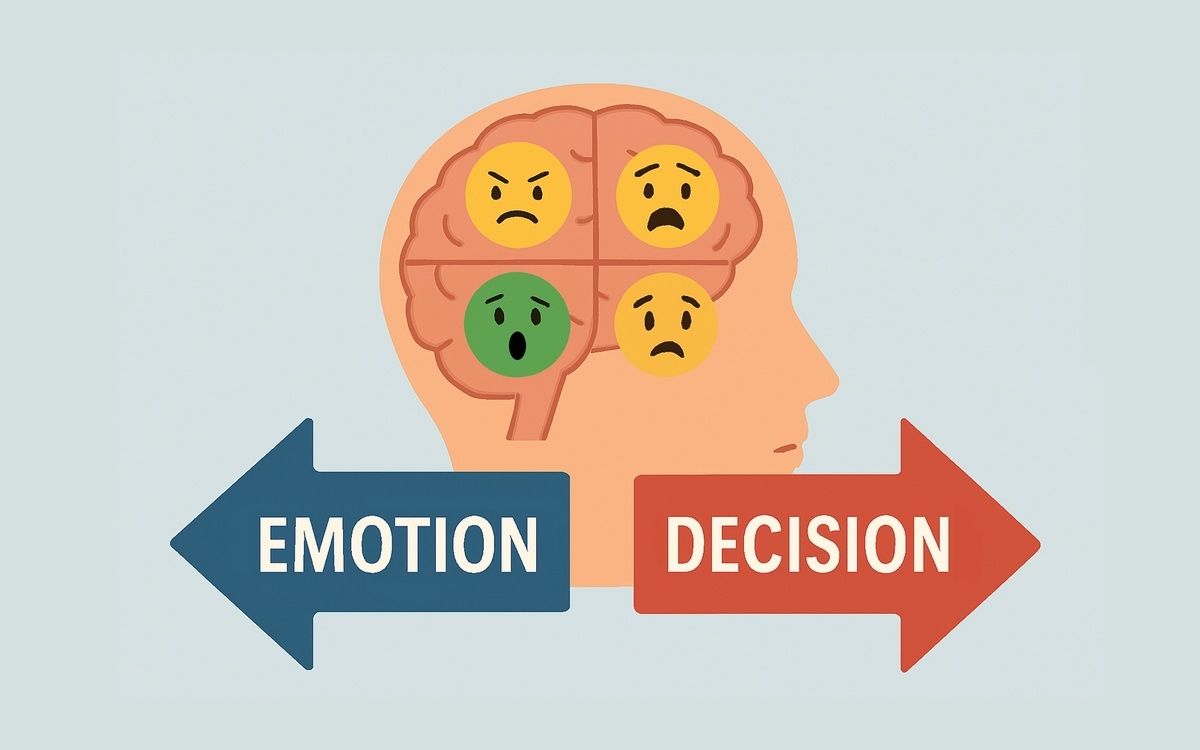
How Do Emotions Affect Decision Making? Understanding the Psychology Behind Better Choices
Every important decision feels rational while we are making it.
That may be the most convincing illusion of all.
Whether choosing a career, negotiating a contract, investing savings, or responding to criticism, we often believe that facts are driving our conclusions. Emotions, we tell ourselves, belong elsewhere. They influence other people—the impulsive shopper, the impatient investor, the angry executive—but not us. We assume our reasoning stands apart from our feelings.
Yet neuroscience, psychology, and decades of behavioral research paint a different picture. Emotion is not an occasional interruption to rational thought. It is part of the machinery that makes decisions possible.
The real challenge, then, is not eliminating emotion. It is understanding when emotion serves as valuable information and when it quietly distorts judgment.
I learned this lesson while helping evaluate several competing proposals for a business initiative. The numbers favored one option, but I found myself repeatedly searching for reasons to reject it. At first, I assumed my concerns reflected careful analysis. After stepping away from the decision for a day, I realized something else had been shaping my thinking. Months earlier, I had experienced a disappointing outcome with a remarkably similar project. Without recognizing it, I had begun treating resemblance as evidence.
Nothing in the data justified my hesitation.
Memory did.
That experience permanently changed how I evaluate important decisions. Before questioning the evidence, I now ask whether an emotional reaction is quietly influencing how I interpret it.
Emotion Is Not the Opposite of Reason
Popular culture often portrays emotion and logic as competing forces.
The reality is considerably more nuanced.
People with damage to the brain regions responsible for emotional processing frequently struggle to make even ordinary decisions. They can analyze alternatives endlessly, yet fail to choose between them.
Emotion supplies value.
Reason organizes information.
Neither functions particularly well without the other.
The difficulty arises because emotional signals evolved to solve immediate problems. Modern decisions often involve delayed consequences, abstract probabilities, and uncertain futures. Under these conditions, feelings remain useful—but not always reliable.
Why Feelings Shape Judgment
Emotions simplify complexity.
Imagine entering an unfamiliar situation. Rather than consciously evaluating hundreds of variables, your brain generates an immediate emotional response.
Safe.
Dangerous.
Interesting.
Threatening.
Promising.
These impressions allow rapid action.
The trade-off is accuracy.
Quick emotional assessments work well in familiar environments but become less dependable when decisions involve investments, long-term planning, strategic choices, or uncertain risks.
The Brain Seeks Efficiency
Every decision consumes mental resources.
Emotion acts as a shortcut, allowing us to reduce complicated choices into manageable impressions.
Sometimes that shortcut reflects genuine experience.
Sometimes it reflects coincidence.
Recognizing the difference requires deliberate reflection.
Different Emotions Produce Different Decisions
Not all emotions influence judgment in the same way.
Each alters attention, risk perception, and confidence differently.
| Emotion | Typical Cognitive Effect | Common Decision Outcome | Helpful Countermeasure |
|---|---|---|---|
| Fear | Overestimates danger | Excessive caution | Compare objective probabilities |
| Anger | Increases confidence | Greater risk-taking | Delay important decisions |
| Happiness | Encourages optimism | Underestimates potential problems | Conduct a structured risk review |
| Anxiety | Narrows attention | Indecision and overanalysis | Focus on controllable variables |
| Pride | Reinforces existing beliefs | Resistance to feedback | Invite independent review |
| Regret | Emphasizes past mistakes | Missed future opportunities | Evaluate current evidence independently |
The important observation is not that emotions create mistakes.
It is that different emotions create different kinds of mistakes.
Fear Protects—and Limits
Fear evolved for good reasons.
It prepares us to respond quickly to uncertainty.
Yet fear also magnifies unlikely outcomes.
Investors sell during market declines because temporary losses feel permanent.
Employees avoid proposing innovative ideas because rejection appears more painful than missed opportunity.
Leaders postpone difficult conversations because immediate discomfort outweighs future benefits.
Fear narrows attention.
The future begins to resemble the worst plausible scenario rather than the most probable one.
Happiness Can Encourage Overconfidence
Positive emotions improve creativity and collaboration.
They also influence judgment.
When people feel unusually optimistic, they frequently underestimate obstacles and overestimate the likelihood of success.
Confidence rises.
Critical evaluation declines.
This does not mean positive emotions should be avoided.
It means optimism deserves balancing with structured analysis.
Anger Changes Risk Perception
Anger often creates certainty.
People become convinced they understand both the problem and its solution.
Research consistently suggests that angry individuals are more willing to accept risk because they perceive uncertain situations as more predictable than they truly are.
This explains why important decisions made immediately after conflict frequently produce disappointing outcomes.
Time is sometimes the simplest decision-making tool.
Emotional Memory Quietly Influences Present Choices
Our experiences rarely remain confined to the past.
A negative customer interaction may influence future negotiations.
A successful investment encourages confidence in similar opportunities.
A failed partnership creates hesitation toward comparable ventures.
The emotional residue remains long after the objective circumstances have changed.
The challenge lies in distinguishing useful experience from misleading similarity.
Just because two situations feel alike does not mean they are alike.
Why We Rationalize Emotional Decisions
One fascinating aspect of human cognition is that emotional decisions rarely appear emotional.
Instead, we construct logical explanations afterward.
This process feels genuine because our reasoning is sincere.
Unfortunately, sincerity does not guarantee objectivity.
One practical question helps interrupt this pattern:
"If I had reached the opposite conclusion, what evidence would I have considered persuasive?"
If the answer is difficult to produce, emotion may be shaping interpretation more than evidence.
The Influence of Social Emotions
Many decisions occur in groups.
Social emotions therefore become important.
The desire for acceptance encourages agreement.
Fear of criticism discourages dissent.
Status influences whose opinions receive attention.
These emotional dynamics affect organizations as much as individuals.
Healthy decision-making cultures normalize respectful disagreement because disagreement exposes assumptions that consensus often hides.
My Most Valuable Lesson About Emotional Decisions
Several years ago, I found myself defending a recommendation with unusual determination.
Every challenge felt unreasonable.
Every opposing argument seemed incomplete.
Eventually, someone asked a simple question:
"What evidence would convince you that your recommendation is wrong?"
I realized I had no satisfactory answer.
The recommendation itself was not necessarily flawed.
My attachment to it was.
That moment taught me that confidence deserves examination precisely when it feels strongest.
Since then, I have tried to separate commitment to finding the best answer from commitment to defending my first answer.
The distinction appears subtle.
Its consequences are not.
Separate Immediate Feelings from Lasting Values
Not every emotional response deserves equal weight.
Some reflect temporary moods.
Others express deeply held values.
Learning to distinguish the two improves judgment considerably.
Ask yourself:
-
Am I reacting to today's circumstances or long-term priorities?
-
Will this emotion likely persist tomorrow?
-
Would I recommend this same decision to someone else facing identical facts?
These questions create useful distance between emotion and action.
Practical Strategies for Better Decisions
Emotion cannot be removed from decision-making.
It can be managed more effectively.
Several habits consistently improve judgment:
Pause Before Major Decisions
Strong emotions often weaken quickly.
Delaying irreversible decisions by even one day frequently changes perspective.
Write Down Your Reasoning
Documenting assumptions makes emotional influences easier to identify later.
Seek Contradictory Evidence
Instead of searching for confirmation, deliberately explore information supporting the opposite conclusion.
Consider Alternative Futures
Rather than predicting one outcome, imagine several plausible scenarios.
This encourages flexibility instead of certainty.
Invite Independent Perspectives
People who are less emotionally invested often recognize assumptions that insiders overlook.
Emotion Is Information, Not Instruction
One of the most useful mental models is surprisingly simple.
Treat emotions as data.
Not commands.
Feeling anxious may indicate uncertainty worth exploring.
Feeling excited may highlight genuine opportunity.
Feeling defensive may reveal attachment rather than evidence.
The emotion itself is valuable.
It simply should not receive the final vote.
Conclusion: Better Decisions Require Emotional Awareness, Not Emotional Suppression
People often imagine that good decision-makers suppress emotion while poor decision-makers surrender to it.
Neither description reflects reality.
Emotion is woven into every meaningful choice because it shapes attention, motivation, memory, and perception. Without it, decisions become difficult. With it, decisions become vulnerable to predictable distortions.
The objective is therefore not emotional detachment. It is emotional awareness.
Recognize when fear exaggerates risk.
Notice when confidence exceeds evidence.
Question conclusions that appear obvious immediately.
Invite perspectives capable of challenging your assumptions.
Most importantly, remember that the strongest decisions rarely emerge from choosing between emotion and reason. They emerge from allowing each to perform the role it serves best.
Reason organizes.
Emotion prioritizes.
Wisdom lies in ensuring neither governs alone.
- Arts
- Business
- Computers
- Games
- Health
- Home
- Kids and Teens
- Money
- News
- Personal Development
- Recreation
- Regional
- Reference
- Science
- Shopping
- Society
- Sports
- Бизнес
- Деньги
- Дом
- Досуг
- Здоровье
- Игры
- Искусство
- Источники информации
- Компьютеры
- Личное развитие
- Наука
- Новости и СМИ
- Общество
- Покупки
- Спорт
- Страны и регионы
- World

 Russian
 French
 Spanish
 Portuguese
 Deutsch
 Turkish
 Dutch
Dutch
 Italiano
 Arabic
 Romaian
 Portuguese (Brazil)
 Greek
Greek