
What Is the Difference Between PaaS and IaaS?
Two Companies, Two Choices—and Two Very Different Futures
Several years ago, I met with leaders from two software companies that were remarkably similar on paper. They served comparable markets, had engineering teams of roughly the same size, and were both preparing for rapid growth.
Yet when the conversation turned to technology strategy, their priorities couldn't have been more different.
The first team wanted complete control. They wanted to decide how servers were configured, which operating systems to run, how networking should be managed, and when infrastructure would scale. Every layer mattered because they believed customization would become a competitive advantage.
The second team asked a different question.
"What can we stop worrying about so we can spend more time building features customers actually notice?"
Neither perspective was inherently right or wrong. But those contrasting questions pointed toward two distinct cloud computing models: Infrastructure as a Service (IaaS) and Platform as a Service (PaaS).
It's tempting to frame the difference as simply "more control versus more convenience." That's accurate, but incomplete. The more meaningful distinction lies in where an organization chooses to invest its attention.
Technology decisions are rarely just about technology. They're decisions about focus, responsibility, and opportunity cost.
Understanding the Cloud Through Layers
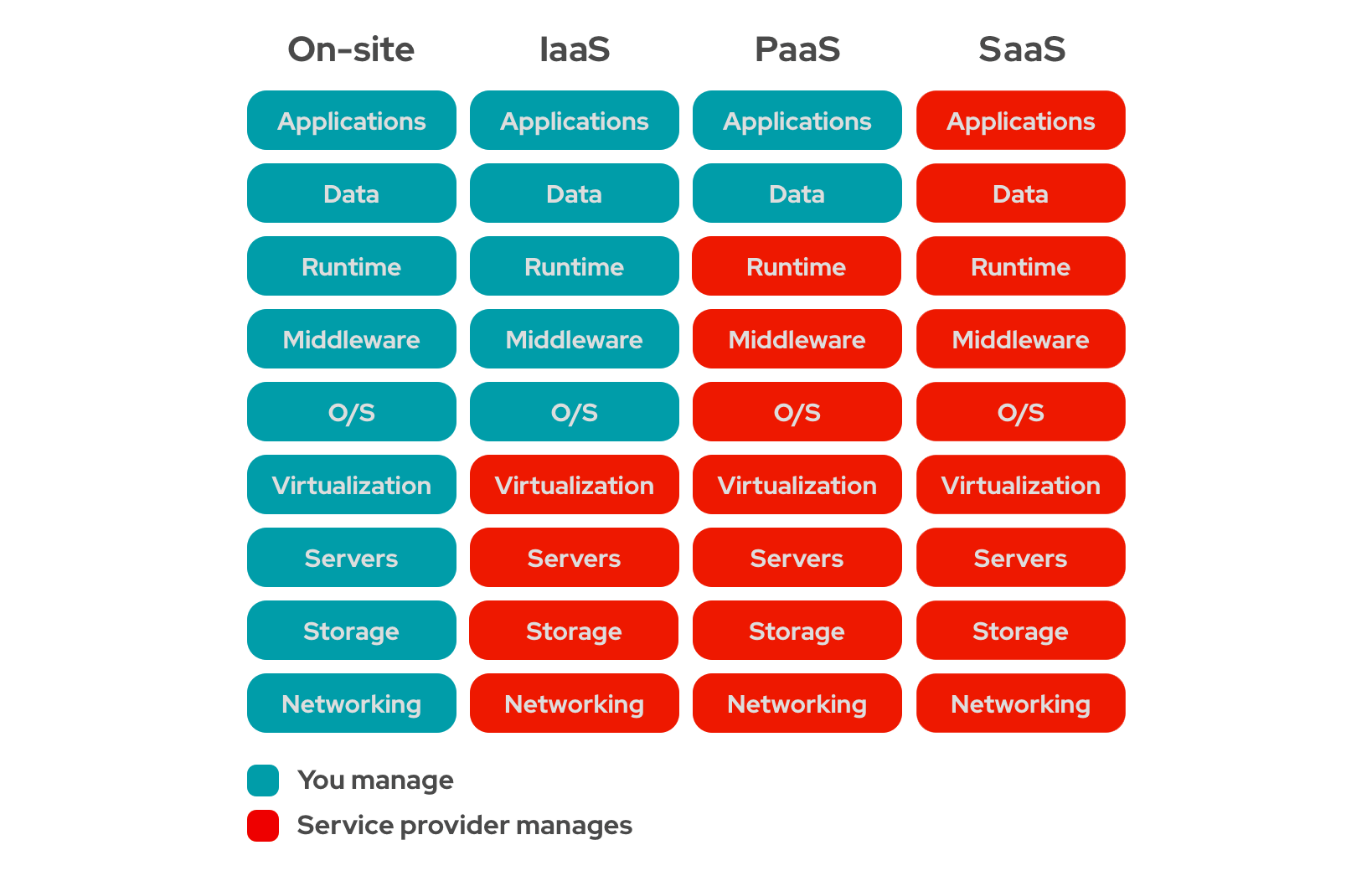
Before comparing PaaS and IaaS, it helps to imagine software development as a stack of responsibilities.
At the bottom sits the physical infrastructure: servers, storage devices, networking equipment, and data centers.
Above that come virtual machines, operating systems, middleware, runtime environments, databases, development tools, and finally the applications customers use every day.
Every one of those layers requires expertise.
The real question isn't whether those responsibilities exist.
It's who manages them.
That's where PaaS and IaaS begin to diverge.
What Is IaaS?
Infrastructure as a Service delivers virtualized computing resources over the cloud.
Instead of purchasing physical servers, organizations rent infrastructure from a cloud provider.
The provider manages the physical hardware, while customers remain responsible for much of the software environment.
With IaaS, organizations typically control:
- Virtual machines
- Operating systems
- Middleware
- Runtime environments
- Applications
- Security configurations
- Networking rules
- Storage management
This approach offers significant flexibility.
It also introduces significant responsibility.
Organizations gain freedom because they manage much of the infrastructure stack themselves.
What Is PaaS?
Platform as a Service builds on top of cloud infrastructure by managing much more of the technical foundation.
Rather than simply providing virtual servers, PaaS supplies an environment where developers can build, test, deploy, and maintain applications without managing the underlying infrastructure.
The provider typically manages:
- Infrastructure
- Virtualization
- Operating systems
- Runtime environments
- Middleware
- Development frameworks
- Scaling
- Platform maintenance
Developers primarily focus on:
- Application code
- Business logic
- User experience
- Data models
Notice the shift.
The platform absorbs operational complexity, allowing engineering teams to direct more attention toward creating customer value.
The Biggest Difference Isn't Technical
At first glance, the distinction appears architectural.
In practice, it's strategic.
IaaS asks:
"How would you like to configure your infrastructure?"
PaaS asks:
"What would you like to build?"
That subtle difference influences hiring decisions, deployment speed, operational overhead, budgeting, security responsibilities, and even company culture.
Organizations aren't simply choosing technology.
They're choosing where complexity should live.
PaaS vs. IaaS: Side-by-Side Comparison
| Feature | Infrastructure as a Service (IaaS) | Platform as a Service (PaaS) |
|---|---|---|
| Infrastructure Management | Provider manages physical hardware | Provider manages infrastructure and platform |
| Operating System | Customer manages | Provider manages |
| Runtime Environment | Customer manages | Provider manages |
| Middleware | Customer manages | Provider manages |
| Application Development | Customer responsibility | Customer responsibility |
| Scalability | Configured by customer | Frequently automated |
| Deployment | Greater manual control | Simplified deployment |
| Customization | Extensive | Moderate |
| Operational Overhead | Higher | Lower |
| Ideal For | Custom infrastructure needs | Rapid application development |
One pattern becomes immediately visible.
PaaS consistently removes operational responsibilities.
IaaS consistently preserves flexibility.
Neither characteristic is universally better.
The better choice depends on the organization's priorities.
When IaaS Makes More Sense
Complete control has value.
Organizations with specialized infrastructure requirements often benefit from IaaS because they can customize nearly every aspect of their computing environment.
Common examples include:
Highly Regulated Industries
Healthcare, finance, and government organizations may require infrastructure configurations that align with strict compliance frameworks.
Legacy Application Support
Older enterprise systems sometimes depend on operating system versions or middleware that managed platforms don't support.
Complex Enterprise Architectures
Organizations integrating multiple systems often need granular networking, storage, and infrastructure configurations.
Performance Optimization
Engineering teams with specialized workloads may prefer optimizing infrastructure directly.
The trade-off is straightforward.
Greater flexibility usually means greater operational responsibility.
When PaaS Becomes the Better Choice
Now consider organizations whose competitive advantage comes from delivering software quickly rather than maintaining infrastructure.
For these companies, PaaS often creates substantial leverage.
Startup Companies
Early-stage teams can launch products without hiring dedicated infrastructure engineers.
SaaS Businesses
Application updates become faster because deployment pipelines are largely automated.
Innovation Teams
Internal development groups can experiment rapidly without waiting for environment provisioning.
Growing Businesses
Automatic scaling reduces the operational burden associated with customer growth.
The emphasis shifts from maintaining systems to improving products.
That's an important distinction.
The Hidden Cost Most Teams Underestimate
One lesson I've learned after observing software organizations over the years is that infrastructure rarely consumes attention all at once.
It does so gradually.
A server update here.
A deployment issue there.
Security patches.
Runtime upgrades.
Storage expansion.
Monitoring configuration.
Each task feels relatively small.
Collectively, they consume an astonishing amount of engineering capacity.
I once worked alongside a product team convinced they needed additional developers. After reviewing how engineers spent their time, the surprise wasn't a lack of talent.
It was the volume of operational work.
Their most experienced developers had become infrastructure specialists almost by accident.
Moving portions of their workload onto a managed platform didn't make those engineers less valuable.
It allowed them to become valuable in different ways.
Within months, feature delivery accelerated—not because anyone worked harder, but because attention shifted toward customer-facing innovation.
That experience permanently changed how I evaluate cloud architecture decisions.
Sometimes the smartest investment isn't adding resources.
It's removing distractions.
Security Responsibilities Look Different
Security often becomes another deciding factor.
With IaaS, organizations assume responsibility for securing operating systems, runtime environments, applications, user permissions, network configurations, and many infrastructure settings.
PaaS shifts many platform-level responsibilities to the provider.
That doesn't eliminate security obligations.
Developers still secure applications, APIs, authentication, and sensitive data.
The difference lies in the division of responsibility.
Organizations choosing PaaS often inherit stronger operational consistency because security updates and platform maintenance happen centrally.
Cost Isn't Just About Monthly Pricing
Cloud discussions frequently focus on subscription costs.
That's understandable.
Monthly invoices are visible.
Engineering attention isn't.
Imagine two companies paying identical cloud bills.
One spends hundreds of engineering hours maintaining infrastructure.
The other spends those same hours improving customer experiences.
Financially, the invoices appear similar.
Strategically, the investment couldn't be more different.
Opportunity cost belongs in every cloud conversation.
Can Organizations Use Both?
Absolutely.
In fact, many enterprises do.
A customer-facing application might run on a PaaS platform for rapid development while specialized analytics workloads operate on IaaS infrastructure requiring custom configurations.
Hybrid cloud strategies recognize an important reality.
Different workloads have different priorities.
The goal isn't choosing one model forever.
It's selecting the right model for each business need.
Choosing Between PaaS and IaaS
Rather than asking which model is objectively superior, organizations should ask better questions.
- How much infrastructure control do we truly require?
- Is our competitive advantage rooted in infrastructure customization or software innovation?
- Do we have the internal expertise to manage operating systems and runtime environments?
- How quickly do we need to deliver new features?
- Would engineering time create more value building products than maintaining platforms?
Those questions usually produce clearer answers than technical feature comparisons alone.
Because cloud architecture is ultimately about organizational priorities.
Conclusion
The difference between PaaS and IaaS extends well beyond technical architecture.
Infrastructure as a Service provides flexibility, customization, and granular control for organizations willing to manage much of their software environment.
Platform as a Service reduces operational complexity by managing much of that environment on behalf of developers, allowing teams to focus on building applications instead of supporting infrastructure.
Neither model represents a universally correct answer.
Each reflects a different philosophy about where expertise should be applied.
The organizations that benefit most from IaaS tend to view infrastructure as a strategic capability.
Those that thrive with PaaS often see infrastructure as essential—but not differentiating.
That distinction may sound subtle.
In practice, it influences hiring, budgeting, product velocity, customer experience, and long-term growth.
Because every hour an engineering team spends maintaining infrastructure is an hour not spent solving a customer's problem.
And for many organizations, that's the comparison that matters most.
- Arts
- Business
- Computers
- Giochi
- Health
- Home
- Kids and Teens
- Money
- News
- Personal Development
- Recreation
- Regional
- Reference
- Science
- Shopping
- Society
- Sports
- Бизнес
- Деньги
- Дом
- Досуг
- Здоровье
- Игры
- Искусство
- Источники информации
- Компьютеры
- Личное развитие
- Наука
- Новости и СМИ
- Общество
- Покупки
- Спорт
- Страны и регионы
- World

 English
 Russian
 French
 Spanish
 Portuguese
 Deutsch
 Turkish
 Dutch
Dutch
 Arabic
 Romaian
 Portuguese (Brazil)
 Greek
Greek