
What Is the Difference Between PaaS and SaaS?
The Question That Revealed a Bigger Strategy
A few years ago, I was facilitating a workshop with a leadership team preparing to modernize their technology stack. Midway through the discussion, one executive leaned back and asked a question that initially sounded simple:
"If we're already using cloud software, why would we need a cloud platform too?"
Around the table, several people nodded.
They had heard the acronyms—PaaS, SaaS, IaaS—but the distinctions blurred together. Everything seemed to live "in the cloud," so the differences felt academic.
The conversation that followed changed the direction of the meeting.
We stopped talking about technology and started talking about outcomes.
One solution helped employees accomplish their work.
The other helped developers create entirely new solutions.
That realization transformed what had seemed like a technical comparison into a strategic decision.
The difference between Platform as a Service (PaaS) and Software as a Service (SaaS) isn't merely about architecture. It's about who creates value, who consumes it, and how organizations decide where to focus their energy.
Understanding the Cloud Through a Different Lens
Cloud computing isn't one product.
It's a collection of service models designed to remove different kinds of complexity.
Imagine opening a restaurant.
You could purchase ingredients and cook every meal yourself.
Or you could lease a fully equipped kitchen.
Or you could simply order prepared meals from a catering company.
Each option solves a different problem.
Cloud services work much the same way.
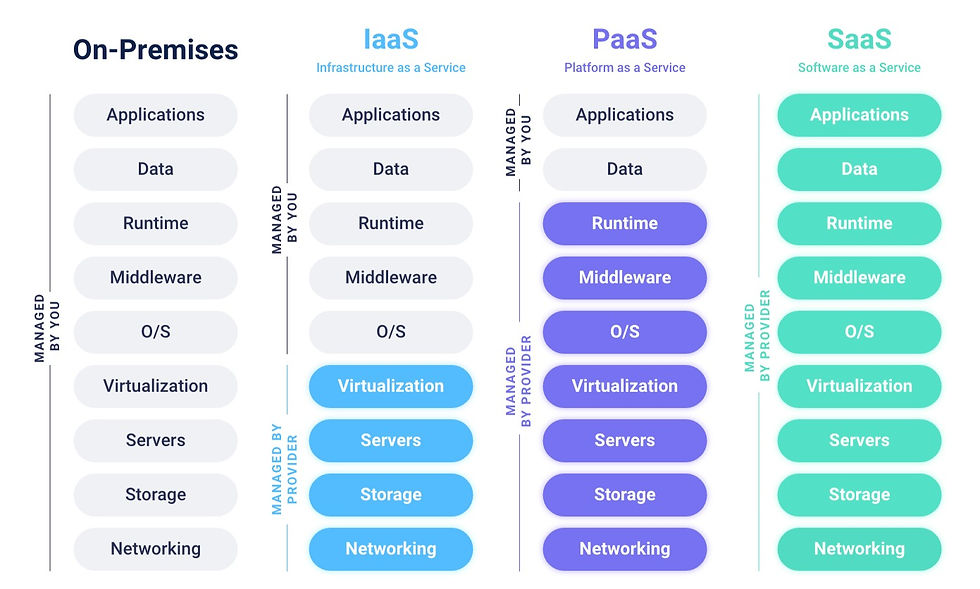
SaaS delivers finished software that's ready to use.
PaaS delivers the environment developers need to build software.
Both eliminate work.
They simply eliminate different kinds of work.
What Is SaaS?
Software as a Service provides fully developed applications over the internet.
Users access the software through a web browser or mobile app without worrying about installation, servers, updates, or maintenance.
The provider manages everything behind the scenes.
Common SaaS applications include:
- Customer relationship management (CRM)
- Email platforms
- Project management tools
- Video conferencing software
- Accounting applications
- Marketing automation platforms
The customer simply logs in and begins working.
From the user's perspective, the infrastructure is invisible.
That's precisely the point.
What Is PaaS?
Platform as a Service serves a different audience.
Instead of delivering completed software, PaaS provides developers with the tools, infrastructure, runtime environment, databases, deployment pipelines, and services required to build and launch their own applications.
The provider handles much of the operational foundation.
Developers concentrate on writing code, designing experiences, integrating services, and solving business problems.
Rather than using an application, organizations use PaaS to create applications.
That distinction sits at the heart of the comparison.
The Most Important Difference
The technical definitions are helpful.
The practical distinction is even clearer.
SaaS answers the question:
"What software do we need?"
PaaS answers:
"What software do we want to build?"
Those questions may appear similar.
They're not.
One focuses on consumption.
The other focuses on creation.
Everything else flows from that difference.
PaaS vs. SaaS: A Side-by-Side Comparison
| Category | Platform as a Service (PaaS) | Software as a Service (SaaS) |
|---|---|---|
| Primary Users | Developers and engineering teams | Business users and employees |
| Purpose | Build, test, and deploy applications | Use completed software |
| Coding Required | Yes | No |
| Infrastructure Management | Managed by provider | Managed entirely by provider |
| Software Development Tools | Included | Not applicable |
| Custom Application Creation | Yes | Limited to configuration and integrations |
| Maintenance | Provider manages platform | Provider manages application and platform |
| Time to Value | Depends on development effort | Immediate after setup |
| Typical Flexibility | High | Moderate |
| Best Fit | Building unique software | Solving common business needs |
One pattern stands out.
PaaS provides the foundation for innovation.
SaaS provides the finished experience.
Who Benefits Most from SaaS?
SaaS is designed for organizations that want to solve familiar business challenges efficiently.
Most companies don't gain a competitive advantage by building their own email system or payroll software.
Purchasing mature solutions often makes far more sense.
SaaS is particularly valuable for:
Growing Businesses
Organizations can adopt enterprise-grade software without maintaining infrastructure or dedicated IT teams.
Distributed Teams
Employees can collaborate from virtually anywhere using browser-based applications.
Fast Implementation
Many SaaS products can be configured and deployed within days rather than months.
Predictable Operations
Updates, maintenance, backups, and security enhancements occur without disrupting everyday users.
The goal isn't customization.
It's productivity.
Who Benefits Most from PaaS?
PaaS shines when organizations need software that doesn't already exist.
Perhaps a company is creating a customer portal.
Perhaps it's launching a digital marketplace.
Perhaps it's building internal applications unique to its operations.
Rather than managing operating systems, databases, runtime environments, and deployment pipelines independently, development teams rely on a managed platform.
That allows them to spend more time solving customer problems instead of infrastructure problems.
The emphasis shifts from maintaining technology to creating differentiated experiences.
A Lesson That Changed My Perspective
One experience continues to shape how I think about this comparison.
I worked with an organization determined to build nearly everything internally. They believed custom software would provide complete control over every process.
At first, that philosophy felt ambitious.
Then reality intervened.
Developers found themselves maintaining login systems, notification services, reporting modules, and collaboration tools that already existed as mature SaaS products.
Meanwhile, the truly unique application—the one customers actually cared about—progressed slowly because resources were scattered.
Eventually, the company made two decisions.
They adopted SaaS wherever the problem was common.
They reserved PaaS for building capabilities that reflected their unique expertise.
The change wasn't dramatic overnight.
But within a year, engineering discussions sounded different.
Less time was spent rebuilding standard functionality.
More time centered on customer feedback, product improvements, and experimentation.
The lesson stayed with me.
Technology creates the most value when it amplifies what makes an organization distinctive—not when it duplicates work that countless providers have already solved exceptionally well.
Cost Means More Than Subscription Fees
It's tempting to compare PaaS and SaaS through monthly pricing.
That comparison misses something important.
The largest cost is often attention.
SaaS minimizes attention by delivering finished software.
PaaS directs attention toward building something new while minimizing infrastructure responsibilities.
Neither eliminates work.
They simply move effort to different places.
One saves teams from developing common applications.
The other saves developers from managing complex platforms.
Understanding where your organization wants to invest effort often matters more than comparing invoices.
Can Organizations Use Both?
Absolutely.
In fact, most modern organizations do.
A marketing team may rely on SaaS applications for customer engagement, analytics, and collaboration.
At the same time, the engineering organization may use PaaS to develop customer-facing products, internal automation tools, or industry-specific applications.
These models complement one another.
They aren't competitors.
A healthy technology strategy often combines both, using each where it creates the greatest leverage.
How to Decide Between PaaS and SaaS
Rather than asking which model is superior, consider a different set of questions:
- Are we trying to use software or create software?
- Does this capability differentiate our business?
- Would purchasing an established application satisfy the need?
- Do our developers create more value building customer-facing features than maintaining infrastructure?
- Which choice allows our teams to focus on their highest-value work?
These questions move the discussion beyond technical terminology and toward business outcomes.
That's where better decisions usually emerge.
Conclusion
The difference between PaaS and SaaS isn't simply a matter of cloud architecture.
It's a reflection of organizational priorities.
Software as a Service delivers complete applications that help people accomplish everyday work quickly and efficiently.
Platform as a Service provides developers with the foundation to create applications tailored to unique business needs.
Both reduce complexity.
Both accelerate progress.
Yet they do so from opposite directions.
SaaS removes the burden of building software that already exists.
PaaS removes the burden of managing the infrastructure required to build software that doesn't.
For many organizations, the smartest strategy isn't choosing one over the other.
It's recognizing which challenges deserve custom innovation and which are better solved by proven software.
Because every technology decision is ultimately a decision about focus.
And focus remains one of the few resources every organization has in limited supply.
- Arts
- Business
- Computers
- الألعاب
- Health
- الرئيسية
- Kids and Teens
- مال
- News
- Personal Development
- Recreation
- Regional
- Reference
- Science
- Shopping
- Society
- Sports
- Бизнес
- Деньги
- Дом
- Досуг
- Здоровье
- Игры
- Искусство
- Источники информации
- Компьютеры
- Личное развитие
- Наука
- Новости и СМИ
- Общество
- Покупки
- Спорт
- Страны и регионы
- World

 English
 Russian
 French
 Spanish
 Portuguese
 Deutsch
 Turkish
 Dutch
Dutch
 Italiano
 Romaian
 Portuguese (Brazil)
 Greek
Greek