
How Do PaaS Providers Charge for Usage?
A product leader once told me something that has stayed with me for years.
“We budgeted for cloud infrastructure. What we didn’t budget for was understanding the bill.”
The statement drew laughter around the conference table.
Then the room became quiet.
Because everyone had experienced some version of the same challenge.
A cloud invoice arrives. The total seems higher than expected. Teams start investigating. Was it traffic growth? Database activity? Storage expansion? Background jobs? Network bandwidth? Additional environments?
The answer is often all of the above.
This is the paradox of Platform as a Service (PaaS). Providers work hard to make infrastructure feel simple. Deploying an application may require only a few clicks. Scaling may happen automatically. Monitoring may be integrated from the start.
Yet behind that simplicity sits a sophisticated pricing engine.
And understanding how PaaS providers charge for usage is no longer a niche technical skill. It has become a strategic capability. Product leaders need it. Finance teams need it. Engineering organizations certainly need it.
Because cloud costs don't emerge from a single metric.
They emerge from a collection of behaviors.
The more clearly you understand those behaviors, the easier it becomes to predict, optimize, and manage spending.
The Short Answer: PaaS Providers Charge Based on Resource Consumption
At the highest level, most PaaS providers follow a straightforward principle:
The more platform resources your application consumes, the more you pay.
That sounds obvious.
But the details matter.
Resource consumption can include:
- CPU usage
- Memory allocation
- Storage consumption
- Network bandwidth
- Database operations
- Application runtime
- Requests processed
- Additional managed services
Different providers emphasize different metrics.
Some focus on allocated resources.
Others focus on actual usage.
Many blend multiple approaches together.
The result is a pricing structure that can appear simple from a distance and surprisingly nuanced up close.
Why Usage-Based Charging Became the Industry Standard
Traditional software pricing was relatively predictable.
Organizations purchased licenses.
They paid annual subscriptions.
Costs remained stable.
Cloud computing changed the equation.
Applications no longer consumed fixed infrastructure.
Workloads fluctuated.
Traffic varied.
Customer activity changed daily.
Static pricing models struggled to reflect those realities.
Usage-based charging emerged as a natural solution.
Organizations pay more when they consume more resources.
They pay less when they consume fewer.
The model aligns provider economics with customer behavior.
That alignment explains why usage-based pricing now dominates much of the cloud ecosystem.
The Five Most Common Usage Metrics
Although providers use different terminology, most PaaS pricing ultimately revolves around five core measurements.
1. Compute Resources
Compute represents the processing power allocated to an application.
This category often includes:
- Virtual CPUs (vCPUs)
- Container resources
- Runtime execution
- Processing capacity
Applications performing intensive calculations consume more compute resources.
Simple websites consume less.
Many providers charge based on allocated compute capacity rather than actual utilization.
Others measure both.
The distinction matters.
Paying for allocated resources creates predictability.
Paying for actual consumption creates efficiency.
2. Memory Usage
Memory is one of the most important pricing variables in modern PaaS environments.
Applications require RAM to function effectively.
Larger workloads typically require larger allocations.
A lightweight API might operate comfortably with 512 MB.
A machine learning application may require several gigabytes.
Because memory directly influences infrastructure costs, providers frequently incorporate it into pricing calculations.
3. Storage Consumption
Applications generate data.
User uploads.
Logs.
Backups.
Databases.
Configuration files.
Storage costs generally increase alongside application maturity.
What begins as a few megabytes can evolve into terabytes.
The pricing is usually straightforward:
More storage equals higher charges.
Yet storage often grows quietly.
Organizations notice compute expenses immediately.
Storage expansion tends to happen gradually.
That makes it easy to underestimate.
4. Network Traffic
Data moving into and out of applications generates network activity.
Providers commonly track:
- Outbound bandwidth
- Data transfer
- API traffic
- Content delivery usage
This category becomes increasingly important as applications gain users.
Growth creates traffic.
Traffic creates costs.
Many organizations discover that bandwidth becomes a meaningful expense sooner than expected.
5. Request Volume
Some modern platforms focus heavily on requests processed.
Examples include:
- HTTP requests
- API calls
- Serverless executions
- Function invocations
This model feels intuitive.
Applications generating more activity incur higher charges.
Applications generating less activity incur lower charges.
Google Cloud Run and several serverless-oriented platforms rely extensively on this approach.
How Major PaaS Providers Charge for Usage
While providers share common concepts, their implementations differ significantly.
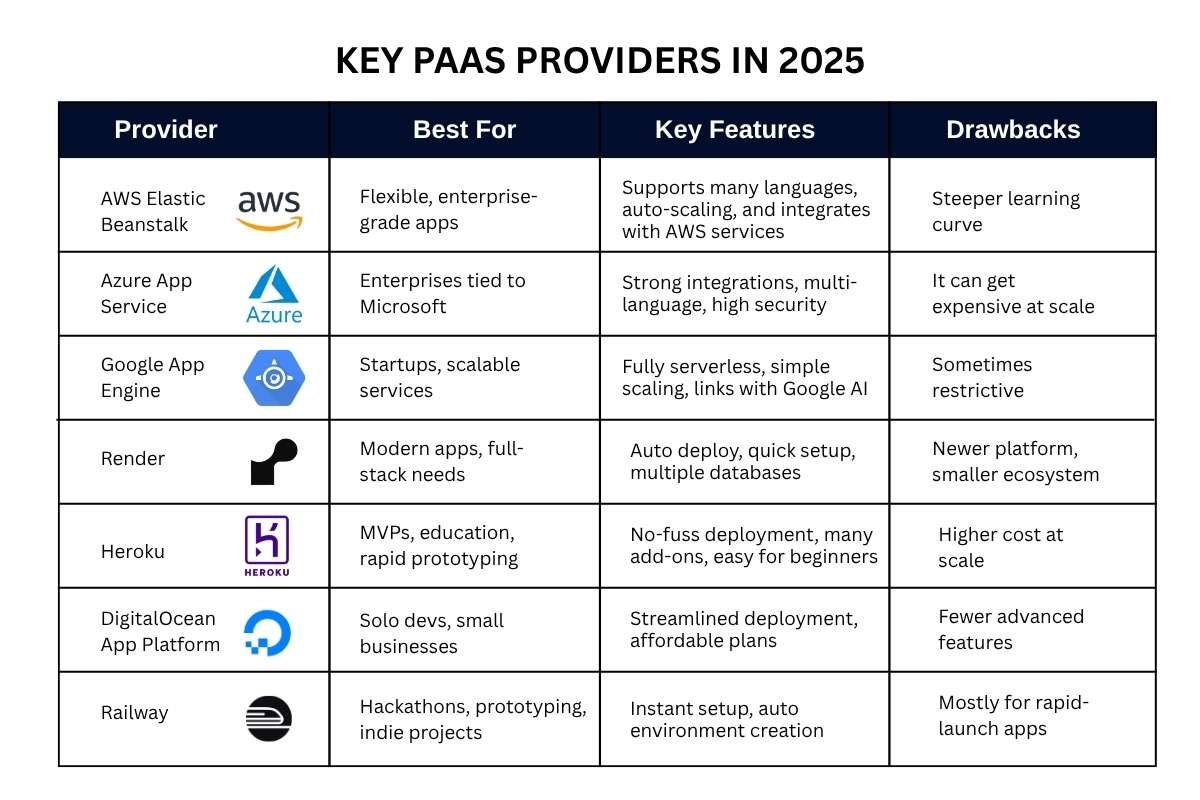
PaaS Usage Charging Models Compared
| Provider | Primary Usage Metric | Billing Style | Predictability |
|---|---|---|---|
| Heroku | Allocated dynos | Fixed monthly pricing | High |
| Render | Resource allocation | Monthly plans | High |
| Railway | Resource consumption | Usage-based credits | Medium |
| Fly.io | CPU and memory usage | Consumption-based | Medium |
| Google Cloud Run | Requests and execution time | Pure usage billing | Variable |
| Azure App Service | Tier-based resources | Fixed plans | High |
| AWS Elastic Beanstalk | Underlying AWS resources | Consumption billing | Variable |
| Platform.sh | Environment resources | Subscription-based | High |
Notice something interesting.
Some providers optimize for predictability.
Others optimize for precision.
This distinction influences both budgeting and operational decision-making.
The Difference Between Allocated Usage and Actual Usage
One of the most misunderstood aspects of PaaS billing involves allocation.
Consider two applications.
Each receives a server with 2 GB of RAM.
Application A uses nearly all of it.
Application B uses only a fraction.
On many platforms, both customers pay the same amount.
Why?
Because they are paying for reserved capacity.
Not actual consumption.
Other providers take a different approach.
They charge according to real-time usage.
This creates efficiency but introduces variability.
The tradeoff is fascinating.
Predictability and optimization often sit in tension with one another.
Organizations must decide which matters more.
The Hidden Charges That Surprise Teams
Most teams understand compute pricing.
Fewer understand the supporting costs surrounding modern applications.
These secondary charges frequently create surprises.
Managed Databases
Databases often represent one of the largest recurring expenses.
High availability.
Backups.
Replication.
Storage growth.
Each contributes to the final invoice.
Logging and Monitoring
Applications generate operational data continuously.
Logs.
Metrics.
Traces.
Monitoring platforms help organizations understand system behavior.
They also consume resources.
Background Workers
Many applications perform work outside user-facing requests.
Email processing.
Data synchronization.
Analytics generation.
Queue processing.
These activities consume compute resources and therefore contribute to billing.
Multi-Environment Architectures
Development.
Testing.
Staging.
Production.
Most mature software organizations operate multiple environments.
Each environment incurs additional charges.
The application itself may remain unchanged.
The operational footprint expands.
A Lesson Learned from an Unexpected Cloud Bill
Several years ago, I worked with a SaaS company experiencing rapid customer growth.
The leadership team expected infrastructure spending to increase.
What they didn't expect was the pace.
Monthly cloud costs nearly doubled within a short period.
The immediate assumption was increased application traffic.
That assumption was partially correct.
But it wasn't the whole story.
A deeper review revealed several contributors:
Additional staging environments.
Expanded logging retention.
Larger database backups.
New monitoring integrations.
Background processing workloads.
None of these changes seemed significant individually.
Collectively, they transformed the economics of the platform.
The lesson was powerful.
Cloud spending is rarely driven by a single factor.
It emerges from the accumulation of many small decisions.
Understanding usage-based billing means understanding those decisions.
Why Providers Favor Usage-Based Charging
From a provider perspective, usage-based pricing solves several challenges.
First, it aligns revenue with infrastructure costs.
Customers consuming more resources generate higher expenses.
Usage-based billing reflects that reality.
Second, it lowers adoption barriers.
Organizations can begin with small workloads and modest spending.
Growth occurs naturally.
Third, it creates scalability.
The pricing model expands alongside customer success.
This alignment explains why usage-based approaches have become increasingly popular across the cloud industry.
How to Predict PaaS Usage Costs
Forecasting cloud expenses can feel intimidating.
Yet the process becomes manageable when broken into components.
Start by estimating:
- Application traffic
- Compute requirements
- Memory needs
- Storage growth
- Database activity
- Network transfer volumes
Then examine platform-specific pricing structures.
Finally, add a contingency margin.
Growth rarely follows perfectly linear patterns.
Neither do cloud costs.
Organizations that budget only for expected consumption often encounter surprises.
Organizations that budget for growth tend to experience fewer of them.
The Strategic Question Behind Usage-Based Pricing
Most discussions about PaaS billing focus on invoices.
That perspective is understandable.
Invoices are visible.
Budgets are measurable.
Costs attract attention.
Yet the more interesting question is not how providers charge.
It is why organizations willingly accept those charges.
The answer is simple.
Because usage-based pricing reflects value creation.
More users.
More transactions.
More activity.
More growth.
In many cases, higher cloud spending accompanies greater business success.
That doesn't eliminate the need for optimization.
But it changes the conversation.
The goal is not merely reducing costs.
The goal is ensuring that costs scale efficiently alongside value.
Conclusion: PaaS Billing Is Really About Behavior
When someone asks, “How do PaaS providers charge for usage?” they are often looking for a technical explanation.
CPU.
Memory.
Bandwidth.
Requests.
Storage.
Those metrics matter.
But beneath them lies a broader truth.
PaaS providers do not simply charge for infrastructure.
They charge for behavior.
Every deployment.
Every user interaction.
Every database transaction.
Every application decision contributes to resource consumption.
The bill becomes a reflection of how software is designed, operated, and adopted.
That is why two organizations running similar applications can experience dramatically different costs.
Their behaviors differ.
Their architectures differ.
Their priorities differ.
Understanding usage-based pricing, therefore, is not merely about reading a pricing page.
It is about understanding the relationship between technology decisions and economic outcomes.
And in a world where software increasingly defines competitive advantage, that relationship may be one of the most important metrics an organization can track.
- Arts
- Business
- Computers
- Jogos
- Health
- Início
- Kids and Teens
- Money
- News
- Personal Development
- Recreation
- Regional
- Reference
- Science
- Shopping
- Society
- Sports
- Бизнес
- Деньги
- Дом
- Досуг
- Здоровье
- Игры
- Искусство
- Источники информации
- Компьютеры
- Личное развитие
- Наука
- Новости и СМИ
- Общество
- Покупки
- Спорт
- Страны и регионы
- World

 English
 Russian
 French
 Spanish
 Portuguese
 Deutsch
 Turkish
 Dutch
Dutch
 Italiano
 Arabic
 Romaian
 Greek
Greek