
What Is Inventory Turnover? The Retail Metric That Reveals More Than You Think
Walk into a grocery store at 8 a.m. and then return at 8 p.m.
The shelves may look remarkably different.
Milk has been restocked. Produce bins have shifted. Cases of bottled water have disappeared. Entire displays have been refreshed. Products arrive, products leave, and the cycle continues with astonishing speed.
Now walk into a luxury furniture showroom.
The experience is entirely different. A sectional sofa may occupy the same floor space for weeks. A handcrafted dining table may remain on display for months before finding a buyer.
Neither retailer is necessarily succeeding or failing.
They are simply operating under different realities.
Yet both businesses are connected by one of the most revealing metrics in retail: inventory turnover.
At first glance, inventory turnover appears straightforward. It measures how frequently inventory is sold and replaced during a specific period. But like many retail metrics, its apparent simplicity masks a deeper story.
Inventory turnover is not merely an accounting calculation. It is a signal. Sometimes a warning signal. Sometimes a growth signal. Often both.
It reflects demand, merchandising effectiveness, pricing strategy, operational discipline, and customer behavior. In many respects, it serves as a retailer’s pulse.
The challenge is that too many businesses measure inventory turnover without truly understanding what it means.
Defining Inventory Turnover
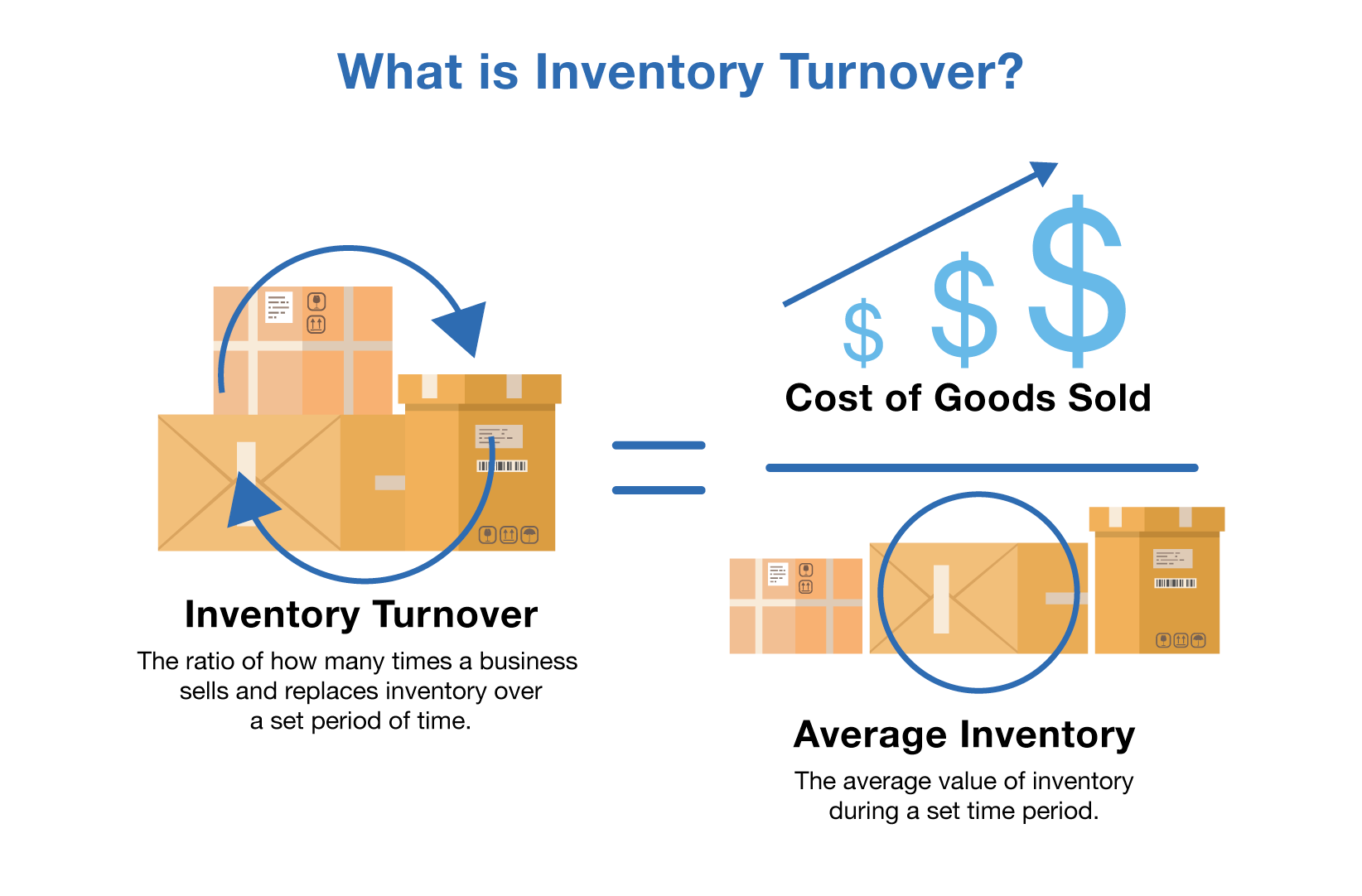
Inventory turnover measures how often a company sells and replenishes its inventory during a given period, typically a year.
The standard formula is:
Inventory Turnover = Cost of Goods Sold (COGS) ÷ Average Inventory
The result indicates how many times inventory cycles through the business.
For example:
- Annual Cost of Goods Sold: $1,000,000
- Average Inventory: $250,000
Inventory Turnover = 4
This means the retailer effectively sold and replaced its inventory four times during the year.
Simple enough.
Yet the real value lies not in the calculation itself but in the interpretation.
A turnover ratio of four might represent outstanding performance for one retailer and disappointing performance for another.
Context changes everything.
Why Retailers Obsess Over Turnover
Retailers do not make money by storing products.
They make money by moving products.
This distinction sounds obvious, but it is surprisingly easy to forget.
Inventory sitting in a warehouse represents cash that cannot be used elsewhere. Inventory sitting on shelves consumes space, labor, insurance, and attention. Every unsold unit carries an opportunity cost.
Inventory turnover helps retailers answer a critical question:
How efficiently are we converting inventory into revenue?
The answer influences nearly every aspect of business performance.
High turnover generally suggests:
- Strong demand
- Effective assortment planning
- Efficient inventory investment
- Lower carrying costs
Low turnover may suggest:
- Weak demand
- Excess purchasing
- Poor forecasting
- Ineffective merchandising
Yet the relationship is rarely linear.
Retail metrics rarely are.
The Hidden Tension Between Speed and Availability
One of the most interesting retail paradoxes is that faster is not always better.
Many executives initially assume inventory turnover should be maximized at all costs.
That assumption can create problems.
Imagine a retailer aggressively reducing inventory levels to improve turnover.
The metric improves.
Investors applaud.
Financial reports look stronger.
Then customers begin encountering stockouts.
Popular products disappear.
Purchase intentions go unfulfilled.
Sales decline.
What appeared efficient suddenly becomes costly.
Inventory turnover therefore requires balance.
Retailers must move products quickly enough to avoid excess inventory while maintaining sufficient availability to satisfy demand.
This balancing act sits at the heart of inventory management.
Inventory Turnover Across Retail Categories
Comparisons become especially interesting when examining different retail sectors.
Not all merchandise behaves similarly.
Fresh food moves differently than luxury handbags.
Consumer electronics move differently than fine jewelry.
The expected turnover rate varies significantly.
Typical Inventory Turnover Comparison
| Retail Category | Typical Turnover Range | Inventory Characteristics | Strategic Focus |
|---|---|---|---|
| Grocery Stores | 10–20+ | Perishable products, rapid replenishment | Speed and freshness |
| Fast Fashion | 4–8 | Trend-sensitive inventory | Agility and responsiveness |
| Consumer Electronics | 3–6 | Moderate product lifecycle risk | Demand forecasting |
| Home Furnishings | 2–4 | Larger-ticket items, slower sales cycles | Margin optimization |
| Luxury Retail | 1–3 | Scarcity-driven demand | Exclusivity and brand value |
| Automotive Dealerships | 2–5 | High-value inventory investments | Capital efficiency |
The table highlights an important lesson.
Inventory turnover is meaningful only when evaluated within category context.
Comparing a luxury watch retailer to a supermarket creates more confusion than insight.
What High Inventory Turnover Really Means
A high inventory turnover ratio often attracts praise.
Sometimes deservedly.
Sometimes not.
High turnover may indicate:
Strong Customer Demand
Customers consistently purchase merchandise.
Products resonate.
Assortments align with market preferences.
This is the ideal scenario.
Effective Merchandising
Product selection matches customer needs.
Pricing strategies support sales velocity.
Store execution encourages conversion.
Again, positive.
Lean Inventory Operations
The retailer minimizes excess stock while maintaining availability.
Capital efficiency improves.
Carrying costs decline.
Also positive.
But there is another possibility.
Chronic Understocking
A retailer may experience high turnover simply because inventory levels are too low.
Products sell immediately because insufficient inventory exists.
Customers repeatedly encounter stockouts.
Sales opportunities vanish.
In this situation, high turnover masks operational weakness.
The number alone cannot tell the full story.
What Low Inventory Turnover Reveals
Low turnover often generates concern.
Sometimes appropriately.
Sometimes prematurely.
Several factors may contribute.
Excess Inventory
Retailers order too aggressively.
Demand forecasts prove inaccurate.
Inventory accumulates.
Cash becomes trapped.
Weak Customer Interest
Products fail to connect with shoppers.
Assortments miss the mark.
Consumer preferences evolve.
Inventory remains unsold.
Pricing Misalignment
Customers perceive insufficient value.
Prices exceed willingness to pay.
Sales slow.
Inventory lingers.
Strategic Choice
Not every low-turnover business is struggling.
Luxury brands often deliberately maintain slower inventory movement.
Scarcity contributes to perceived exclusivity.
A rare product can become more desirable precisely because it is not everywhere.
The key is understanding whether low turnover reflects intentional strategy or operational inefficiency.
My Lesson Learned About Inventory Turnover
Years ago, I worked with a specialty retailer that proudly celebrated its inventory turnover improvements.
The numbers looked impressive.
Quarter after quarter, turnover increased.
Leadership viewed the trend as evidence of operational excellence.
Then customer satisfaction scores began declining.
Store associates reported increasing complaints about product availability.
Repeat customers started purchasing elsewhere.
The company had optimized for turnover while inadvertently sacrificing assortment depth.
The metric improved.
The customer experience deteriorated.
That experience reinforced a lesson I have carried ever since: metrics should illuminate customer value, not replace it.
Inventory turnover matters enormously, but it should never be interpreted in isolation.
Numbers tell stories.
The challenge is determining whether they are telling the entire story.
The Relationship Between Inventory Turnover and Cash Flow
One reason executives pay close attention to turnover is its direct connection to cash flow.
Inventory requires investment.
Retailers purchase merchandise before customers buy it.
That timing gap matters.
The faster inventory sells, the faster capital returns to the business.
Improved turnover can produce:
- Greater liquidity
- Reduced storage costs
- Lower markdown exposure
- Stronger financial flexibility
Conversely, slow-moving inventory creates financial friction.
Cash remains locked in products.
Warehousing expenses increase.
Markdown risk grows.
Profitability becomes more difficult to sustain.
Inventory turnover therefore acts as both an operational metric and a financial metric.
Its influence extends well beyond the sales floor.
Technology Has Changed Visibility, Not Complexity
Modern inventory systems provide extraordinary visibility.
Retailers can track stock levels in real time.
They can monitor sales patterns instantly.
They can automate replenishment recommendations.
These capabilities undoubtedly improve decision-making.
Yet technology has not eliminated uncertainty.
Consumers remain unpredictable.
Trends emerge unexpectedly.
Weather events disrupt demand.
Social media accelerates product popularity overnight.
Technology supplies information.
Managers still supply judgment.
The strongest retailers combine analytical rigor with market awareness.
Neither alone is sufficient.
Inventory Turnover and Customer Experience
Inventory discussions frequently focus on efficiency.
Customers focus on availability.
The distinction matters.
A retailer can achieve excellent turnover metrics while disappointing shoppers.
Likewise, a retailer can maintain slightly lower turnover while delivering superior customer satisfaction.
The most successful organizations understand that inventory turnover should support customer experience rather than compete with it.
Customers rarely ask about inventory turnover.
They notice whether desired products are available.
They notice whether replenishment feels reliable.
They notice whether shopping feels effortless.
Inventory turnover influences all these outcomes, even when customers never see the metric itself.
Improving Inventory Turnover Without Hurting Sales
Retailers seeking healthier turnover typically focus on several areas.
Better Forecasting
More accurate demand predictions reduce excess inventory accumulation.
Assortment Optimization
Removing underperforming products improves inventory productivity.
Strategic Pricing
Thoughtful pricing accelerates movement without excessive markdown dependence.
Supplier Collaboration
Improved supplier responsiveness reduces the need for large inventory buffers.
Data Analysis
Continuous monitoring identifies emerging inventory risks before they become significant problems.
Importantly, improvement should not mean indiscriminate inventory reduction.
The objective is smarter inventory allocation, not simply less inventory.
The Most Dangerous Mistake: Chasing the Metric
Perhaps the greatest risk associated with inventory turnover is becoming overly focused on the ratio itself.
Metrics possess a seductive quality.
They appear objective.
They create clarity.
They simplify complexity.
Yet retail reality remains stubbornly multidimensional.
A retailer can improve turnover while damaging customer loyalty.
A retailer can reduce inventory while reducing sales.
A retailer can optimize short-term performance while undermining long-term growth.
The metric should inform decisions, not dictate them.
Inventory turnover works best as part of a broader performance framework that includes customer satisfaction, profitability, assortment effectiveness, and brand strategy.
Conclusion: Inventory Turnover Is a Mirror, Not a Scorecard
When people ask, “What is inventory turnover?” they often expect a formula.
The formula is easy.
The interpretation is where things become interesting.
Inventory turnover is not simply a measure of how quickly products move. It reflects how effectively a retailer aligns inventory investment with customer demand. It reveals whether capital is being deployed productively. It exposes forecasting strengths and merchandising weaknesses. It highlights operational discipline while occasionally disguising operational mistakes.
Most importantly, inventory turnover acts as a mirror.
It reflects the quality of countless decisions made throughout the organization—from purchasing and pricing to assortment planning and customer experience design.
Retailers who treat inventory turnover as a standalone score often miss its deeper significance. Those who view it as a diagnostic tool gain something far more valuable: insight.
And in retail, insight is often the difference between inventory that creates value and inventory that quietly destroys it.
- Arts
- Business
- Computers
- Juegos
- Health
- Home
- Kids and Teens
- Money
- News
- Personal Development
- Recreation
- Regional
- Reference
- Science
- Shopping
- Society
- Sports
- Бизнес
- Деньги
- Дом
- Досуг
- Здоровье
- Игры
- Искусство
- Источники информации
- Компьютеры
- Личное развитие
- Наука
- Новости и СМИ
- Общество
- Покупки
- Спорт
- Страны и регионы
- World

 English
 Russian
 French
 Portuguese
 Deutsch
 Turkish
 Dutch
Dutch
 Italiano
 Arabic
 Romaian
 Portuguese (Brazil)
 Greek
Greek
