
Retail Terminology: The Language of Retail—and Why It Shapes More Than Communication
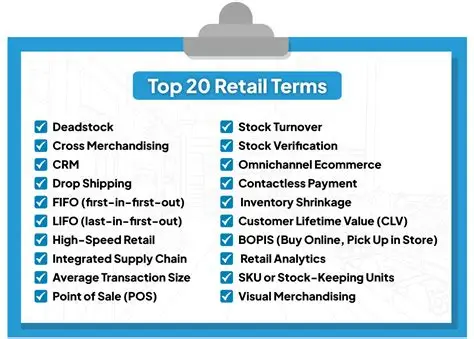
Walk into a retail meeting and you may hear a conversation that sounds oddly foreign, even to experienced business professionals.
Someone mentions GMROI.
Another references sell-through.
A merchant discusses SKU rationalization.
An analyst raises concerns about basket size.
A marketer celebrates customer lifetime value.
A store manager worries about shrink.
Everyone nods.
Everyone appears to understand.
Yet beneath this specialized vocabulary lies something far more interesting than jargon. Retail terminology does not merely describe retail operations. It shapes how retailers think about customers, inventory, profitability, and growth.
Language, after all, influences attention.
What we name, we notice.
What we notice, we manage.
And what we manage ultimately determines performance.
That is why understanding retail terminology matters. Not because memorizing acronyms is impressive. Not because speaking retail fluently earns credibility in meetings. But because each term reflects a specific way of viewing the business.
Some terms focus attention on products.
Others focus attention on customers.
The most important ones reveal how those two worlds intersect.
Why Retail Has Its Own Vocabulary
Retail is deceptively simple.
A customer buys a product.
A retailer earns revenue.
End of story.
Except, of course, it is never the end of the story.
Behind every purchase lies an intricate system involving merchandising, inventory planning, pricing, logistics, customer experience, marketing, forecasting, and financial management.
Over time, retailers developed specialized terminology to manage this complexity.
Consider the difference between saying:
"We sold a lot of products."
And:
"Our sell-through rate improved while maintaining gross margin."
The second statement conveys far more information.
Retail terminology exists because precision matters.
Small shifts in inventory levels can influence profitability. Minor changes in conversion rates can significantly impact revenue. A seemingly insignificant increase in returns can erase margins.
Retail language evolved to capture these nuances.
The Essential Retail Terminology Every Professional Should Know
Let's start with the foundational terms.
These are the concepts that appear repeatedly across retail organizations.
SKU (Stock Keeping Unit)
A SKU represents a unique product identifier.
For example:
A blue medium-sized T-shirt is one SKU.
The same shirt in black is another SKU.
The same shirt in large is yet another.
Retailers track inventory at the SKU level because customers purchase specific variations rather than generic products.
When merchants discuss assortment complexity, they're often discussing SKU counts.
Assortment
Assortment refers to the collection of products a retailer offers.
A retailer can have:
- Broad assortment (many categories)
- Deep assortment (many options within a category)
Walmart offers broad assortment.
Sephora offers deep assortment within beauty.
The distinction matters because assortment strategy directly influences customer perception.
Category Management
Category management treats product categories as strategic business units.
Instead of managing products individually, retailers manage groups of related products together.
For example:
- Beauty
- Home furnishings
- Footwear
- Consumer electronics
This approach helps optimize pricing, promotions, and inventory decisions.
The Inventory Terms That Drive Profitability
Retail success depends heavily on inventory management.
Too much inventory creates financial strain.
Too little inventory creates missed sales.
Retail terminology helps navigate this tension.
Inventory Turnover
Inventory turnover measures how quickly products sell and are replenished.
The formula:
Cost of Goods Sold ÷ Average Inventory
Higher turnover often indicates strong demand and efficient inventory management.
However—and this is important—higher is not always better.
A luxury retailer may intentionally operate with lower turnover to preserve exclusivity.
Context matters.
Sell-Through Rate
Sell-through measures how much inventory sells within a specific period.
Formula:
Units Sold ÷ Units Received
A high sell-through rate generally suggests products are resonating with customers.
A low sell-through rate may indicate pricing, assortment, or demand challenges.
Stockout
A stockout occurs when inventory is unavailable when customers want to purchase it.
This sounds simple.
Its consequences are not.
Stockouts can reduce sales, weaken customer trust, and push shoppers toward competitors.
Shrink
Shrink refers to inventory losses caused by theft, damage, administrative errors, or fraud.
Few retail terms sound as harmless as shrink.
Few create as much concern in financial reviews.
Because shrink directly impacts profitability, retailers monitor it closely.
Retail Performance Metrics and Their Meaning
Retail organizations depend on performance indicators to evaluate success.
Many of the industry's most common terms fall into this category.
Conversion Rate
Conversion rate measures the percentage of visitors who make a purchase.
Formula:
Purchases ÷ Visitors
Retailers analyze conversion across stores, websites, apps, and marketing campaigns.
Traffic alone means very little.
Conversion explains what happened after customers arrived.
Average Transaction Value (ATV)
ATV measures average customer spending per transaction.
Formula:
Revenue ÷ Number of Transactions
Retailers often increase ATV through:
- Cross-selling
- Upselling
- Product bundling
The goal is not merely selling more.
The goal is creating more value within each purchase occasion.
Basket Size
Basket size measures how many items customers purchase in a transaction.
Historically, retailers literally examined shopping baskets.
The terminology survived long after the physical basket ceased to matter.
Today, basket size remains an important indicator of customer purchasing behavior.
Retail Terminology Comparison Table
The following table highlights some of the industry's most important terms and their practical significance.
| Retail Term | Definition | Why It Matters | Strategic Impact |
|---|---|---|---|
| SKU | Unique product identifier | Enables inventory tracking | Supports assortment decisions |
| Assortment | Collection of offered products | Shapes customer choice | Influences differentiation |
| Inventory Turnover | Inventory movement rate | Measures efficiency | Impacts cash flow |
| Sell-Through Rate | Percentage of inventory sold | Indicates demand strength | Improves forecasting |
| Stockout | Product unavailable for purchase | Causes lost sales | Affects customer satisfaction |
| Shrink | Inventory loss | Reduces profitability | Requires operational controls |
| Conversion Rate | Visitors who purchase | Measures selling effectiveness | Improves revenue generation |
| Basket Size | Items per transaction | Reveals purchasing behavior | Supports cross-selling |
| Gross Margin | Revenue minus product costs | Measures profitability | Guides pricing decisions |
| Customer Lifetime Value | Long-term customer value | Predicts future revenue | Shapes acquisition strategy |
Notice something interesting.
Many retail terms focus less on products themselves and more on movement.
Inventory movement.
Customer movement.
Revenue movement.
Retail, at its core, is a business of flows.
Products flow through supply chains.
Customers flow through channels.
Money flows through transactions.
Retail terminology reflects this dynamic reality.
Customer-Centric Retail Language
One of the most important shifts in modern retail involves language itself.
Historically, retailers emphasized product-centric terminology.
Today, customer-centric terminology increasingly dominates strategic conversations.
Customer Acquisition Cost (CAC)
CAC measures the expense required to acquire a new customer.
Formula:
Marketing Spend ÷ New Customers Acquired
Retailers monitor CAC carefully because customer growth is valuable only when economically sustainable.
Customer Lifetime Value (CLV)
CLV estimates the total value a customer generates throughout a relationship with a retailer.
This term has become increasingly influential because it encourages long-term thinking.
A customer is no longer viewed as a transaction.
A customer becomes an asset.
That subtle change influences countless decisions.
Retention Rate
Retention measures how effectively a retailer keeps customers over time.
Acquiring customers is expensive.
Retaining customers is often more profitable.
Retailers that understand this distinction frequently outperform competitors.
Omnichannel Terminology and the New Retail Reality
Retail vocabulary continues to evolve.
As customer behavior changes, new terminology emerges.
Omnichannel
Omnichannel retail refers to creating seamless experiences across physical and digital touchpoints.
Customers may:
- Browse online
- Visit a store
- Purchase through an app
- Return through another channel
The experience feels unified.
At least, that's the goal.
Buy Online, Pick Up In Store (BOPIS)
BOPIS has become one of retail's most widely used operational terms.
Customers purchase online and collect products in-store.
Retailers benefit through convenience and reduced fulfillment costs.
Customers benefit through speed and flexibility.
Endless Aisle
The endless aisle concept allows retailers to offer products digitally beyond physical store inventory.
Stores effectively expand their assortment without expanding physical space.
It is a simple idea.
Its implications are significant.
A Lesson I Learned About Retail Language
Several years ago, I attended a strategic planning session involving executives from merchandising, marketing, operations, and finance.
Everyone appeared aligned.
Everyone used the same words.
Yet confusion persisted.
Eventually, the source became obvious.
Different departments were assigning different meanings to the same terminology.
Marketing discussed customer value.
Finance discussed profit value.
Merchants discussed product value.
All were technically correct.
None were discussing the same thing.
That experience reinforced an important lesson.
Retail terminology is most powerful when accompanied by shared understanding.
Words matter.
Definitions matter.
Alignment matters even more.
Because organizations rarely fail due to a lack of vocabulary.
They fail because people interpret the vocabulary differently.
The Terms That Will Shape Retail's Future
Retail language continues to evolve alongside customer expectations.
Terms gaining prominence include:
Personalization
Delivering individualized experiences based on customer behavior and preferences.
Retail Media Networks
Advertising platforms operated by retailers using first-party customer data.
First-Party Data
Information collected directly from customers rather than external sources.
Unified Commerce
A model that integrates customer, inventory, and transaction data across channels.
These concepts reflect a broader transformation.
Retail is becoming increasingly customer-centered, data-informed, and experience-driven.
Not because terminology changed.
But because customer expectations changed.
The language simply followed.
Conclusion: Retail Terminology Is Really About Understanding Customers
At first glance, retail terminology can appear intimidating.
A dense collection of acronyms.
A vocabulary reserved for insiders.
A business dialect designed to exclude outsiders.
But a closer examination reveals something different.
The most important retail terms are not really about inventory, margins, channels, or transactions.
They are about understanding behavior.
Why customers buy.
How products move.
Where value is created.
Which decisions improve outcomes.
The language of retail exists because retail itself is complex. Yet the most successful retailers never lose sight of a remarkably simple truth hidden beneath all the terminology.
Every SKU ultimately serves a customer.
Every metric ultimately reflects a customer decision.
Every strategy ultimately succeeds or fails based on customer response.
That is why mastering retail terminology matters.
Not because it helps you speak the language of retail.
Because it helps you understand the business the language was created to describe.
And that business, despite all its complexity, remains fundamentally human.
- Arts
- Business
- Computers
- Giochi
- Health
- Home
- Kids and Teens
- Money
- News
- Personal Development
- Recreation
- Regional
- Reference
- Science
- Shopping
- Society
- Sports
- Бизнес
- Деньги
- Дом
- Досуг
- Здоровье
- Игры
- Искусство
- Источники информации
- Компьютеры
- Личное развитие
- Наука
- Новости и СМИ
- Общество
- Покупки
- Спорт
- Страны и регионы
- World

 English
 Russian
 French
 Spanish
 Portuguese
 Deutsch
 Turkish
 Dutch
Dutch
 Arabic
 Romaian
 Portuguese (Brazil)
 Greek
Greek
