
Strategy vs. Tactics in Digital Marketing: What’s the Difference?
Introduction: Why This Distinction Matters
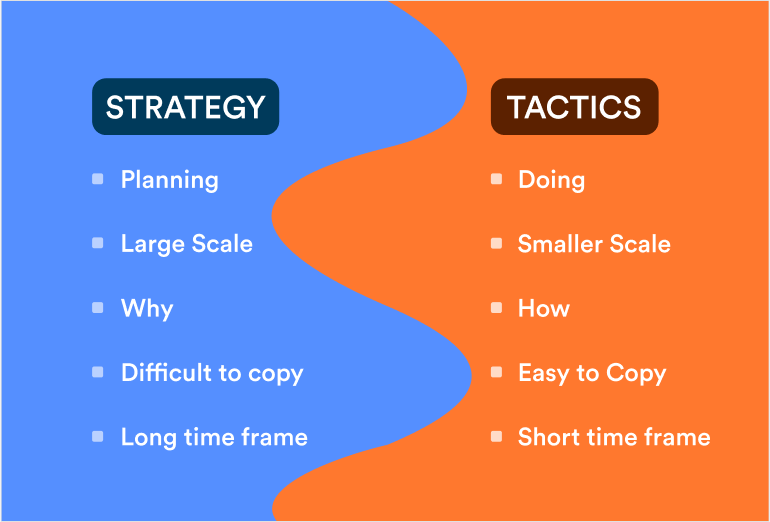
One of the biggest mistakes businesses make in digital marketing is confusing strategy with tactics. They are closely related, but not the same. Without a strategy, tactics lack direction. Without tactics, strategy remains theoretical.
Think of it like a road trip:
-
Strategy = choosing the destination (overall plan).
-
Tactics = the actual roads you take, the car you drive, and the stops you make (specific actions).
This article explains the difference between strategy and tactics in digital marketing, why both are essential, and how to align them for maximum results.
1. Defining Strategy in Digital Marketing
A strategy is a long-term plan that outlines how a business will achieve its marketing goals.
Key Characteristics of a Strategy
-
Goal-Oriented: Starts with “what do we want to achieve?”
-
Long-Term: Sets direction for months or years.
-
Focused: Provides clarity on priorities.
-
Data-Driven: Based on research, customer insights, and market analysis.
Example of a Strategy:
A SaaS company’s strategy might be to increase brand awareness and capture leads in the B2B sector through content-driven thought leadership.
2. Defining Tactics in Digital Marketing
Tactics are the specific actions or methods used to implement the strategy.
Key Characteristics of Tactics
-
Action-Oriented: Answers “how will we do it?”
-
Short-Term: Executed over days, weeks, or months.
-
Measurable: Directly linked to KPIs.
-
Flexible: Can be changed quickly based on performance.
Examples of Tactics:
-
Running LinkedIn ads targeting decision-makers.
-
Hosting webinars on industry trends.
-
Creating gated whitepapers to collect email leads.
3. The Relationship Between Strategy and Tactics
Strategy and tactics are interdependent:
-
Strategy sets direction.
-
Tactics execute direction.
Without strategy → Tactics lack focus.
Without tactics → Strategy doesn’t produce results.
Analogy:
Strategy is the blueprint of a house. Tactics are the tools and construction methods used to build it.
4. Examples of Strategy vs. Tactics in Digital Marketing
Let’s break down some real-world examples:
Example 1: E-Commerce Store
-
Strategy: Increase online sales by 20% in 12 months.
-
Tactics:
-
Run Google Shopping Ads.
-
Create a loyalty program for repeat customers.
-
Optimize checkout process to reduce cart abandonment.
-
Example 2: B2B SaaS Startup
-
Strategy: Position the company as a thought leader in the cybersecurity space.
-
Tactics:
-
Publish in-depth blog posts twice a week.
-
Launch a monthly industry trends newsletter.
-
Speak at 5 virtual conferences in 2025.
-
Example 3: Local Coffee Shop
-
Strategy: Increase brand awareness in the local community.
-
Tactics:
-
Launch an Instagram campaign showcasing behind-the-scenes content.
-
Offer a free coffee for referrals.
-
Use geotargeted ads to reach nearby customers.
-
5. Common Mistakes: When Businesses Mix Them Up
Many businesses fail because they confuse strategy and tactics.
Mistake 1: Jumping Straight into Tactics
-
Running ads without knowing your audience.
-
Posting daily on social media without a clear purpose.
Mistake 2: Over-Focusing on Strategy
-
Endless planning without execution.
-
Waiting for “perfect” plans instead of testing.
Mistake 3: Misalignment
-
Strategy says “increase brand awareness,” but tactics focus only on hard-selling ads.
6. Frameworks to Align Strategy and Tactics
To ensure balance, marketers can use frameworks:
a. The SOSTAC Model
-
Situation Analysis – Where are we now?
-
Objectives – Where do we want to go?
-
Strategy – How do we get there?
-
Tactics – What actions will we take?
-
Action – Who does what and when?
-
Control – How do we measure success?
b. The Marketing Funnel Approach
-
Strategy: Define objectives for Awareness → Consideration → Conversion.
-
Tactics: Choose channels and campaigns for each stage.
7. Measuring Success: How Strategies and Tactics Differ in KPIs
KPIs help differentiate the two:
-
Strategy-Level KPIs (big picture):
-
Market share.
-
Brand awareness surveys.
-
Overall ROI of marketing.
-
-
Tactic-Level KPIs (execution-specific):
-
CTR on ads.
-
Engagement on social posts.
-
Webinar attendance rates.
-
8. Case Study: Strategy vs. Tactics in Action
Scenario: Mid-Sized Fashion Brand
Step 1: Strategy
Goal: Increase online revenue by 25% in one year.
Approach: Focus on improving brand visibility with Millennials through social-first campaigns.
Step 2: Tactics
-
Launch TikTok influencer collaborations.
-
Retarget cart abandoners via email automation.
-
Use PPC campaigns during holiday seasons.
Results (after 12 months):
-
30% revenue growth.
-
45% increase in repeat customer rate.
-
TikTok contributed 25% of total new customer acquisition.
9. Adapting Strategy and Tactics Over Time
-
Strategies evolve annually based on goals and market conditions.
-
Tactics change weekly or monthly depending on performance.
Example:
If Instagram ads underperform, the strategy (brand awareness via social) remains, but tactics shift to TikTok or YouTube.
10. The Balance Between Flexibility and Focus
-
Strategy provides stability → like a compass.
-
Tactics provide agility → like turning the steering wheel.
Businesses must balance both: Don’t change your strategy too often, but always refine tactics based on results.
Conclusion: Strategy + Tactics = Success
The secret to effective digital marketing isn’t choosing between strategy and tactics—it’s aligning them.
-
Strategy = the “why” and “what.”
-
Tactics = the “how.”
Businesses that understand the difference, and balance both, can avoid wasted effort, improve ROI, and achieve sustainable growth.
- Arts
- Business
- Computers
- Jeux
- Health
- Domicile
- Kids and Teens
- Argent
- News
- Personal Development
- Recreation
- Regional
- Reference
- Science
- Shopping
- Society
- Sports
- Бизнес
- Деньги
- Дом
- Досуг
- Здоровье
- Игры
- Искусство
- Источники информации
- Компьютеры
- Личное развитие
- Наука
- Новости и СМИ
- Общество
- Покупки
- Спорт
- Страны и регионы
- World

 English
 Russian
 Spanish
 Portuguese
 Deutsch
 Turkish
 Dutch
Dutch
 Italiano
 Arabic
 Romaian
 Portuguese (Brazil)
 Greek
Greek