
What Is the Law of Diminishing Returns?
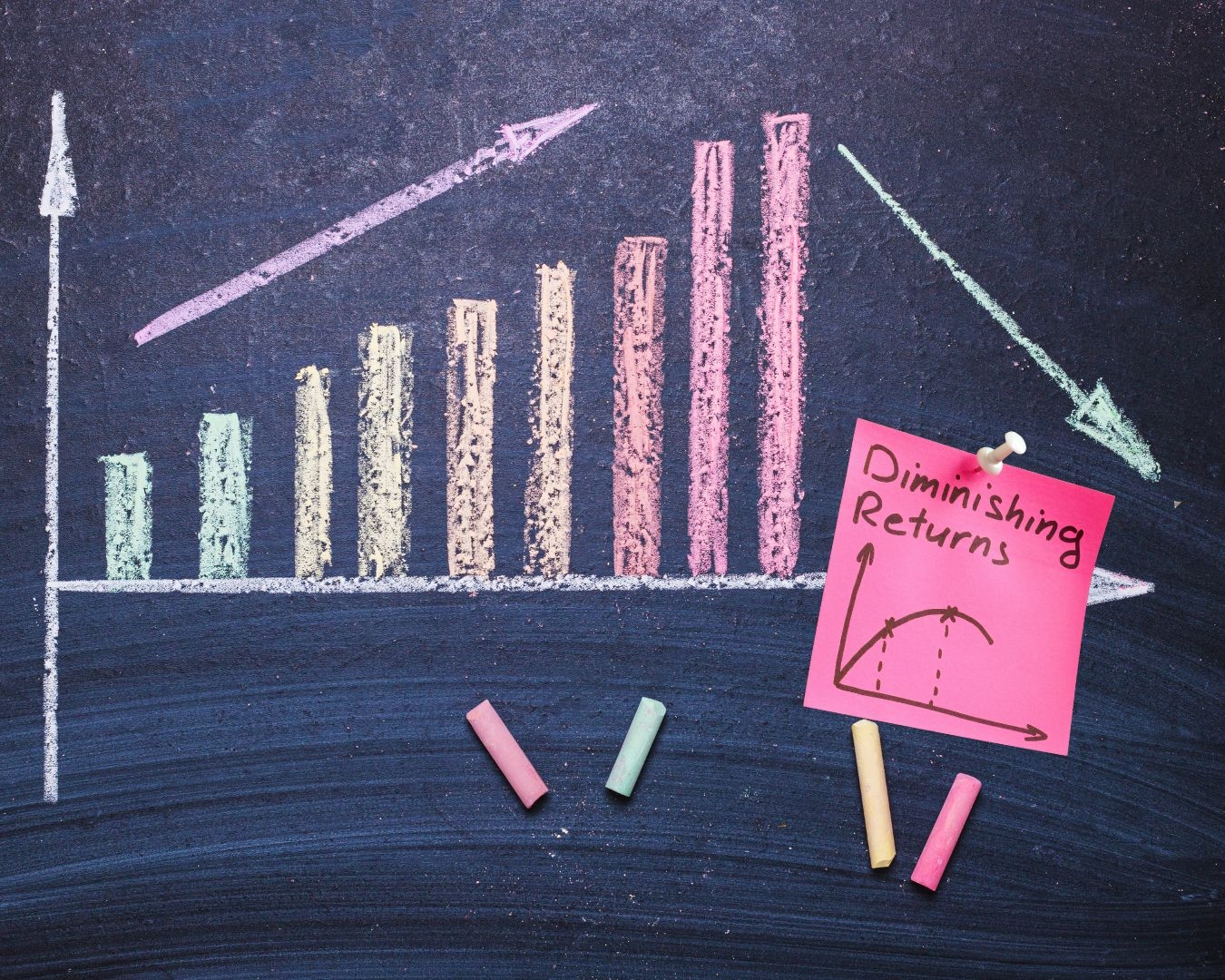
What Is the Law of Diminishing Returns?
The law of diminishing returns is a basic but powerful idea in economics. It explains why adding more and more of something—like workers, machines, or study time—does not always lead to equally large improvements in results. After a certain point, each additional unit of input produces a smaller increase in output than the one before it.
In simple terms: at first, extra effort helps a lot. Later, it still helps—but less and less.
This law shows up in business, farming, schoolwork, sports, and everyday life.
A simple definition
The law of diminishing returns states that when one input is increased while other inputs stay the same, the extra output gained from each new unit of that input will eventually decrease.
The key part is “while other inputs stay the same.”
For example, if a factory adds more workers but keeps the same building and machines, there will come a point when adding another worker makes only a small difference.
A classic example: farming
Imagine a small farm with a fixed amount of land.
At first, the farmer hires one worker. The harvest improves.
Then a second worker is hired. The harvest improves even more.
A third worker is hired. Output still increases.
So far, things look great.
But after several workers are already working on the same land, space becomes tight. Workers start waiting for tools, getting in each other’s way, and doing tasks that could already be done by someone else.
The harvest still goes up when a new worker is added—but not by as much as before.
That is diminishing returns.
What exactly is “diminishing”?
It is important to understand what the law does not say.
It does not say that total production goes down.
It says that the extra production from one more unit of input becomes smaller.
Economists call this extra production marginal product.
So the law really means:
The marginal product of an input eventually declines when more of that input is added to a fixed system.
For example:
-
First worker adds 10 extra units of output.
-
Second worker adds 8.
-
Third worker adds 5.
-
Fourth worker adds 2.
Output is still increasing—but at a slower rate each time.
Why does diminishing returns happen?
The main reason is limited supporting resources.
Most production needs a mix of things:
-
space
-
tools
-
machines
-
managers
-
time
If only one factor increases while the others stay fixed, that growing factor becomes less effective.
A few common reasons include:
1. Congestion and crowding
Too many people or resources trying to use the same tools or space create delays and inefficiency.
2. Specialization runs out
At first, adding workers allows people to specialize and work more efficiently. But once all the useful roles are filled, new workers cannot specialize in meaningful ways.
3. Coordination problems
More people often means more communication, supervision, and mistakes.
A school example: studying for a test
The law of diminishing returns also applies to studying.
Suppose you study for one hour and learn a lot.
The second hour helps too.
The third hour helps, but not as much.
By the sixth or seventh hour in a row, you are tired, distracted, and slow.
You are still learning something—but the extra benefit from each new hour is smaller.
This does not mean studying more is bad. It means that each additional hour is usually less productive than the earlier ones.
A business example: hiring more workers
Think about a small coffee shop with:
-
one counter
-
one espresso machine
-
a limited space behind the counter
At first:
-
One worker is overwhelmed.
-
A second worker dramatically improves service.
Later:
-
A third worker helps.
-
A fourth worker mostly waits or bumps into others.
The shop still produces more coffee, but the extra output created by the fourth worker is much lower than that created by the second.
The role of “fixed” and “variable” inputs
To really understand the law, you need to separate inputs into two types:
Fixed inputs
These cannot easily change in the short run, such as:
-
building size
-
major machines
-
land
Variable inputs
These can change more easily, such as:
-
labor hours
-
number of workers
-
raw materials
The law of diminishing returns applies when:
one or more variable inputs increase while at least one key input is fixed.
If the business expands its building and buys more machines, diminishing returns can be postponed or avoided for a while. But if it only adds workers, the problem shows up.
Diminishing returns versus decreasing returns to scale
These two ideas sound similar but are different.
Diminishing returns focus on:
-
increasing one input
-
while other inputs stay fixed
Returns to scale focus on:
-
increasing all inputs together
For example:
-
Adding more workers to the same small factory → diminishing returns.
-
Building a larger factory and hiring more workers at the same time → returns to scale.
So the law of diminishing returns is mainly a short-run idea, when at least one resource cannot be easily changed.
Can output ever start to fall?
Yes, it can—but that is not the core of the law.
In extreme cases, adding too much of one input can actually reduce total output. For example, too many cooks in a tiny kitchen might slow everything down so badly that fewer meals get made.
However, the law of diminishing returns does not require output to fall. It only requires the extra output to decline.
Why this law matters
The law of diminishing returns helps explain many real-world decisions.
For businesses
It shows why firms do not keep hiring endlessly without upgrading equipment or space. They need to balance workers, machines, and facilities.
For governments and planners
It helps explain why simply adding more staff or funding to a poorly structured system may produce only small improvements unless the system itself is redesigned.
For individuals
It explains why pushing harder and harder without changing your tools, strategy, or environment often leads to burnout instead of big gains.
A practical lesson
Here is the most useful takeaway:
If you keep adding more effort to the same setup and your progress slows down, the problem is often not your effort—it is the system.
Instead of asking,
“Should I just work more?”
a better question is,
“What new tool, structure, or resource would remove the bottleneck?”
That mindset—changing the fixed inputs instead of endlessly increasing the variable ones—is how people and organizations move past diminishing returns.
Conclusion
The law of diminishing returns states that when more of one input is added to a situation where other important inputs are fixed, the additional benefit from each new unit of that input will eventually shrink.
It appears in farming, factories, schools, sports, and daily life. It does not mean progress stops, and it does not mean effort is wasted. It simply means that without improving the underlying system, extra effort becomes less effective over time.
Understanding this law helps you make smarter choices about when to push harder—and when it is time to change the tools, environment, or strategy instead.
- Arts
- Business
- Computers
- Jogos
- Health
- Início
- Kids and Teens
- Money
- News
- Personal Development
- Recreation
- Regional
- Reference
- Science
- Shopping
- Society
- Sports
- Бизнес
- Деньги
- Дом
- Досуг
- Здоровье
- Игры
- Искусство
- Источники информации
- Компьютеры
- Личное развитие
- Наука
- Новости и СМИ
- Общество
- Покупки
- Спорт
- Страны и регионы
- World

 English
 Russian
 French
 Spanish
 Deutsch
 Turkish
 Dutch
Dutch
 Italiano
 Arabic
 Romaian
 Portuguese (Brazil)
 Greek
Greek