
What Are Ergonomic Office Supplies?
The first sign wasn’t pain.
That’s what surprised me.
It was irritability.
A low-grade, difficult-to-explain mental exhaustion that showed up around midafternoon every day while I worked at a desk I had carefully convinced myself was “fine.” My shoulders tightened constantly. I shifted positions every few minutes without noticing. Concentration shortened. Small interruptions felt disproportionately aggravating.
Then eventually came the wrist stiffness.
The neck tension.
The headaches.
Like many people, I treated discomfort as background noise for far too long because modern work quietly trains employees to normalize physical strain as professionalism. If you spend enough years hunched over laptops, answering emails from poorly adjusted chairs beneath terrible lighting, your body stops protesting dramatically and starts negotiating silently instead.
That negotiation becomes expensive.
Ergonomic office supplies exist to interrupt that cycle.
Not to create luxury.
Not to satisfy workplace aesthetics.
To reduce the physical friction that slowly drains attention, endurance, and cognitive clarity throughout the workday.
And despite how often ergonomics gets framed as corporate wellness theater, the effects are remarkably practical.
People think better when their bodies stop fighting their environments constantly.
Ergonomics Is About Energy Preservation
Not comfort alone.
That distinction matters.
A soft chair is not automatically ergonomic.
A sleek desk setup is not automatically healthy.
A standing desk is not automatically beneficial simply because productivity influencers post photos beside them holding suspiciously untouched green smoothies.
Ergonomics is the science of reducing unnecessary physical strain during repetitive activity.
In office environments, that usually means designing workspaces that minimize:
- Muscle tension
- Joint stress
- Eye fatigue
- Repetitive strain
- Poor posture compensation
The strongest ergonomic supplies don’t feel dramatic initially.
They feel quietly stabilizing.
That’s the point.
Why Modern Work Creates So Much Physical Strain
Because office work appears physically harmless while being biomechanically repetitive in ways humans weren’t really designed for.
Consider the average workday:
- Hours staring downward at screens
- Minimal movement variation
- Constant keyboard repetition
- Static seated positions
- Continuous visual focus at fixed distances
None of this looks strenuous externally.
But repetition changes the equation.
One awkward wrist angle repeated thousands of times daily becomes a problem eventually. One poorly positioned monitor creates neck compensation patterns employees barely notice until tension becomes chronic.
The body adapts impressively.
Then it invoices later.
The Core Ergonomic Office Supplies That Actually Matter
Some ergonomic tools genuinely improve long-term comfort and productivity.
Others mostly exist because workplace wellness became marketable.
Here’s the difference:
| Ergonomic Supply | Primary Benefit | Why It Matters | Common Mistake |
|---|---|---|---|
| Ergonomic Chair | Supports spinal alignment | Reduces fatigue and tension | Choosing appearance over adjustability |
| Monitor Stand | Elevates screen height | Prevents neck strain | Positioning monitors too low |
| Wrist Rest | Supports neutral wrist posture | Reduces repetitive strain | Using incorrect height |
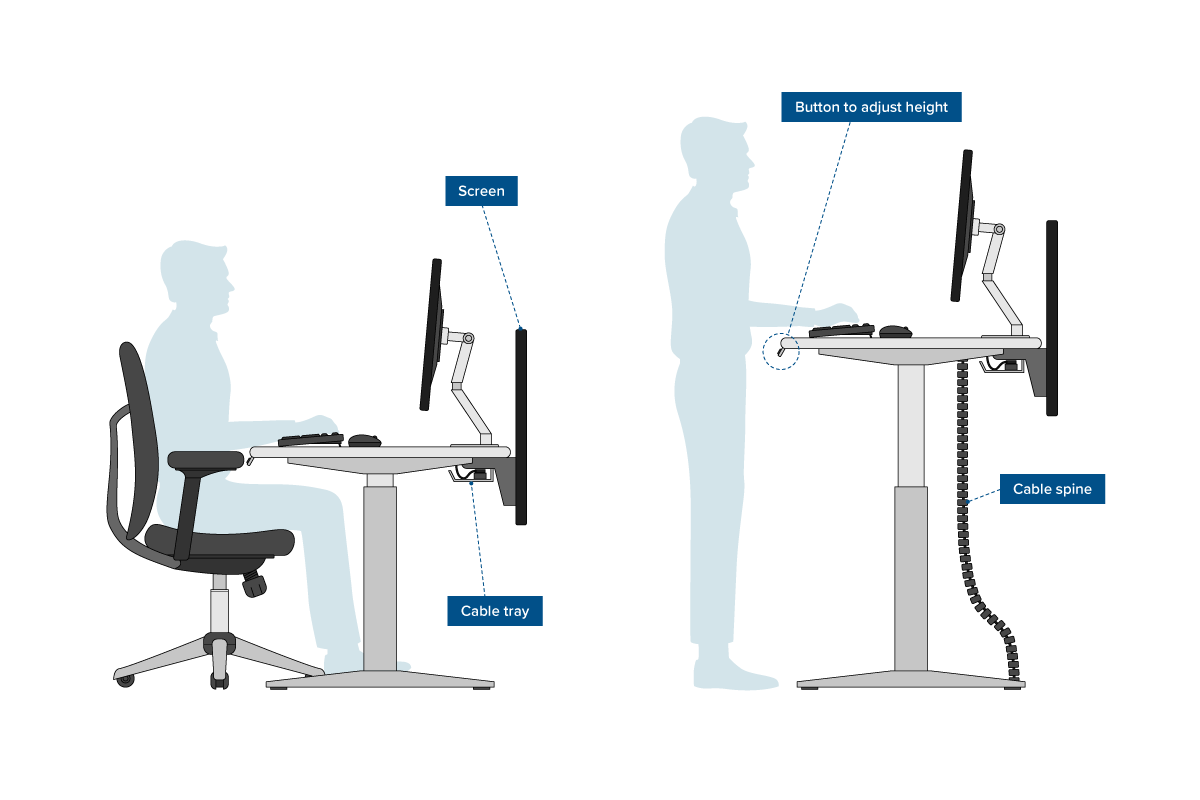
| Standing Desk | Encourages movement variation | Reduces static posture fatigue | Standing all day without balance |
| Ergonomic Keyboard | Reduces wrist deviation | Improves hand positioning | Ignoring typing habits entirely |
| Footrest | Improves seated posture | Supports circulation | Using fixed non-adjustable versions |
| Desk Lamp | Reduces eye fatigue | Improves visual comfort | Harsh glare positioning |
| Mouse Pad with Support | Reduces wrist pressure | Improves repetitive movement comfort | Over-relying without posture correction |
The strongest ergonomic systems work collectively.
No single product compensates for an unhealthy workstation entirely.
Ergonomic Chairs Matter More Than People Want to Admit
Mostly because people underestimate how exhausting physical instability becomes over time.
A poor chair creates continuous micro-adjustments:
shifting,
leaning,
compensating,
tensing.
The brain may focus on work consciously while the body spends hours managing discomfort in the background.
I learned this embarrassingly late.
For years, I worked from dining chairs, coffee shops, airport lounges, basically any flat surface pretending productivity mattered more than posture. Then during a brutal deadline-heavy project, I finally invested in a properly adjustable ergonomic chair.
The difference wasn’t immediate euphoria.
It was absence.
Less fidgeting.
Less lower-back tension.
Less cognitive fatigue by evening.
That’s how ergonomic improvements often reveal themselves:
through problems disappearing quietly.
Standing Desks Are Useful — But Also Slightly Misunderstood
Standing desks became strangely ideological for a while.
People talked about them as though standing automatically transformed workplaces into temples of vitality and focus.
Reality is more nuanced.
Standing desks help because they encourage movement variability.
That’s important.
Static positions become problematic whether seated or standing. The body responds best to variation:
sit,
stand,
shift,
move,
reset.
One company I visited installed standing desks across entire departments expecting dramatic productivity gains. Instead, many employees developed leg fatigue because nobody explained proper usage.
The desks weren’t the issue.
Rigidity was.
Ergonomics is not about replacing one fixed posture with another. It’s about reducing prolonged physical stress through adaptability.
Monitor Placement Quietly Shapes Cognitive Endurance
This sounds absurdly minor until you experience the difference.
A monitor positioned slightly too low encourages forward head posture all day long. Employees compensate unconsciously by tilting downward repeatedly for hours.
That posture compounds:
- Neck strain
- Shoulder tension
- Headaches
- Eye fatigue
Monitor stands solve a surprisingly large percentage of workstation discomfort simply by restoring neutral visual alignment.
One graphic designer described the experience perfectly after adjusting her setup:
“I didn’t realize how much energy I spent holding my body incorrectly.”
Exactly.
Bad ergonomics consume attention invisibly.
Ergonomic Keyboards Feel Strange Until They Don’t
Most people resist ergonomic keyboards initially because traditional keyboards feel familiar.
But familiarity and functionality are not identical.
Standard typing positions often force:
- Wrist bending
- Shoulder tension
- Repetitive compression patterns
Ergonomic keyboards attempt to reduce those stresses through more natural alignment.
Adaptation takes time though.
I remember switching reluctantly during a period of persistent wrist discomfort while writing heavily every day. The first week felt awkward. By the third week, traditional keyboards started feeling surprisingly cramped.
That transition taught me something useful:
people normalize inefficient physical habits remarkably fast.
Lighting Is an Ergonomic Issue Too
Ergonomics extends beyond posture.
Visual strain matters enormously.
Poor lighting creates:
- Squinting
- Eye fatigue
- Mental exhaustion
- Headaches
- Reduced concentration endurance
And modern offices often combine overhead fluorescent lighting with extended screen exposure, which creates its own subtle form of cognitive depletion.
Task lighting helps because it restores control over visual conditions.
Not brighter necessarily.
More balanced.
A properly positioned desk lamp can improve comfort dramatically simply by reducing glare and harsh contrast employees stop consciously noticing after prolonged exposure.
Why Remote Work Complicated Ergonomics
Home offices exposed how fragile many workplace setups actually were.
Suddenly employees worked from:
- Kitchen tables
- Sofas
- Beds
- Dining chairs
- Improvised laptop stations
Short-term convenience became long-term strain astonishingly quickly.
Organizations began recognizing ergonomic support wasn’t optional infrastructure confined to corporate offices anymore. Distributed work environments still produce physical consequences.
And unlike office spaces, home setups vary wildly in quality.
Some employees created excellent ergonomic environments.
Others worked eight-hour days from stools designed for thirty-minute breakfasts.
The body notices eventually.
Ergonomic Supplies Improve Productivity Indirectly
This is important.
Ergonomic tools rarely create productivity through stimulation.
They improve productivity by reducing physical distraction.
Less discomfort means:
- Longer focus windows
- Reduced fatigue
- Better concentration endurance
- Fewer posture interruptions
- Lower physical stress accumulation
The effects feel subtle daily.
Significant cumulatively.
That’s why ergonomics often gets undervalued financially. Companies expect dramatic short-term performance spikes when the real value appears gradually through consistency, reduced strain, and fewer attention disruptions over time.
The Most Common Ergonomic Mistake
Buying products without adjusting behavior.
An ergonomic chair doesn’t help much if:
- Monitor height remains terrible
- Breaks never happen
- Keyboard placement stays awkward
- Employees maintain unhealthy posture habits
Tools support movement patterns.
They don’t automatically replace them.
One consultant told me something years ago that stuck permanently:
“Ergonomics is a system, not a purchase.”
Exactly.
A Lesson I Learned From Wrist Pain
Several years ago, I ignored persistent wrist tension because the discomfort seemed manageable. I kept working longer hours assuming endurance mattered more than adjustment.
Eventually typing became painful enough to force change.
I restructured everything:
keyboard angle,
chair height,
monitor position,
desk lighting,
scheduled movement breaks.
The improvement arrived slowly, then all at once.
And the strangest part?
My concentration improved too.
I hadn’t realized how much mental bandwidth physical discomfort had been consuming quietly in the background every single day.
That experience permanently changed how I view ergonomic supplies.
They are not luxury items.
They are cognitive support systems disguised as furniture.
The Future of Ergonomic Office Supplies
Workplaces are gradually shifting toward more adaptive environments:
- Adjustable desks
- Dynamic seating
- Flexible monitor systems
- Portable ergonomic accessories
- Hybrid workspace support
Not because employees became fragile.
Because organizations finally started acknowledging that repetitive strain carries operational costs:
fatigue,
burnout,
reduced focus,
absenteeism,
physical injury.
Bodies influence productivity whether companies measure it directly or not.
Ergonomics Is Really About Respecting Human Limits
That’s the deeper truth underneath all this.
Modern work often treats human bodies like passive delivery systems for cognitive labor. Sit still. Stay productive. Ignore discomfort. Continue performing.
But attention, focus, and endurance are physical experiences too.
The body participates in every spreadsheet, every meeting, every deadline, every strategic decision.
Ergonomic office supplies matter because they recognize something workplaces ignored for too long:
physical friction accumulates psychologically.
And once you experience a workspace designed to reduce that friction properly, it becomes surprisingly difficult to tolerate environments that constantly demand unnecessary physical compensation.
The body remembers efficiency.
Even when the office forgets it.
- Arts
- Business
- Computers
- Spiele
- Health
- Startseite
- Kids and Teens
- Geld
- News
- Personal Development
- Recreation
- Regional
- Reference
- Science
- Shopping
- Society
- Sports
- Бизнес
- Деньги
- Дом
- Досуг
- Здоровье
- Игры
- Искусство
- Источники информации
- Компьютеры
- Личное развитие
- Наука
- Новости и СМИ
- Общество
- Покупки
- Спорт
- Страны и регионы
- World

 English
 Russian
 French
 Spanish
 Portuguese
 Turkish
 Dutch
Dutch
 Italiano
 Arabic
 Romaian
 Portuguese (Brazil)
 Greek
Greek