
What Are the Most Common Business Models?
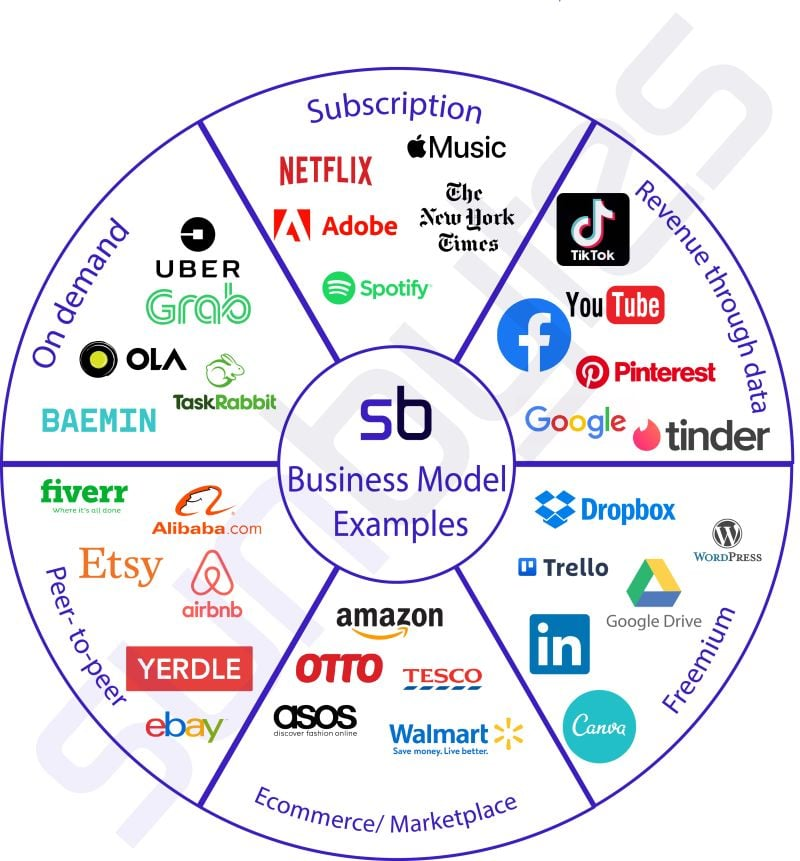
Every business eventually confronts the same unforgiving question.
Not during launch week, when optimism hangs thick in the conference room air like expensive perfume. Not during investor presentations filled with upward-trending graphs and carefully rehearsed certainty.
Later.
Usually when cash flow tightens, growth slows, or operational stress exposes weaknesses nobody wanted to discuss publicly.
That question is deceptively simple:
How does this company actually make money sustainably?
The answer is the business model.
And while entrepreneurial culture often celebrates originality with near-religious intensity, most successful companies operate within a surprisingly familiar set of structures. The mechanics vary. The branding changes. The technology evolves. Yet the underlying models repeat across industries because certain economic frameworks consistently survive reality better than others.
I learned this while advising a founder who insisted his startup had “reinvented commerce.” The presentation deck used words like revolutionary, category-defining, and paradigm-shifting with exhausting frequency.
After two hours, I asked him one question:
“So it’s essentially a subscription marketplace with transaction fees?”
He paused.
Looked mildly offended.
Then admitted that, yes, structurally speaking, it was.
This is not criticism. Quite the opposite.
Understanding common business models is valuable precisely because it removes the illusion that success depends on inventing economic physics from scratch. Most enduring companies succeed because they execute familiar models with unusual discipline.
And discipline scales better than hype.
What Is a Business Model?
At its core, a business model explains:
- How a company creates value
- Who pays for that value
- How revenue is generated
- What costs sustain operations
- Why the economics remain viable over time
The business model is the structural logic beneath the company.
Products attract customers.
Business models determine whether the organization survives long enough to matter.
Some models produce predictable recurring revenue. Others prioritize transaction volume, network effects, licensing opportunities, or audience monetization. Each carries advantages, vulnerabilities, and behavioral consequences.
Understanding the most common models reveals something important:
Businesses rarely fail because the model category itself is flawed.
They fail because execution and economics become misaligned.
The Most Common Business Models
Subscription Business Model
The subscription model has become one of the dominant structures in modern commerce.
Customers pay recurring fees—monthly, quarterly, annually—in exchange for continued access to products or services.
Examples include:
- Streaming services
- Software platforms
- Membership programs
- Digital publications
- Fitness apps
Why It Became So Popular
Recurring revenue creates predictability.
Predictability stabilizes:
- Hiring
- Forecasting
- Product development
- Investor confidence
- Expansion planning
A customer paying monthly is economically more valuable than one requiring reacquisition repeatedly.
The Structural Risk
Subscriptions create constant pressure to justify recurring payment psychologically.
Consumers increasingly audit recurring expenses aggressively. If the perceived value weakens, cancellations happen quickly.
A subscription business survives only while relevance remains continuous.
Transaction-Based Business Model
This is among the oldest and most recognizable business structures.
Customers purchase individual products or services. Revenue occurs one transaction at a time.
Retail stores, restaurants, airlines, hotels, consultants, and manufacturers commonly operate this way.
Strengths
- Simple pricing
- Immediate revenue realization
- Clear customer expectations
Weaknesses
Revenue becomes highly dependent on ongoing customer activity.
If demand slows, cash flow reacts almost immediately.
This model rewards operational discipline because every transaction must remain profitable independently.
Freemium Business Model
The freemium model offers basic services at no cost while charging for premium features or enhanced functionality.
Mobile apps, software companies, productivity tools, and gaming platforms frequently use this structure.
Why Companies Use It
Removing payment barriers accelerates adoption.
Users experiment freely without financial commitment, which often drives rapid audience growth.
The Hidden Problem
Most free users never convert into paying customers.
This creates a dangerous imbalance when infrastructure costs scale faster than monetization.
I once reviewed a startup whose user numbers looked spectacular publicly. Internally, however, the conversion rate remained below 2%.
The company was subsidizing massive usage without sufficient revenue support.
Growth became expensive theater.
Marketplace Business Model
Marketplaces connect buyers and sellers while earning commissions from transactions.
Examples include:
- Ride-sharing platforms
- Freelance marketplaces
- Real estate listing services
- E-commerce exchanges
Why This Model Is Powerful
Successful marketplaces generate network effects.
More buyers attract more sellers.
More sellers attract more buyers.
That cycle creates momentum competitors struggle to replicate.
Why It Is Difficult Initially
Early-stage marketplaces often feel empty.
Without sufficient participants on both sides, value remains weak. Solving this liquidity problem requires careful strategic sequencing.
Marketplace businesses are extraordinarily attractive once scale emerges—but notoriously difficult to launch effectively.
Advertising Business Model
This structure monetizes audience attention rather than direct customer payments.
Media outlets, search engines, podcasts, video platforms, and social networks often depend heavily on advertising revenue.
Benefits
Consumers receive free access.
This dramatically lowers barriers to adoption.
Tradeoffs
Advertisers become the paying customers.
That changes incentives profoundly.
Businesses relying heavily on advertising often optimize for:
- Engagement
- Visibility
- Attention duration
- Traffic volume
Sometimes at the expense of user well-being or informational quality.
Business models shape behavior more than public mission statements usually do.
Franchise Business Model
Franchising allows independent operators to replicate an established business system under a shared brand identity.
Fast-food chains perfected this model, though hospitality, education, fitness, and retail industries use it extensively.
Advantages
- Rapid geographic expansion
- Lower corporate operational burden
- Shared financial risk
Challenges
Brand consistency becomes difficult across multiple operators.
One poorly managed location can damage public perception broadly.
Franchising succeeds when systems become replicable with remarkable precision.
Licensing Business Model
Licensing monetizes intellectual property by allowing others to use it legally in exchange for fees or royalties.
Examples include:
- Software licensing
- Brand licensing
- Entertainment rights
- Patent agreements
Why It Works
The company profits from ownership rather than direct operational execution.
This often creates high-margin revenue with reduced operational complexity.
Risks
Licensing models depend heavily on maintaining intellectual property relevance and perceived value.
Once the brand weakens, licensing leverage deteriorates quickly.
Razor-and-Blade Business Model
This model sells a primary product at low cost while generating recurring profits from complementary purchases.
Examples include:
- Razors and replacement blades
- Printers and ink cartridges
- Coffee machines and pods
Structural Advantage
Low initial pricing encourages adoption.
Recurring purchases generate long-term profitability.
Consumer Resistance
Customers increasingly recognize ecosystem dependency. When replacement costs feel exploitative, loyalty erodes rapidly.
The balance between convenience and resentment matters enormously here.
Comparison Table: Most Common Business Models
| Business Model | Primary Revenue Source | Key Advantage | Main Risk | Common Industries |
|---|---|---|---|---|
| Subscription | Recurring fees | Predictable income | Customer churn | SaaS, streaming |
| Transaction-Based | Individual sales | Simplicity | Revenue volatility | Retail, hospitality |
| Freemium | Premium upgrades | Rapid growth | Weak conversion rates | Apps, gaming |
| Marketplace | Transaction commissions | Network effects | Liquidity challenges | E-commerce, gig economy |
| Advertising | Ad placements | Free user access | Attention dependency | Media, publishing |
| Franchise | Franchise fees | Fast expansion | Quality inconsistency | Restaurants, fitness |
| Licensing | Royalties and fees | High margins | Brand dependency | Technology, entertainment |
| Razor-and-Blade | Consumable repeat sales | Recurring purchases | Consumer fatigue | Consumer goods |
Why Some Business Models Survive Longer Than Others
Because some structures absorb pressure better.
A successful business model must withstand:
- Economic downturns
- Competitive imitation
- Rising operational costs
- Changing customer behavior
- Technological disruption
Models dependent entirely on perpetual growth often become fragile quickly when market conditions tighten.
By contrast, businesses with strong margins, customer retention, operational leverage, and defensible positioning usually maintain greater resilience.
This is why investors obsess over recurring revenue and retention metrics so intensely.
They are evaluating survivability.
Not excitement.
Hybrid Business Models Are Increasingly Common
Many modern companies combine multiple structures simultaneously.
For example:
- Media companies blend subscriptions and advertising
- Software firms combine freemium acquisition with enterprise licensing
- Retail brands integrate transaction sales with memberships
Diversification can reduce dependence on a single revenue stream.
Yet hybridization introduces complexity.
Operational confusion emerges when incentives conflict internally.
I once worked with a media company attempting to maximize subscription loyalty while simultaneously increasing intrusive advertising aggressively.
Predictably, subscribers became irritated.
Leadership had built two monetization systems working against one another psychologically.
Hybrid models require exceptional alignment to function effectively.
The Most Important Lesson About Business Models
Most businesses are not destroyed by lack of ambition.
They are damaged by structural incoherence.
A business model must align:
- Customer expectations
- Revenue generation
- Operational capacity
- Scalability
- Incentives
When these elements reinforce one another, businesses develop resilience.
When they conflict, instability spreads quietly through the organization.
That instability may remain hidden during growth phases.
Eventually it surfaces.
Usually all at once.
Conclusion: Common Does Not Mean Weak
There is a tendency among entrepreneurs to romanticize originality.
Yet many of the world’s strongest companies operate using remarkably familiar business models. Their advantage does not come from inventing entirely new structures.
It comes from executing proven structures with unusual clarity and discipline.
A successful business model is not judged by how innovative it sounds during presentations.
It is judged by whether the economics remain durable under pressure.
Can the company retain customers?
Protect margins?
Scale intelligently?
Adapt without panic?
Survive volatility?
That is the real examination.
Because eventually every business confronts the same moment when optimism fades and reality begins asking harder questions.
At that point, the business model becomes impossible to hide behind branding, momentum, or excitement.
And the strongest models rarely need dramatic language to prove their value.
- Arts
- Business
- Computers
- Jogos
- Health
- Início
- Kids and Teens
- Money
- News
- Personal Development
- Recreation
- Regional
- Reference
- Science
- Shopping
- Society
- Sports
- Бизнес
- Деньги
- Дом
- Досуг
- Здоровье
- Игры
- Искусство
- Источники информации
- Компьютеры
- Личное развитие
- Наука
- Новости и СМИ
- Общество
- Покупки
- Спорт
- Страны и регионы
- World

 English
 Russian
 French
 Spanish
 Portuguese
 Deutsch
 Turkish
 Dutch
Dutch
 Italiano
 Arabic
 Romaian
 Greek
Greek