
What Are Scalable Business Models?
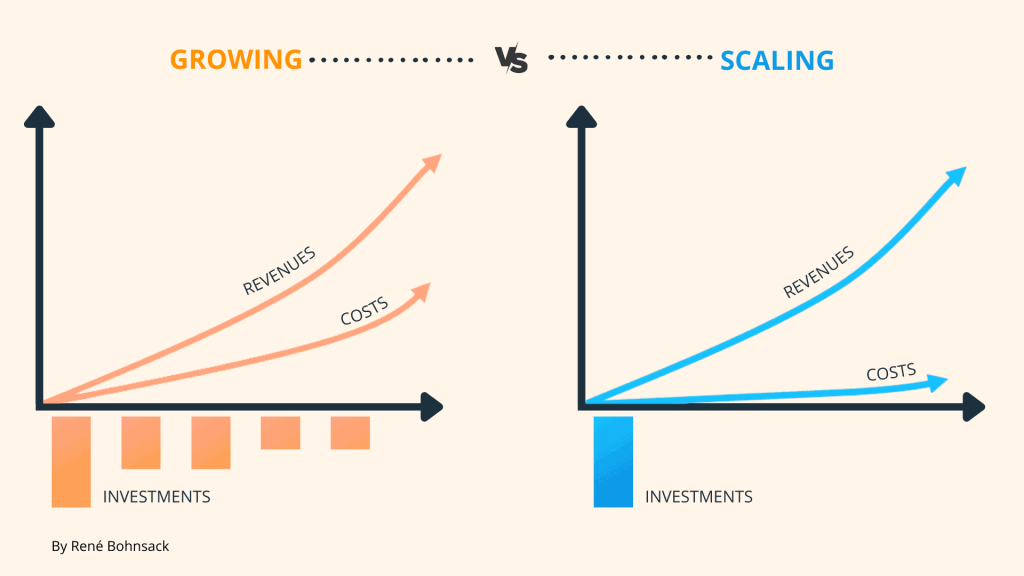
A scalable business model is not a business that grows fast. That misunderstanding has launched more doomed ventures than weak cash flow ever did.
Growth, by itself, is noisy. Scale is mathematical.
A scalable company expands revenue without carrying a matching increase in cost, labor, or operational complexity. The ratio matters. If revenue doubles while expenses crawl upward at a much slower pace, the model has elasticity. If every new customer demands another hire, another warehouse, another sleepless manager, then the business may be growing — but it is not scaling.
That distinction sounds clinical until you sit inside a company trying to outrun its own infrastructure.
Years ago, I consulted for a boutique logistics firm that had become the darling of its region. Orders surged. Clients multiplied. The founder spoke breathlessly about expansion into three neighboring states. On paper, it looked triumphant. Behind the scenes, dispatchers were sleeping in shifts on office couches, invoices were manually corrected at midnight, and customer complaints arrived faster than trucks.
Revenue climbed 41% in a single year.
Profit fell.
The business had confused momentum with scalability. It had built a machine that required more human strain every time it accelerated. Watching that unfold permanently changed the way I evaluate companies.
The market rewards scale because scale compounds. But scalable businesses are not assembled from ambition alone. They are engineered.
The Architecture of Scalability
At its core, scalability is about leverage.
Not financial leverage. Operational leverage.
A scalable business extracts increasing output from systems that do not need to expand proportionally with demand. Software companies understood this earlier than most industries. Once the product exists, distributing it to an additional customer often costs pennies. The infrastructure absorbs growth more gracefully than labor-intensive enterprises.
That does not mean scalability belongs exclusively to Silicon Valley. Some of the most scalable businesses in America are hidden in plain sight: subscription education firms, licensing companies, franchise systems, cloud accounting services, payment processors, and digital marketplaces.
What unites them is not industry. It is structural efficiency.
Four Hallmarks of a Scalable Business Model
1. Low Marginal Costs
Marginal cost refers to the expense required to serve one additional customer.
In a scalable model, that cost remains relatively small as demand rises.
A streaming platform can add millions of subscribers without building millions of new physical products. A consulting firm, by contrast, often needs more consultants for more clients. That creates a labor ceiling.
2. Repeatable Processes
Scalable businesses remove improvisation wherever possible.
The founder’s genius cannot remain the operating system forever. Processes must become standardized, documented, measurable, and transferable. Otherwise growth produces chaos rather than efficiency.
McDonald’s did not conquer global markets because hamburgers were revolutionary. It scaled because operations became replicable.
3. Automation and Technology
Technology is not automatically scalable. Plenty of expensive software creates little more than digital clutter. But effective automation reduces dependence on manual intervention.
Customer onboarding, billing, inventory management, support workflows, analytics — these functions become increasingly critical as volume rises.
Scalable businesses automate selectively and ruthlessly.
4. Recurring Revenue
Predictable income stabilizes expansion.
Subscription models, retainers, memberships, and licensing agreements create recurring cash flow that allows businesses to forecast growth with greater precision. Investors favor these structures because they reduce volatility.
One-time transactions create spikes. Recurring revenue creates continuity.
Scalable vs. Non-Scalable Business Models
The contrast becomes clearer when examined side by side.
| Business Model | Revenue Growth Potential | Cost Increase with Growth | Scalability Rating | Key Constraint |
|---|---|---|---|---|
| SaaS Platform | Extremely High | Low | High | Customer retention |
| E-commerce Marketplace | High | Moderate | High | Logistics complexity |
| Traditional Law Firm | Moderate | High | Low | Billable-hour dependency |
| Franchise Restaurant Chain | High | Moderate | Medium-High | Operational consistency |
| Online Course Business | Extremely High | Very Low | Very High | Market saturation |
| Manufacturing Plant | Moderate-High | High | Medium | Capital expenditures |
| Freelance Consulting | Limited | Directly proportional | Low | Founder capacity |
| Subscription Media Company | High | Low-Moderate | High | Content quality |
Notice the pattern. The least scalable businesses rely heavily on human hours as the primary unit of production. The most scalable models detach revenue from individual labor.
That separation changes everything.
Why Investors Obsess Over Scalability
Because scalable businesses possess asymmetry.
The upside expands faster than the downside.
This explains why venture capital firms aggressively pursue software startups while often ignoring otherwise profitable local businesses. A successful neighborhood bakery may generate healthy income for decades, but its growth curve remains geographically constrained. A cloud-based payroll platform can expand globally with far fewer physical limitations.
Scalability also influences valuation.
Investors pay premiums for companies capable of exponential revenue expansion because future earnings appear less tethered to operational costs. The promise is not simply higher revenue. It is widening margins over time.
That promise, however, is frequently exaggerated.
Many founders market “scalability” when what they really possess is temporary demand.
Those are not the same thing.
The Most Common Scalability Illusions
Entrepreneurs routinely mistake certain conditions for scalable infrastructure.
High Demand
Demand validates interest. It does not validate operational sustainability.
A bakery with lines around the block still faces physical production limits. Demand without scalable systems often produces burnout rather than profitability.
Social Media Visibility
Attention scales faster than execution.
A viral brand can collapse under fulfillment failures, weak supply chains, or customer service bottlenecks. Visibility accelerates pressure points. It does not solve them.
Hiring More People
This is perhaps the most dangerous illusion of all.
Adding employees can increase capacity, but labor-heavy expansion introduces coordination costs, training demands, managerial complexity, and cultural instability. Growth through hiring alone eventually creates diminishing returns.
At a certain point, organizations become slower precisely because they became larger.
Industries Built for Scalability
Some sectors naturally lend themselves to scalable economics.
Software-as-a-Service (SaaS)
SaaS remains the archetype because products can be distributed digitally at minimal incremental cost. Subscription pricing also creates recurring revenue.
Examples include project management tools, accounting software, CRM platforms, and cybersecurity services.
Digital Education
Online learning businesses can sell the same course thousands of times without reproducing physical inventory. Margins become attractive once audience acquisition stabilizes.
That said, competition is fierce and customer trust is fragile.
Marketplaces
Marketplaces scale by facilitating transactions between buyers and sellers while owning relatively little inventory themselves.
Think of ride-sharing platforms, freelance exchanges, or accommodation marketplaces. The platform benefits as network effects strengthen.
Licensing and Intellectual Property
Music catalogs, patented technologies, publishing rights, and licensing agreements create revenue streams detached from continuous labor.
A well-positioned intellectual property portfolio can generate income for decades.
The Human Cost of Scaling
This part receives less attention because it complicates the mythology.
Scalability changes organizations culturally, not merely financially.
Founders who thrive in early-stage improvisation sometimes struggle once systems replace instinct. Employees who loved intimacy may resent standardization. Customers may perceive efficiency as impersonality.
I once interviewed the founder of a rapidly expanding specialty retail chain who admitted something striking after opening the company’s 80th location.
“We became excellent at growth,” he said, “and mediocre at recognition.”
He meant recognition in the human sense. Managers no longer knew staff personally. Customers became metrics. Decision-making centralized. The company had scaled operationally while thinning emotionally.
That tradeoff appears more often than executives admit publicly.
A scalable business is not inherently a better business. It is simply a business capable of multiplying output efficiently. Whether that multiplication preserves quality, culture, and integrity depends entirely on leadership.
Can Small Businesses Be Scalable?
Absolutely.
Scalability is not reserved for billion-dollar corporations.
A small accounting firm that develops standardized systems, automates workflows, and introduces subscription advisory services may scale more effectively than a much larger competitor drowning in inefficiency.
Likewise, a niche e-commerce brand with disciplined supply-chain management can scale faster than a sprawling retailer burdened by excessive overhead.
Scale begins with structure, not size.
That distinction matters because entrepreneurs often delay system-building until after growth arrives. By then, the business already operates under stress.
Scalable companies prepare for expansion before expansion appears.
Questions Every Founder Should Ask
Before pursuing aggressive growth, leaders should examine several uncomfortable questions:
- Does each new customer significantly increase operational strain?
- Can revenue grow without hiring proportionally?
- Are processes documented and repeatable?
- Does the business rely excessively on one individual?
- Is customer acquisition cost sustainable?
- Can infrastructure absorb sudden demand spikes?
- Does growth improve margins or compress them?
Those answers reveal more about scalability than investor presentations ever will.
The Economics Behind True Scale
Economists often describe scalability through economies of scale — the cost advantages companies gain as production expands.
But the modern version extends beyond manufacturing.
Data compounds. Automation compounds. Distribution networks compound. Brand recognition compounds.
Amazon did not become dominant merely because it sold products online. Its logistics infrastructure, cloud computing division, customer data ecosystem, and marketplace structure created layered scalability. One system strengthened another.
That interconnectedness is what modern businesses chase relentlessly.
Yet scale can also produce fragility.
Overextended supply chains, bloated corporate layers, cybersecurity vulnerabilities, and regulatory scrutiny frequently emerge alongside massive expansion. The larger the system, the harder it becomes to pivot quickly.
Scalability creates power. It also creates inertia.
The Future of Scalable Models
Artificial intelligence will almost certainly widen the gap between scalable and non-scalable enterprises.
Businesses capable of automating analysis, customer support, logistics forecasting, and personalization will operate with dramatically different cost structures than firms relying entirely on manual labor.
But technology alone will not guarantee scale.
Consumers still reward trust, clarity, reliability, and emotional resonance. Companies that automate themselves into coldness may discover efficiency has limits.
The future likely belongs to businesses that combine scalable infrastructure with highly intentional human experience.
That balance is difficult. Which is precisely why it matters.
Conclusion: Scale Is a Design Decision
The language around entrepreneurship often glorifies growth as if expansion itself proves excellence.
It does not.
A business can grow rapidly while becoming weaker underneath. It can accumulate customers while bleeding operational discipline. It can look impressive from a distance while exhausting everyone inside it.
Scalability is different.
It is deliberate. Structural. Often unglamorous in the beginning.
The companies that scale successfully usually spend years refining systems nobody notices: onboarding flows, supply chains, billing architecture, process documentation, customer retention models. The public sees the acceleration phase. Rarely the engineering beneath it.
That is the uncomfortable truth many founders resist.
Scale is not charisma multiplied.
It is complexity reduced.
- Arts
- Business
- Computers
- Jogos
- Health
- Início
- Kids and Teens
- Money
- News
- Personal Development
- Recreation
- Regional
- Reference
- Science
- Shopping
- Society
- Sports
- Бизнес
- Деньги
- Дом
- Досуг
- Здоровье
- Игры
- Искусство
- Источники информации
- Компьютеры
- Личное развитие
- Наука
- Новости и СМИ
- Общество
- Покупки
- Спорт
- Страны и регионы
- World

 English
 Russian
 French
 Spanish
 Portuguese
 Deutsch
 Turkish
 Dutch
Dutch
 Italiano
 Arabic
 Romaian
 Greek
Greek
