
How to build good habits?
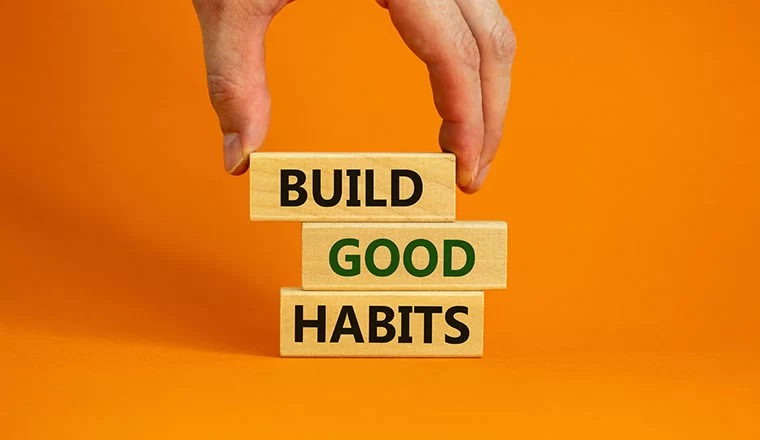
How to Build Good Habits?
Most people approach habit building like a motivation problem.
They assume the issue is effort:
-
not enough discipline
-
not enough consistency
-
not enough willpower
So they try to fix behavior with intensity. Bigger goals. Stricter rules. More pressure.
It works briefly.
Then it collapses.
That pattern repeats because habit formation is not primarily an intensity problem. It is a systems problem. Specifically, it is about designing conditions where the desired behavior becomes the path of least resistance.
Good habits are not built by forcing behavior.
They are built by engineering repetition.
Start With the Real Unit of Change: Repetition, Not Outcome
A common mistake is anchoring habits to outcomes:
-
“I will get fit”
-
“I will be productive”
-
“I will read more”
But outcomes are lagging indicators. They do not tell the brain what to do today.
The brain learns from repetition, not aspiration.
So the real question becomes:
What behavior can I repeat consistently under real conditions?
Not:
What result do I want?
This shift matters because habits form through repeated execution, not desired identity.
Make the Cue Obvious
Every habit starts with a cue—something that triggers the behavior.
If the cue is unclear, the habit will not stabilize.
Good habit design makes cues:
-
visible
-
predictable
-
stable
Examples:
-
placing a book on your pillow (cue → reading)
-
leaving running shoes by the door (cue → exercise)
-
opening a specific document each morning (cue → writing)
The brain responds strongly to environmental triggers because they reduce decision-making.
If you want a habit to form, you must reduce ambiguity in initiation.
No cue means no automaticity.
Reduce Friction Until Action Is Almost Inevitable
Friction is the silent killer of habits.
Even small obstacles matter:
-
needing to search for materials
-
unclear starting steps
-
switching contexts
-
decision overhead
Each additional step increases the probability of delay.
Good habit formation removes friction before it appears.
This means:
-
preparing tools in advance
-
simplifying the first action
-
removing decision points
-
making the environment support the behavior
If a habit requires motivation to start, it is too complex for early formation.
The goal is not effortlessness forever.
The goal is effortlessness at initiation.
Make the Habit Small Enough to Not Fail
One of the most effective principles in behavioral science is scaling down the initial behavior until resistance is minimal.
Not “read for an hour.”
Instead:
-
read one page
-
do one push-up
-
write one sentence
-
study for two minutes
This is not about staying small forever.
It is about ensuring repetition happens even on low-energy days.
Habits are formed through consistency of initiation, not intensity of execution.
Once repetition stabilizes, scaling becomes natural.
Without repetition, scaling never matters.
Attach the Habit to an Existing Routine
The brain learns sequences better than isolated actions.
This is why habit stacking works: new behaviors attach to existing ones.
Examples:
-
after brushing teeth → meditate
-
after coffee → review tasks
-
after sitting at desk → start writing
The structure becomes:
\text{Existing Habit} \rightarrow \text{New Habit}
This works because the cue is already stabilized.
You are not creating a new trigger from scratch—you are piggybacking on one that already exists.
Make the Reward Immediate (Even If Artificially)
The brain prioritizes immediate reinforcement.
Long-term benefits are cognitively weak drivers during early habit formation.
So good habits need immediate reward signals such as:
-
checking off a list
-
small visual progress tracking
-
short-term satisfaction rituals
-
positive self-feedback
Without immediate reinforcement, the brain struggles to link action with outcome.
This is why many good habits fail early: the reward is real but delayed.
The solution is not to change the habit, but to add a near-term feedback signal.
Focus on Identity, Not Just Behavior
Behavior sticks more reliably when it aligns with identity.
Instead of:
-
“I want to read more”
Shift toward:
-
“I am someone who reads daily”
This matters because identity creates consistency pressure.
The brain prefers coherence:
-
if you see yourself as someone who exercises, skipping feels inconsistent
-
if you see yourself as a writer, writing becomes expected
Identity does not replace behavior. It stabilizes it.
But identity only changes through repeated action. It is a feedback loop, not a declaration.
Expect Resistance Early On
New habits rarely feel natural at the beginning.
There is a reason for this: existing neural pathways are still dominant.
Early-stage habit formation often includes:
-
friction
-
forgetfulness
-
inconsistency
-
low motivation
This is not failure. It is transition.
The brain is still deciding whether the behavior is worth automating.
Most habits fail during this phase because people interpret normal resistance as a signal to stop.
In reality, resistance is part of the stabilization process.
Track Repetition, Not Perfection
Perfection is not a requirement for habit formation.
Consistency is.
A habit does not require flawless execution. It requires repeated exposure over time.
Tracking should focus on:
-
“Did I do it today?”
not -
“Did I do it perfectly?”
This matters because the brain learns from repetition frequency, not execution quality during early formation.
Missing once does not break a habit.
Missing repeatedly without recovery does.
Design for Low-Energy Versions of Yourself
Most habit plans assume ideal conditions:
-
high motivation
-
stable focus
-
available time
-
emotional clarity
Real life does not operate in ideal conditions.
Good habit design anticipates low-energy states:
-
tired days
-
stressful days
-
distracted days
This is where “minimum viable habits” matter.
If the smallest version of the habit is still possible, the habit survives variability.
If it requires ideal conditions, it collapses under normal life fluctuations.
Environment Is More Powerful Than Willpower
Habits are strongly context-driven.
This means environment often determines behavior more than intention.
If you want a habit to form:
-
make it visible
-
make it accessible
-
make it unavoidable
If you want to break a habit:
-
increase friction
-
remove cues
-
disrupt context
Behavior follows environment because the brain treats environmental signals as reliable predictors.
Willpower is temporary. Environment is constant.
A Personal Observation About Habit Building
For a long time, I tried building habits through structured discipline.
Detailed plans. Strict schedules. High expectations.
The problem was not effort—it was dependence on effort.
When motivation dipped, the system collapsed.
What eventually changed the outcome was redesigning behavior so that initiation required almost no negotiation.
Not more discipline. Less friction.
Once repetition became easier than avoidance, consistency stopped feeling like a decision and started feeling like a default.
That shift is where habits actually begin to form—not in moments of motivation, but in environments where action is easier than inaction.
The Real Mechanism Behind Good Habit Formation
At a structural level, building good habits is about aligning four variables:
-
clear cue
-
low friction
-
immediate reinforcement
-
repeated execution
\text{Cue + Low Friction + Immediate Reward + Repetition} \rightarrow \text{Habit Formation}
When these conditions align, the brain gradually shifts behavior from conscious effort to automatic execution.
That is the transition point.
Not inspiration.
Not discipline.
But repetition under favorable conditions.
Conclusion: Good Habits Are Engineered, Not Forced
Good habits are not the product of willpower spikes.
They are the result of system design.
They form when behavior becomes:
-
obvious enough to trigger
-
simple enough to start
-
rewarding enough to repeat
-
stable enough to maintain
Once those conditions are in place, the brain begins doing what it is designed to do: conserve energy by automating repetition.
The goal is not to fight the brain.
It is to arrange conditions where the desired behavior becomes the easiest available option.
And once that happens consistently, the habit stops feeling like effort at all.
It simply becomes what happens next.
- Arts
- Business
- Computers
- Παιχνίδια
- Health
- Κεντρική Σελίδα
- Kids and Teens
- Money
- News
- Personal Development
- Recreation
- Regional
- Reference
- Science
- Shopping
- Society
- Sports
- Бизнес
- Деньги
- Дом
- Досуг
- Здоровье
- Игры
- Искусство
- Источники информации
- Компьютеры
- Личное развитие
- Наука
- Новости и СМИ
- Общество
- Покупки
- Спорт
- Страны и регионы
- World

 English
 Russian
 French
 Spanish
 Portuguese
 Deutsch
 Turkish
 Dutch
Dutch
 Italiano
 Arabic
 Romaian
 Portuguese (Brazil)
