
How to remove bad habits?
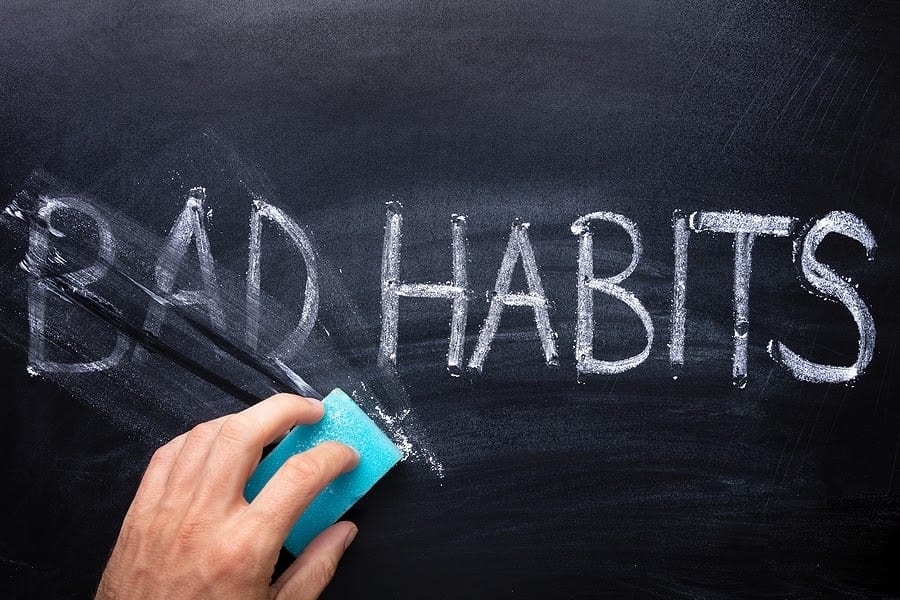
How to Remove Bad Habits?
Bad habits are rarely as “stubborn” as they appear.
What looks like persistence is usually just repetition under favorable conditions—conditions that quietly keep reinforcing the behavior.
That distinction matters.
Because it shifts the problem from:
“How do I force myself to stop?”
to:
“What is repeatedly making this behavior easy to start again?”
Most attempts to remove bad habits fail because they target the wrong layer. They focus on suppression instead of structure, willpower instead of environment, and awareness instead of system design.
If a habit keeps returning, it is not because you are failing to resist it.
It is because something in the system still supports it.
The Core Truth: You Don’t Erase Habits—You Disrupt Loops
A habit is not a single action.
It is a loop:
-
cue
-
craving
-
behavior
-
reward
\text{Cue} \rightarrow \text{Craving} \rightarrow \text{Behavior} \rightarrow \text{Reward}
If you only try to stop the behavior, the loop remains intact.
And any intact loop will eventually restart.
So removing a bad habit is not about “stopping something.”
It is about breaking at least one part of the loop so the system can no longer sustain itself.
Step 1: Identify the Real Cue (Not the Obvious One)
Most people misdiagnose cues.
They think the cue is:
-
boredom
-
stress
-
time of day
-
emotional state
But those are conditions, not triggers.
A cue is something more specific:
-
location
-
preceding action
-
emotional spike
-
environmental object
-
digital trigger
To remove a bad habit, you must identify:
What consistently happens right before it starts?
\text{Cue} \rightarrow \text{Behavior Initiation}
If you don’t isolate the cue, you are trying to eliminate behavior blindly.
And blind suppression always fails under pressure.
Step 2: Increase Friction Until the Habit Becomes Inconvenient
Bad habits thrive on low friction.
They survive because they are:
-
immediate
-
effortless
-
accessible
-
automatic
So one of the most effective interventions is structural resistance:
-
add steps before access
-
increase physical or digital distance
-
introduce delay between impulse and action
-
remove instant availability
\text{Higher Friction} \rightarrow \text{Lower Execution Probability}
This is not about punishment.
It is about changing default behavior by making the undesired action no longer the path of least resistance.
Step 3: Replace the Loop Instead of Just Removing It
A critical mistake is trying to create a “vacuum”:
-
stop scrolling
-
stop snacking
-
stop procrastinating
But behavior systems do not tolerate empty space well.
When a habit is removed, the brain often searches for a substitute.
So instead of only removing the habit, you must replace it with a competing loop:
-
cue still triggers
-
but behavior changes
-
reward remains partially satisfied
Example:
-
stress → smoking → relief
becomes -
stress → breathing/walk → relief
\text{Cue} \rightarrow \text{New Behavior} \rightarrow \text{Similar Reward}
If the reward is not replaced, the original loop will reassert itself.
Step 4: Make the Cue Invisible
If you cannot remove the habit entirely, remove the trigger exposure.
Bad habits are often environment-dependent:
-
snacks in visible places
-
apps on home screen
-
notifications constantly present
-
objects within reach
Behavior is strongly influenced by visibility.
If the cue disappears, the habit weakens significantly.
This is one of the most underused interventions because it feels too simple.
But simplicity is precisely why it works.
Step 5: Interrupt the First Step of the Chain
Bad habits do not begin with full execution.
They begin with micro-actions:
-
opening an app
-
walking into a room
-
picking up a device
-
starting a routine gesture
If you interrupt the earliest step, the entire loop collapses.
Because habits are path-dependent.
\text{Early Interruption} \rightarrow \text{Behavior Breakdown}
It is far easier to prevent initiation than to stop continuation.
Most people intervene too late.
Step 6: Reduce Emotional Triggers Without Denial
Many bad habits are emotionally anchored:
-
stress
-
boredom
-
loneliness
-
fatigue
-
overwhelm
If you only suppress the behavior without addressing the state, the habit returns under pressure.
So the goal is not denial.
It is substitution of response:
-
stress → movement instead of avoidance
-
boredom → structured activity instead of passive consumption
-
fatigue → rest instead of stimulation-seeking behavior
If emotional states remain unchanged, behavior loops remain active.
Step 7: Increase Delay Between Cue and Action
One of the simplest but most powerful interventions is introducing time.
Bad habits thrive on immediacy:
-
impulse → action
-
cue → reaction
But if you introduce delay:
-
the craving weakens
-
attention shifts
-
rational control increases
Even a small delay can break automaticity.
\text{Delay} \rightarrow \text{Reduced Impulsivity} \rightarrow \text{Behavior Disruption}
The goal is not to eliminate desire.
It is to reduce its control over immediate action.
Step 8: Change Identity Feedback Loops
Bad habits persist when they reinforce identity:
-
“I always do this”
-
“This is just who I am”
Even subtle self-perception strengthens repetition.
So breaking a habit often requires interrupting identity reinforcement:
-
replace “I am someone who does this”
with -
“I am someone who is changing this pattern”
Identity is not fixed—it is continuously updated by behavior.
Each interruption weakens the identity loop.
Each replacement strengthens a new one.
Step 9: Design for Failure Instead of Assuming Perfection
Most people approach bad habit removal as binary:
-
succeed or fail
-
quit or continue
But behavior is probabilistic.
There will be relapses.
So the system must include:
-
rapid recovery mechanisms
-
non-punitive resets
-
small restart steps
cue removal or weakening
-
increased friction
-
delayed response
-
reward replacement
-
environmental redesign
-
identity interruption
\text{Disrupted Cue or Behavior or Reward} \rightarrow \text{Habit Weakening}
If the loop is intact, the habit persists.
If one critical link is broken, the habit destabilizes.
If multiple links are disrupted, the habit collapses.
Conclusion: You Don’t Fight Bad Habits—You Deconstruct Them
Bad habits are not sustained by willpower alone.
They are sustained by structure.
So removing them is not a matter of force.
It is a matter of redesign.
The most effective approach is not:
-
trying harder to resist
-
relying on motivation
-
waiting for discipline to increase
But instead:
-
identifying cues
-
increasing friction
-
replacing rewards
-
interrupting early behavior
-
reshaping environment
-
simplifying alternatives
Because once the loop no longer runs automatically, the habit stops being a constant struggle.
And what remains is not resistance.
It is absence.
The behavior simply loses its place in the system.
- Arts
- Business
- Computers
- Juegos
- Health
- Home
- Kids and Teens
- Money
- News
- Personal Development
- Recreation
- Regional
- Reference
- Science
- Shopping
- Society
- Sports
- Бизнес
- Деньги
- Дом
- Досуг
- Здоровье
- Игры
- Искусство
- Источники информации
- Компьютеры
- Личное развитие
- Наука
- Новости и СМИ
- Общество
- Покупки
- Спорт
- Страны и регионы
- World

 English
 Russian
 French
 Portuguese
 Deutsch
 Turkish
 Dutch
Dutch
 Italiano
 Arabic
 Romaian
 Portuguese (Brazil)
 Greek
Greek
