
What is supply and demand?
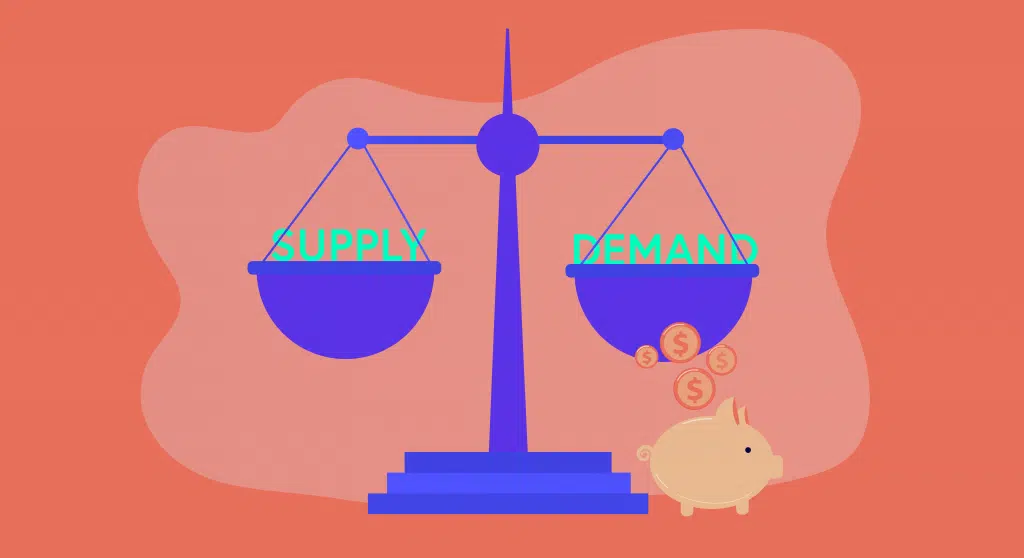
What Is Supply and Demand? The Relentless Force Behind Every Economy
Walk into a grocery store at 6:00 p.m. on a Friday.
The strawberries are nearly gone. The rotisserie chickens are disappearing faster than employees can replace them. Meanwhile, a shelf full of canned beets sits untouched, quietly collecting dust.
Nothing about that scene is random.
Behind every empty shelf, every soaring stock price, every housing boom, every oil shock, and every discount sign hanging in a store window, there is a simple idea at work: supply and demand.
Now, here's the remarkable part. Supply and demand isn't merely an economic theory. It isn't a classroom diagram sketched on a whiteboard by a professor with elbow patches. It's a living force. It moves markets. It rewards good decisions. It punishes bad ones. And whether you're running a lemonade stand, managing a Fortune 500 company, or deciding when to buy a home, you're negotiating with it every day.
I've spent decades around entrepreneurs, investors, retailers, builders, and executives. The successful ones came from different backgrounds and industries, but they shared one trait: they respected supply and demand. They understood that no amount of wishful thinking can overpower it.
You can ignore gravity for a while. You can debate gravity. You can write essays criticizing gravity.
Eventually, gravity wins.
Supply and demand works much the same way.
The Basic Idea: A Market's Conversation
At its core, supply and demand is a conversation.
Demand represents how much consumers want a product or service.
Supply represents how much producers are willing and able to provide.
Price becomes the language through which those two groups communicate.
When buyers want more of something than sellers can provide, prices tend to rise.
When sellers have more inventory than buyers want, prices tend to fall.
Simple.
But simplicity should never be confused with weakness. Some of the most powerful forces in business are built on surprisingly straightforward ideas.
Think about concert tickets.
If 20,000 people want tickets to a show and only 5,000 seats exist, prices climb. Not because somebody decided to be unfair. Not because the laws of economics suddenly became cruel. Prices rise because scarcity exists.
Now reverse the equation.
Suppose a theater has 5,000 seats and only 500 people are interested. Suddenly discounts appear. Promotions emerge. Free upgrades become available.
The product didn't change.
The balance between supply and demand did.
Understanding Demand: Why People Buy
Demand isn't simply about desire.
Millions of people would like a beachfront mansion. That doesn't mean they can purchase one.
Economists define demand as the willingness and ability to buy at a given price.
Several factors influence demand:
1. Price
Generally speaking, lower prices increase demand.
Raise the price of a cup of coffee from $3 to $30 and you'll discover very quickly how sensitive consumers can be.
2. Income
When incomes rise, consumers often spend more.
Restaurants fill up. Travel increases. Retail sales improve.
When incomes fall, spending usually becomes more selective.
3. Consumer Preferences
This factor can move markets overnight.
A celebrity endorses a product. A social trend emerges. A technological breakthrough changes behavior.
Suddenly demand shifts.
History is littered with products that looked unstoppable until consumer preferences changed.
4. Expectations
Human beings don't merely react to current conditions.
They anticipate future ones.
If people believe gasoline prices will rise next week, many fill their tanks today. If investors expect a stock to appreciate, demand for that stock often increases before the anticipated event occurs.
Markets are forward-looking machines.
Understanding Supply: Why Producers Sell
Supply reflects the quantity of goods or services producers are willing to offer at different prices.
Higher prices generally encourage greater production.
Why?
Because higher prices often mean higher profits.
That additional profit creates an incentive to invest, expand, hire, and produce.
Several forces affect supply.
Production Costs
If raw materials become more expensive, suppliers may reduce output.
A furniture manufacturer facing higher lumber costs cannot simply pretend those expenses don't exist.
Margins matter.
Technology
Innovation often increases supply.
Automation, improved logistics, and advanced manufacturing methods allow businesses to produce more with fewer resources.
This is one reason productivity gains are so valuable. They expand supply without requiring proportional increases in cost.
Competition
When industries become attractive, new entrants appear.
More competitors generally increase total supply.
That's capitalism doing what it does best: chasing opportunity.
Government Policy
Taxes, regulations, tariffs, and subsidies can all affect supply.
Sometimes these interventions expand production.
Sometimes they constrain it.
The market responds accordingly.
The Meeting Point: Equilibrium
The most important moment in supply and demand occurs where the two curves intersect.
Economists call this equilibrium.
At equilibrium:
-
Buyers can purchase what they want.
-
Sellers can sell what they produce.
-
Prices stabilize.
Of course, real life rarely stays there for long.
Markets are constantly adjusting.
A drought hits agricultural regions.
A new technology enters the market.
Interest rates change.
Consumer tastes evolve.
The equilibrium shifts.
That's why markets feel dynamic. They're continuously searching for balance while simultaneously being disrupted by new information.
A Practical Lesson I Learned Early
One lesson from my business career still sticks with me.
Years ago, I watched a retailer order enormous quantities of inventory because management believed demand would explode during the holiday season.
The forecast looked convincing.
The presentations were polished.
The confidence was contagious.
There was only one problem.
Customers didn't cooperate.
Demand came in far below expectations.
By January, warehouses were overflowing. Merchandise had to be discounted aggressively. Margins evaporated.
The company didn't fail because it lacked intelligence.
It failed because it confused hope with demand.
That experience reinforced something I've never forgotten: markets don't care what you want to happen. They care about what customers actually do.
It's a distinction that sounds obvious until real money is involved.
Supply and Demand in Action
Let's compare several common market situations.
| Market Condition | Supply Level | Demand Level | Likely Price Movement | Real-World Example |
|---|---|---|---|---|
| Shortage | Low | High | Prices rise sharply | Housing inventory during a population boom |
| Surplus | High | Low | Prices decline | Excess retail inventory after weak sales |
| Balanced Market | Moderate | Moderate | Stable prices | Mature consumer goods categories |
| Supply Shock | Sudden decrease | Unchanged | Prices rise | Energy disruptions affecting oil markets |
| Demand Surge | Unchanged | Sudden increase | Prices rise | New technology products after launch |
| Technological Expansion | High increase | Stable | Prices often fall | Consumer electronics manufacturing |
The pattern becomes obvious.
Prices are not arbitrary.
They're signals.
They communicate information faster than almost any government report, survey, or expert forecast.
Why Prices Matter More Than People Think
Many people view prices as outcomes.
They're actually messages.
A rising price tells producers:
"Make more."
A falling price tells producers:
"Make less."
This signaling mechanism is extraordinarily efficient.
Imagine a sudden increase in demand for bottled water after a natural disaster.
Higher prices encourage suppliers from surrounding regions to move inventory into affected areas.
Without those price signals, shortages often persist longer.
This reality can be uncomfortable. It can also be true.
Markets allocate scarce resources through prices.
Whether one likes that mechanism or not, understanding it is essential.
The Housing Market: A Perfect Illustration
Few examples demonstrate supply and demand more clearly than housing.
When population growth accelerates in a city but construction remains limited, housing prices tend to rise.
Why?
More buyers.
Not enough homes.
The math isn't complicated.
Conversely, when construction significantly exceeds demand, prices often soften.
You can see this relationship repeated across decades, countries, and economic systems.
Politicians frequently debate housing affordability.
Developers debate zoning.
Economists debate interest rates.
Yet underneath every debate lies the same fundamental question:
How much housing supply exists relative to housing demand?
The answer explains far more than most people realize.
Supply and Demand in Financial Markets
Investors sometimes search for mysterious explanations behind market movements.
Occasionally the explanation is remarkably straightforward.
A stock rises because more people want to own it than sell it.
A stock falls because more people want to sell than buy.
Certainly, earnings matter.
Growth matters.
Management quality matters.
But ultimately those factors influence supply and demand for ownership itself.
Every trade requires a buyer and a seller.
Every price reflects that negotiation.
Strip away the complexity and the principle remains unchanged.
Common Misunderstandings
"High Demand Guarantees Success"
Not necessarily.
Businesses must still execute effectively.
Strong demand paired with poor operations creates missed opportunities.
"Low Prices Always Increase Sales"
Only to a point.
If consumers perceive quality problems, lower prices may actually reduce demand.
Human psychology matters.
"Supply and Demand Only Applies to Products"
Far from it.
The concept affects labor markets, real estate, financial assets, commodities, and even professional services.
Wherever scarcity exists, supply and demand appears.
"Experts Can Easily Predict Demand"
If that were true, every company would have perfect inventory levels and every investor would be wealthy.
Forecasting remains difficult because human behavior remains difficult.
The Enduring Power of a Simple Idea
What fascinates me about supply and demand is not its complexity.
It's its durability.
Entire industries have emerged and disappeared.
Technologies have transformed the world.
Markets have become faster, larger, and more interconnected.
Yet the underlying principle remains stubbornly intact.
People want things.
Businesses provide things.
Prices emerge from the interaction.
That's the story.
Not glamorous. Not complicated. Not fashionable.
Just true.
The Question Every Decision-Maker Should Ask
Here's a question worth carrying into every business meeting, investment discussion, and economic debate:
What is happening to supply, and what is happening to demand?
Ask it often enough and you begin to see patterns that others miss.
You'll understand why some companies thrive while others struggle.
You'll understand why prices rise, why shortages occur, why bubbles form, and why corrections arrive.
Most important, you'll stop treating market outcomes as mysteries.
Supply and demand isn't merely an economic concept. It's the operating system beneath modern commerce.
Ignore it and you'll spend your career reacting to events.
Understand it and you'll start anticipating them.
That's a meaningful difference. In business, as in life, those differences tend to compound.
- Arts
- Business
- Computers
- Games
- Health
- Home
- Kids and Teens
- Money
- News
- Personal Development
- Recreation
- Regional
- Reference
- Science
- Shopping
- Society
- Sports
- Бизнес
- Деньги
- Дом
- Досуг
- Здоровье
- Игры
- Искусство
- Источники информации
- Компьютеры
- Личное развитие
- Наука
- Новости и СМИ
- Общество
- Покупки
- Спорт
- Страны и регионы
- World

 Russian
 French
 Spanish
 Portuguese
 Deutsch
 Turkish
 Dutch
Dutch
 Italiano
 Arabic
 Romaian
 Portuguese (Brazil)
 Greek
Greek