
What does confirmation bias do?
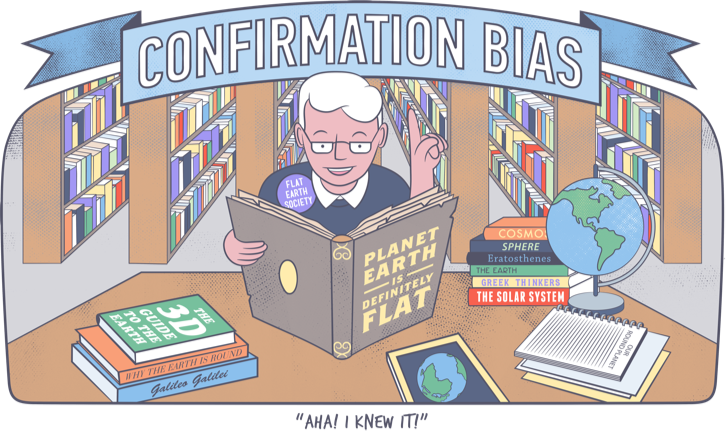
What Does Confirmation Bias Do?
The Quiet Reshaping of What We Think We Know
A person reads a report about a controversial topic.
Halfway through, they already feel certain about what it will conclude.
As they continue reading, they notice details that support their view.
Contradictory points feel less convincing, even when they are clearly stated.
By the end, they feel more confident in their original belief than when they started.
Nothing in the text forced that outcome.
The information was the same for everyone.
What changed was the way it was processed.
This is what confirmation bias does.
It does not merely influence belief.
It actively shapes the flow of attention, interpretation, and memory in ways that reinforce existing views.
It Filters What Gets Noticed
The first effect of confirmation bias is selective attention.
People do not observe everything equally.
Instead, they tend to notice information that aligns with what they already believe.
Relevant details stand out.
Contradictory details fade into the background.
This filtering is subtle.
It happens before conscious evaluation begins.
By the time deliberate thinking starts, the information landscape is already uneven.
It Shapes How Information Is Interpreted
The same piece of evidence can be interpreted in multiple ways.
Confirmation bias influences which interpretation feels most natural.
Ambiguous information is especially vulnerable.
For example:
-
A cautious statement may be seen as supportive or critical depending on prior belief
-
A mixed result may be interpreted as success or failure depending on expectations
The mind does not simply receive information.
It assigns meaning to it.
And that meaning is often guided by existing beliefs.
It Strengthens Existing Beliefs Over Time
Repeated exposure to confirming information creates a cumulative effect.
Each supporting detail reinforces confidence.
Each interpretation consistent with prior belief adds stability.
Over time, beliefs feel more certain—not necessarily because they are more accurate, but because they have been repeatedly reinforced.
This creates a feedback loop:
Belief → selective attention → confirming interpretation → stronger belief
The loop can continue even in the presence of contradictory evidence.
It Weakens the Impact of Contradictory Evidence
One of the most important effects of confirmation bias is asymmetry in evaluation.
Supporting evidence is often:
-
Accepted quickly
-
Viewed as credible
-
Integrated easily
Contradictory evidence is often:
-
Scrutinized more heavily
-
Questioned more aggressively
-
Discounted or reinterpreted
The result is not complete rejection of opposing views.
It is unequal weighting.
This imbalance is what drives persistent disagreement between individuals exposed to the same information.
It Distorts Memory
Memory is not a static archive.
It is reconstructive.
Confirmation bias influences what is stored and what is later retrieved.
Supporting information is more likely to be remembered clearly.
Contradictory information may fade or be reinterpreted over time.
As a result, recall itself becomes biased toward prior beliefs.
When people reflect on past evidence, they often remember more consistency than actually existed.
It Creates Illusions of Objectivity
Perhaps the most subtle effect of confirmation bias is the feeling of objectivity it produces.
Because individuals are exposed to evidence that supports their view, and because that evidence is processed smoothly, their conclusions feel well-supported.
At the same time, contradictory evidence feels less convincing or less relevant.
From the inside, this creates a sense of having carefully evaluated all sides.
In reality, the evaluation has been uneven.
The mind does not experience its own filtering process directly.
It experiences only the final impression.
A Personal Observation on Selective Evidence
At one point, while reviewing different analyses of the same event, I noticed a recurring pattern.
Each interpretation appeared coherent within itself.
Each author cited evidence that seemed reasonable.
Yet the conclusions diverged significantly.
What stood out was not the disagreement itself, but the way each perspective naturally emphasized different pieces of the same underlying data.
It became difficult to separate the data from the interpretive lens.
The evidence did not speak on its own.
It was shaped by the framework applied to it.
It Reinforces Belief Systems Rather Than Isolated Opinions
Confirmation bias does not only affect single beliefs.
It strengthens entire networks of related ideas.
When one belief is reinforced, related assumptions often become stronger as well.
This creates a coherent internal structure.
Within that structure, new information is interpreted in a way that preserves consistency.
Over time, belief systems become increasingly stable and resistant to change.
It Affects Decision-Making Under Uncertainty
In uncertain situations, people rely heavily on prior beliefs.
Confirmation bias increases this reliance.
Instead of treating new information as equally important, the mind weights it according to existing expectations.
This can lead to:
-
Overconfidence in predictions
-
Underestimation of alternative outcomes
-
Resistance to revising judgments
Decisions become less adaptive when feedback is filtered through prior assumptions.
It Reduces Cognitive Effort
There is also a functional aspect to confirmation bias.
Evaluating all evidence equally requires mental effort.
Resolving contradictions is cognitively demanding.
By favoring consistent information, the mind reduces complexity.
This makes thinking more efficient, but less comprehensive.
The bias is not only distortive.
It is also economical.
It Sustains Disagreement Between People
One of the most visible effects of confirmation bias is persistent disagreement among individuals who have access to the same information.
This occurs because:
-
Each person attends to different evidence
-
Each interprets ambiguity differently
-
Each remembers different details more clearly
As a result, conversations often reinforce divergence rather than resolve it.
People do not merely disagree on conclusions.
They often inhabit different informational landscapes.
Conclusion: A Filter That Shapes Understanding
Confirmation bias does not simply influence what people believe.
It shapes the entire process by which beliefs are formed and maintained.
It determines:
-
What information is noticed
-
How it is interpreted
-
What is remembered
-
How strongly conclusions are held
The result is a mind that does not passively receive information, but actively organizes it in ways that preserve coherence.
Understanding confirmation bias is not about eliminating it entirely.
That is unlikely to be possible.
It is about recognizing that what feels like objective evaluation is often structured by prior expectation long before conscious reasoning begins.
- Arts
- Business
- Computers
- Games
- Health
- Home
- Kids and Teens
- Money
- News
- Personal Development
- Recreation
- Regional
- Reference
- Science
- Shopping
- Society
- Sports
- Бизнес
- Деньги
- Дом
- Досуг
- Здоровье
- Игры
- Искусство
- Источники информации
- Компьютеры
- Личное развитие
- Наука
- Новости и СМИ
- Общество
- Покупки
- Спорт
- Страны и регионы
- World

 Russian
 French
 Spanish
 Portuguese
 Deutsch
 Turkish
 Dutch
Dutch
 Italiano
 Arabic
 Romaian
 Portuguese (Brazil)
 Greek
Greek