
What Is a Marketplace Business Model?
Some of the most valuable companies in the world own surprisingly little.
They do not manufacture every product sold through their platforms.
They do not employ every service provider generating revenue within their ecosystems.
They do not maintain ownership of most assets flowing through their networks.
Yet they facilitate billions of transactions.
Influence entire industries.
And generate extraordinary economic value.
That apparent contradiction sits at the center of the marketplace business model.
Traditional businesses typically create value by producing, purchasing, or owning something.
Marketplace businesses create value differently.
They connect.
Buyers with sellers.
Supply with demand.
People with opportunities.
The marketplace itself often becomes the infrastructure through which exchange occurs.
That distinction changes everything.
It changes economics.
Growth dynamics.
Competitive advantages.
Risk profiles.
And ultimately, how businesses scale.
Understanding the marketplace business model requires abandoning the assumption that ownership is the primary source of value.
Because in marketplace economics, coordination often becomes more valuable than possession.
The Marketplace Model Is Built Around Connection
At its core, a marketplace exists to facilitate exchange.
That exchange may involve:
- Products
- Services
- Information
- Assets
- Experiences
The specific transaction matters less than the structure supporting it.
Three Parties Typically Exist
Most marketplaces involve:
- Buyers
- Sellers
- The marketplace operator
Each participant derives value differently.
Buyers gain access.
Sellers gain demand.
The marketplace earns revenue by enabling the interaction.
The Marketplace Creates Efficiency
Without marketplaces, buyers and sellers must find each other independently.
That process is often inefficient.
Marketplaces reduce friction.
Friction reduction creates value.
Marketplace Businesses Do Not Necessarily Own Inventory
This is one of the most important distinctions.
Traditional retailers frequently purchase inventory.
Marketplace operators often do not.
Ownership Shifts to Sellers
Marketplace sellers maintain responsibility for:
- Products
- Pricing
- Inventory
The platform provides infrastructure.
Not necessarily inventory.
Capital Requirements Change
Because inventory ownership decreases, marketplaces often scale differently than traditional retailers.
Growth can become less dependent on inventory investment.
That changes financial dynamics significantly.
Supply and Demand Must Coexist
A marketplace requires participants on both sides.
This creates one of the most difficult challenges in business.
Buyers Need Sellers
Customers expect choice.
Availability.
Selection.
Without sellers, marketplaces lack value.
Sellers Need Buyers
Merchants seek visibility.
Demand.
Revenue opportunities.
Without buyers, participation becomes difficult to justify.
This interdependence creates what many entrepreneurs call the marketplace dilemma.
Supply attracts demand.
Demand attracts supply.
Both are required.
Yet neither appears automatically.
Network Effects Drive Marketplace Growth
Network effects represent one of the most powerful concepts in marketplace economics.
More Sellers Improve Buyer Value
As seller participation increases:
- Selection expands
- Competition increases
- Discovery improves
Buyers often benefit.
More Buyers Improve Seller Value
As customer demand grows:
- Revenue opportunities expand
- Visibility improves
- Marketplace attractiveness increases
Sellers often benefit.
Growth on one side improves value on the other.
This dynamic creates powerful feedback loops.
Trust Is the Foundation of Marketplace Success
Transactions require confidence.
Confidence requires trust.
Marketplaces Create Trust Infrastructure
Trust mechanisms often include:
- Reviews
- Ratings
- Verification systems
- Buyer protections
These systems reduce uncertainty.
Reduced uncertainty increases participation.
Trust Creates Liquidity
Liquidity refers to the ease with which transactions occur.
Trust improves liquidity.
Liquidity improves marketplace performance.
The relationship is difficult to overstate.
Revenue Models Vary Across Marketplaces
Not all marketplaces generate revenue identically.
Several approaches exist.
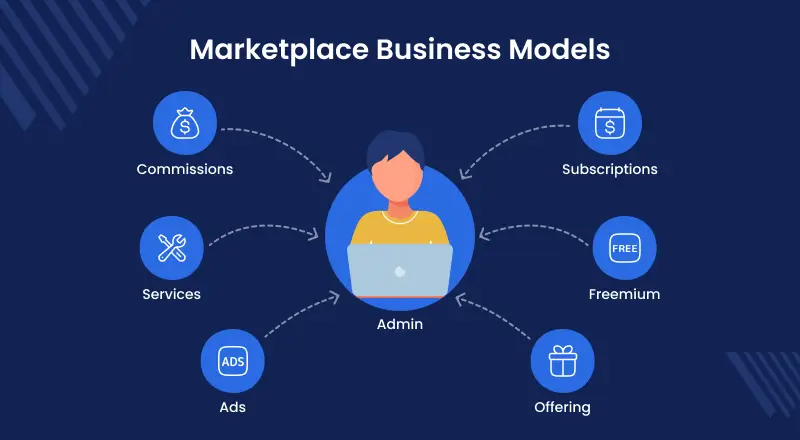
Transaction Fees
Many marketplaces charge commissions when transactions occur.
This aligns revenue with activity.
The marketplace succeeds when participants succeed.
Subscription Models
Some platforms charge recurring fees for access.
Examples include:
- Seller subscriptions
- Membership programs
Revenue becomes more predictable.
Advertising Models
Visibility can become monetized.
Sellers pay for exposure.
Marketplaces earn advertising revenue.
Hybrid Approaches
Many successful marketplaces combine multiple revenue streams.
Diversification improves resilience.
Comparing Marketplace Revenue Structures
| Revenue Model | How Revenue Is Generated | Advantages | Challenges |
|---|---|---|---|
| Transaction Fees | Percentage of sales | Scales naturally | Dependent on volume |
| Subscription Fees | Recurring payments | Predictable income | Requires ongoing value |
| Advertising Revenue | Paid visibility | High-margin revenue | Can affect user experience |
| Listing Fees | Charges per listing | Immediate monetization | May discourage participation |
| Premium Services | Optional enhancements | Additional revenue streams | Requires differentiation |
| Data Services | Market insights and analytics | Valuable at scale | Privacy considerations |
The strongest marketplaces often employ multiple models simultaneously.
Revenue diversification supports long-term stability.
Marketplace Liquidity Determines Success
Liquidity rarely receives the attention it deserves.
It should.
Activity Matters More Than Size
A marketplace with thousands of inactive participants creates little value.
A marketplace with active engagement creates momentum.
Efficient Matching Is Critical
Buyers must find sellers.
Sellers must find buyers.
The faster this occurs, the stronger the marketplace becomes.
Liquidity accelerates growth.
Marketplace Businesses Scale Differently
Traditional businesses often scale through assets.
Marketplaces frequently scale through participation.
Growth Becomes Ecosystem Driven
Every new participant potentially improves value.
The marketplace benefits from collective activity.
Marginal Economics Improve
Adding participants may require relatively little incremental infrastructure.
This characteristic helps explain why successful marketplaces often achieve substantial scale.
Data Becomes a Strategic Asset
Marketplaces generate information continuously.
Every interaction produces signals.
Market Intelligence Emerges Naturally
Marketplaces observe:
- Demand trends
- Pricing behavior
- Consumer preferences
This information becomes valuable.
Better Data Improves Decisions
Insights support:
- Recommendations
- Search relevance
- Fraud prevention
Marketplace performance improves as intelligence expands.
Marketplace Competition Is Often Different
Competition extends beyond products.
Marketplaces compete for participation.
The Strongest Marketplace Often Wins
Participants gravitate toward activity.
Activity creates liquidity.
Liquidity creates value.
This dynamic can create concentration.
Switching Costs Increase Over Time
Established marketplaces often develop:
- Reviews
- Reputation systems
- Transaction histories
These assets create persistence.
A Lesson I Learned Studying a Growing Marketplace
Several years ago, I worked with a company attempting to launch a specialized marketplace.
The founders focused obsessively on technology.
Features.
Design.
Functionality.
The platform worked beautifully.
Participation remained weak.
The problem became obvious only after deeper analysis.
Technology was not the challenge.
Liquidity was.
The marketplace lacked enough participants on either side to create meaningful activity.
Eventually, the company shifted its focus.
Instead of building features, it focused on attracting supply.
Transactions increased.
Demand followed.
Growth accelerated.
That experience reinforced a lesson I have never forgotten.
Marketplace businesses are not primarily technology businesses.
They are participation businesses.
Technology supports the ecosystem.
Participation creates it.
The Cold Start Problem Challenges Every Marketplace
Every marketplace begins with limited activity.
This creates a difficult obstacle.
Empty Marketplaces Create Little Value
Customers dislike limited selection.
Sellers dislike limited demand.
The marketplace must solve this imbalance.
Strategic Focus Is Essential
Many successful marketplaces begin by:
- Serving niche audiences
- Concentrating geographically
- Targeting specific industries
Focus often precedes scale.
Marketplace Risks Should Not Be Ignored
Marketplace models offer advantages.
They also introduce challenges.
Dependency Risks
Marketplaces depend heavily on participant behavior.
Supply can leave.
Demand can shift.
Quality Control Challenges
Because third parties participate, maintaining standards becomes difficult.
Governance becomes essential.
Competitive Threats
Successful marketplaces attract competition.
Defending position requires continuous improvement.
The Future of Marketplace Business Models
Marketplaces continue evolving.
Artificial intelligence influences discovery.
Personalization improves matching.
Cross-border participation increases.
Yet the underlying principles remain stable.
Marketplaces still require:
- Trust
- Liquidity
- Participation
- Efficient matching
Technology changes.
Exchange remains.
Conclusion: Marketplace Businesses Are Really About Orchestrating Value
Many people assume businesses create value by producing things.
Marketplace businesses challenge that assumption.
Their primary contribution is often coordination.
They organize.
Connect.
Facilitate.
Enable.
The products may belong to sellers.
The demand may originate with buyers.
Yet without the marketplace, many transactions would never occur.
That reality explains why marketplaces have become such powerful economic structures.
They transform fragmented participants into functioning ecosystems.
They convert isolated opportunities into scalable exchanges.
And they demonstrate something increasingly important in modern commerce.
Ownership remains valuable.
But the ability to connect people efficiently may be even more valuable.
Because when marketplaces succeed, they do not merely create transactions.
They create environments where transactions become inevitable.
- Arts
- Business
- Computers
- Jocuri
- Health
- Home
- Kids and Teens
- Money
- News
- Personal Development
- Recreation
- Regional
- Reference
- Science
- Shopping
- Society
- Sports
- Бизнес
- Деньги
- Дом
- Досуг
- Здоровье
- Игры
- Искусство
- Источники информации
- Компьютеры
- Личное развитие
- Наука
- Новости и СМИ
- Общество
- Покупки
- Спорт
- Страны и регионы
- World

 English
 Russian
 French
 Spanish
 Portuguese
 Deutsch
 Turkish
 Dutch
Dutch
 Italiano
 Arabic
 Portuguese (Brazil)
 Greek
Greek