
Marketplace vs Online Store: Which Business Model Actually Wins?
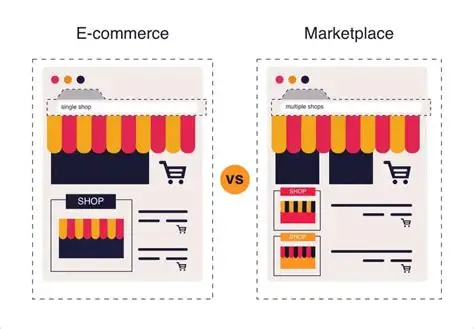
At first glance, the difference appears minor.
Both sell products.
Both process payments.
Both attract customers through digital channels.
Both exist on websites.
To many consumers, a marketplace and an online store feel almost identical.
Click.
Browse.
Purchase.
Done.
Yet beneath that seemingly similar customer experience lie two profoundly different business models.
One owns inventory.
The other orchestrates participation.
One scales through products.
The other scales through people.
One behaves like a retailer.
The other behaves like an ecosystem.
Understanding that distinction is more than an academic exercise.
It determines how businesses grow.
How they generate revenue.
How they manage risk.
And ultimately, how valuable they become.
Many entrepreneurs begin their journey believing they need an online store.
Some discover they actually need a marketplace.
Others pursue a marketplace and eventually realize a store would have served them better.
The difference matters.
Often more than founders initially realize.
The Simplest Explanation
Before exploring complexity, simplicity helps.
What Is an Online Store?
An online store sells products directly to customers.
The business typically controls:
- Inventory
- Pricing
- Product selection
- Customer experience
The transaction occurs between the business and the customer.
What Is a Marketplace?
A marketplace connects buyers and sellers.
The platform facilitates transactions.
The inventory belongs to participants rather than the platform itself.
The marketplace creates the environment.
Participants create the inventory.
That distinction changes everything.
Ownership Is the First Major Difference
Ownership shapes economics.
Economics shape strategy.
Online Stores Own Products
Retailers purchase inventory.
Or manufacture it.
Or source it.
They assume responsibility for:
- Stock management
- Fulfillment
- Storage
Marketplaces Own Participation
Marketplace operators rarely own inventory.
Instead, they facilitate transactions between participants.
This reduces inventory risk significantly.
It introduces different challenges.
Risk Profiles Look Very Different
Every business model contains risk.
The type of risk varies.
Online Store Risks
Retailers face challenges such as:
- Unsold inventory
- Storage costs
- Forecasting errors
Inventory can become expensive quickly.
Marketplace Risks
Marketplaces face challenges such as:
- Liquidity problems
- Supply shortages
- Demand shortages
Their greatest risk is participation.
Not products.
Revenue Models Operate Differently
How money enters the business matters.
Online Store Revenue
Revenue comes primarily from product sales.
Profit depends on:
- Margins
- Volume
- Operational efficiency
Marketplace Revenue
Revenue commonly comes from:
- Transaction fees
- Commissions
- Subscriptions
- Advertising
The marketplace earns from activity rather than inventory ownership.
Growth Behaves Differently
This is where the divergence becomes especially interesting.
Online Store Growth
Growth generally requires:
- More products
- More inventory
- More customers
Expansion often increases operational complexity.
Marketplace Growth
Growth frequently comes through:
- More buyers
- More sellers
- More transactions
Participants contribute much of the value creation.
This can create powerful scaling dynamics.
Comparing Marketplaces and Online Stores
| Factor | Online Store | Marketplace |
|---|---|---|
| Inventory Ownership | Business Owned | Seller Owned |
| Revenue Source | Product Sales | Transaction Fees |
| Operational Complexity | Inventory Heavy | Participation Heavy |
| Scalability | Moderate | Potentially High |
| Risk Type | Inventory Risk | Liquidity Risk |
| Customer Relationships | Direct | Shared |
| Product Selection | Controlled | Participant Driven |
| Capital Requirements | Often Higher | Often Lower Initially |
| Growth Mechanism | Product Expansion | Network Effects |
| Core Challenge | Inventory Management | Supply and Demand Balance |
The similarities are visible.
The differences are strategic.
Customer Experience Feels Similar—but Isn't
Many consumers never notice the distinction.
Businesses certainly do.
Online Stores Control Everything
The retailer determines:
- Product quality
- Pricing
- Fulfillment
Consistency becomes easier.
Marketplaces Coordinate Everything
Control becomes distributed.
Participants influence quality.
Participants influence selection.
Participants influence customer satisfaction.
Coordination replaces control.
Inventory Changes the Entire Equation
Inventory is often overlooked in marketplace discussions.
It should not be.
Inventory Requires Capital
Products must be acquired before they can be sold.
This ties up resources.
Marketplaces Avoid Much of This Burden
Inventory remains with participants.
Capital requirements frequently decline.
Operational flexibility often increases.
The trade-off is reduced control.
Marketplaces Depend on Network Effects
This represents one of the most important distinctions.
Online Stores Grow Through Transactions
Every sale creates revenue.
Growth is valuable.
But largely linear.
Marketplaces Can Create Compounding Value
Additional sellers attract buyers.
Additional buyers attract sellers.
Participation improves participation.
This phenomenon is known as a network effect.
It can become extraordinarily powerful.
Why Many Entrepreneurs Love Marketplaces
The appeal is understandable.
Asset-Light Expansion
Marketplaces often grow without owning inventory.
This creates flexibility.
Diverse Selection
Participant-generated inventory expands product availability.
The platform benefits without sourcing products directly.
Scalability
Network effects can create remarkable growth opportunities.
Few business models offer similar upside.
Why Online Stores Remain Attractive
Marketplaces receive significant attention.
Online stores deserve equal respect.
Greater Control
Retailers control:
- Branding
- Pricing
- Quality
Control simplifies execution.
Stronger Customer Ownership
Relationships remain direct.
This often improves long-term customer value.
Simpler Operations
Although inventory introduces challenges, participation dynamics are generally less complex.
Complexity shifts.
It does not disappear.
The Marketplace Cold-Start Problem
Online stores rarely face this challenge.
Marketplaces almost always do.
Buyers Need Sellers
Sellers need buyers.
Both hesitate to arrive first.
Participation Creates Value
Without participation, marketplaces struggle.
This creates one of the most difficult challenges in platform building.
Liquidity becomes essential.
A Lesson I Learned Watching Two Businesses Grow
Several years ago, I worked with two founders operating in the same industry.
One launched an online store.
The other launched a marketplace.
Initially, the online store appeared stronger.
Revenue arrived quickly.
Customers purchased products immediately.
The marketplace struggled.
Participation remained inconsistent.
Growth felt frustratingly slow.
Yet several years later, the situation reversed.
The marketplace eventually achieved meaningful liquidity.
New sellers joined regularly.
Inventory expanded naturally.
Customer acquisition became easier.
The online store continued growing.
The marketplace accelerated.
That experience taught me something important.
Marketplaces often begin harder.
But once network effects emerge, growth can become dramatically different.
The challenge is surviving long enough to reach that point.
Many never do.
Profitability Timelines Differ
This distinction deserves attention.
Online Stores Can Monetize Quickly
Products sell.
Revenue arrives.
The path is relatively straightforward.
Marketplaces Often Delay Optimization
Many marketplaces prioritize participation before profitability.
Growth comes first.
Monetization follows.
This requires patience.
And often capital.
Customer Trust Functions Differently
Trust remains essential in both models.
Its source varies.
Online Store Trust
Customers trust the business directly.
Marketplace Trust
Customers trust:
- The platform
- The sellers
- The review systems
Trust becomes distributed.
Managing it requires additional infrastructure.
Which Model Is Better?
The question appears simple.
The answer is not.
Online Stores Excel When
Businesses want:
- Brand control
- Product ownership
- Direct customer relationships
Marketplaces Excel When
Businesses want:
- Network effects
- Broad selection
- Scalable participation
The optimal choice depends entirely on the problem being solved.
The Future May Belong to Hybrid Models
Increasingly, businesses combine both approaches.
Stores Add Marketplace Elements
Retailers invite third-party sellers.
Marketplaces Add Retail Functions
Platforms curate inventory directly.
The line between models continues blurring.
Hybrid approaches are becoming increasingly common.
The Future of Digital Commerce
Technology continues evolving.
Artificial intelligence improves discovery.
Automation improves operations.
Personalization becomes more sophisticated.
Yet despite these advances, the fundamental distinction remains remarkably stable.
Online stores sell products.
Marketplaces facilitate participation.
The technology changes.
The economics endure.
Conclusion: The Difference Is Not What They Sell—It's How They Create Value
Many people assume marketplaces and online stores compete directly.
Sometimes they do.
More often, they represent fundamentally different philosophies.
Online stores create value through ownership.
They acquire products.
Manage inventory.
Control experiences.
Marketplaces create value through coordination.
They connect participants.
Facilitate transactions.
Enable ecosystems.
Neither model is inherently superior.
Both can become highly profitable.
Both can achieve extraordinary scale.
The question is not which model wins universally.
The question is which model aligns with the opportunity in front of you.
Because ultimately, the most successful businesses are rarely those that follow trends.
They are the ones that choose the structure best suited to the problem they intend to solve.
And that decision begins long before the first product is listed or the first transaction occurs.
- Arts
- Business
- Computers
- Games
- Health
- Home
- Kids and Teens
- Money
- News
- Personal Development
- Recreation
- Regional
- Reference
- Science
- Shopping
- Society
- Sports
- Бизнес
- Деньги
- Дом
- Досуг
- Здоровье
- Игры
- Искусство
- Источники информации
- Компьютеры
- Личное развитие
- Наука
- Новости и СМИ
- Общество
- Покупки
- Спорт
- Страны и регионы
- World

 Russian
 French
 Spanish
 Portuguese
 Deutsch
 Turkish
 Dutch
Dutch
 Italiano
 Arabic
 Romaian
 Portuguese (Brazil)
 Greek
Greek