
What Are the Different Types of Memberships? Understanding the Many Ways Organizations Create Belonging
When most people hear the word "membership," a surprisingly specific image often comes to mind.
A gym card.
A warehouse club.
A monthly subscription.
A professional association.
Something with a login.
Something with a fee.
Something that renews.
Yet membership is far more expansive than that.
In fact, one of the most common mistakes organizations make is assuming membership is a single business model.
It isn't.
Membership is a strategic framework for building ongoing relationships.
The form it takes can vary dramatically.
Some memberships provide access.
Others deliver expertise.
Some create community.
Others facilitate status, identity, convenience, or transformation.
What unites them is not the product being offered.
It is the promise being made.
Membership says:
"We will continue creating value over time."
Members respond by saying:
"We will continue participating."
That reciprocal commitment is what separates membership from ordinary transactions.
Understanding the different types of memberships is not merely an academic exercise.
It is one of the most important strategic decisions an organization can make.
Because the kind of membership you build determines the kind of relationship you create.
And relationships drive retention.
Why Membership Models Matter
Organizations often focus intensely on acquisition.
How do we attract more customers?
How do we increase sales?
How do we expand reach?
Membership asks a different question.
How do we encourage people to stay?
This shift changes everything.
The organization is no longer optimizing for a purchase.
It is optimizing for participation.
Different membership models accomplish this in different ways.
Some rely on convenience.
Some rely on expertise.
Others rely on emotional connection.
Choosing the wrong model can create friction.
Choosing the right model can create extraordinary loyalty.
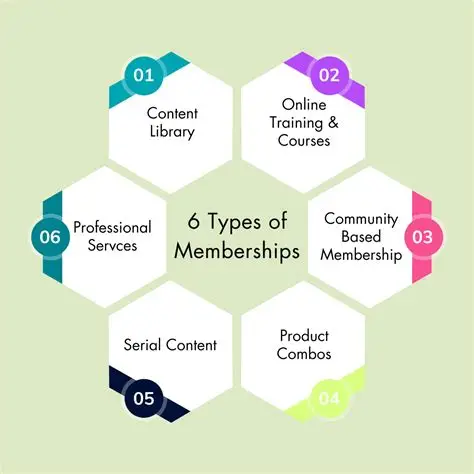
The Seven Primary Types of Memberships
While countless variations exist, most memberships fall into several broad categories.
Each serves a different purpose.
Each creates value differently.
1. Access Memberships
Access memberships are perhaps the most recognizable.
Members pay for access to products, services, locations, or resources unavailable to non-members.
The value proposition is straightforward.
Membership unlocks something.
Examples include:
- Fitness centers
- Streaming platforms
- Private clubs
- Shared workspaces
- Member-only content libraries
The relationship centers on availability.
Members remain because access remains valuable.
Yet access alone rarely creates deep loyalty.
Competitors can often replicate access.
The challenge is making access feel indispensable.
2. Community Memberships
Community memberships focus on connection.
Members join because they want relationships with people who share interests, goals, experiences, or identities.
The organization facilitates interaction.
The members create much of the value.
This distinction is important.
The strongest communities become more valuable as participation increases.
Members learn from one another.
Support one another.
Challenge one another.
Celebrate progress together.
In many cases, members initially join for content or resources but remain because of community.
The relationships become the product.
3. Professional Memberships
Professional memberships help individuals advance careers, expand expertise, and strengthen credibility.
These organizations often provide:
- Certifications
- Training
- Industry research
- Conferences
- Networking opportunities
- Professional standards
The value extends beyond information.
Professional memberships often reinforce identity.
Members feel connected to a profession, not merely an organization.
This emotional component frequently increases retention.
4. Loyalty Memberships
Retailers and consumer brands frequently use loyalty memberships.
These programs reward ongoing engagement.
Discounts.
Points.
Exclusive offers.
Early access.
Special recognition.
At first glance, loyalty memberships appear transactional.
The strongest versions go further.
They create emotional engagement alongside economic incentives.
When members feel recognized rather than merely rewarded, loyalty deepens significantly.
5. Learning Memberships
Learning memberships are built around continuous education.
The promise is not access alone.
The promise is progress.
Members expect to become more knowledgeable, skilled, or capable over time.
Examples include:
- Educational platforms
- Coaching communities
- Skill-development programs
- Certification academies
This model works particularly well because learning rarely ends.
New goals create new opportunities for engagement.
Progress fuels participation.
Participation fuels retention.
6. Status Memberships
Status memberships create exclusivity.
Membership signals achievement, prestige, expertise, or affiliation.
Examples can include:
- Elite travel programs
- Invitation-only communities
- Executive networks
- Premium membership tiers
The value is partially practical.
It is also symbolic.
Status memberships influence how members see themselves and how others perceive them.
Identity becomes central to the experience.
7. Mission-Driven Memberships
Some memberships unite people around a cause.
Environmental organizations.
Advocacy groups.
Charitable associations.
Industry coalitions.
Members participate because they believe in the mission.
The relationship is values-based.
This creates a unique dynamic.
People often remain engaged even when tangible benefits are modest because emotional alignment remains strong.
Purpose becomes the retention engine.
Comparing Membership Types
Each membership category creates value differently.
The distinctions become clearer when viewed side by side.
| Membership Type | Primary Value | Retention Driver | Emotional Connection |
|---|---|---|---|
| Access Membership | Availability | Convenience | Moderate |
| Community Membership | Relationships | Belonging | High |
| Professional Membership | Career Growth | Advancement | High |
| Loyalty Membership | Rewards | Economic Benefit | Moderate |
| Learning Membership | Transformation | Progress | High |
| Status Membership | Recognition | Identity | Very High |
| Mission-Driven Membership | Purpose | Shared Values | Very High |
One pattern quickly emerges.
The strongest retention often occurs when emotional value accompanies functional value.
People join for practical reasons.
They stay for deeper ones.
The Hybrid Membership Model
Many organizations assume they must choose a single membership type.
Increasingly, that assumption is incorrect.
The most successful memberships often blend multiple models.
A professional association may combine:
- Professional development
- Community
- Status recognition
A fitness organization may offer:
- Access
- Community
- Transformation
A retail membership might include:
- Loyalty rewards
- Exclusive access
- Community engagement
Hybrid models create multiple reasons to remain engaged.
When one source of value weakens, another can reinforce the relationship.
This diversification often strengthens retention.
A Lesson I Learned About Membership Design
Several years ago, I worked with an organization facing disappointing retention despite offering an impressive collection of benefits.
The leadership team believed the solution was straightforward.
Add more benefits.
Expand resources.
Increase value.
The organization invested heavily.
New programs launched.
Additional content appeared.
Member surveys remained positive.
Retention barely improved.
Interviews eventually revealed the problem.
Leadership believed they had built an access membership.
Members believed they had joined a community.
The mismatch was subtle.
Powerful.
Members were not asking for additional resources.
They wanted stronger connections.
More interaction.
Greater participation.
Once the organization shifted its focus toward community-building, engagement increased and renewals improved.
The lesson was clear.
The most important membership question is not:
"What are we offering?"
It is:
"Why are members really here?"
The answer often surprises leadership.
Why Membership Types Continue to Evolve
Membership models are becoming increasingly sophisticated.
Organizations now combine technology, personalization, and behavioral insights to create richer experiences.
Artificial intelligence can personalize recommendations.
Digital platforms facilitate engagement.
Data helps organizations understand participation patterns.
Yet technology is not redefining membership.
Human needs continue driving membership design.
People still seek:
- Access
- Progress
- Recognition
- Purpose
- Connection
The tools evolve.
The motivations remain remarkably consistent.
This explains why membership models continue thriving across industries.
They address enduring human desires.
Not temporary market conditions.
Choosing the Right Membership Model
Organizations often begin by asking:
"What benefits should we provide?"
A more useful question is:
"What outcome are we helping members achieve?"
The answer determines the appropriate membership model.
If members seek convenience, access may be sufficient.
If members seek relationships, community becomes essential.
If members seek growth, learning should dominate.
If members seek identity, status may matter most.
Membership strategy becomes significantly clearer when viewed through the lens of member outcomes.
Organizations succeed when membership aligns with member motivations.
Conclusion: Membership Is Not One Thing
Many discussions about membership assume a single model exists.
A standard formula.
A universal framework.
Reality is more interesting.
Membership takes many forms because human motivations take many forms.
People join for access.
For learning.
For recognition.
For advancement.
For purpose.
For connection.
Sometimes all at once.
The organizations that thrive are those that understand which need they are serving and build experiences accordingly.
Because membership is not ultimately defined by pricing structures, renewal cycles, or exclusive benefits.
It is defined by the relationship created between an organization and the people it serves.
And perhaps the most revealing question any leader can ask is this:
If your membership disappeared tomorrow, what would members miss most?
The answer reveals the type of membership you truly have—not the one you think you've built.
- Arts
- Business
- Computers
- Games
- Health
- Home
- Kids and Teens
- Money
- News
- Personal Development
- Recreation
- Regional
- Reference
- Science
- Shopping
- Society
- Sports
- Бизнес
- Деньги
- Дом
- Досуг
- Здоровье
- Игры
- Искусство
- Источники информации
- Компьютеры
- Личное развитие
- Наука
- Новости и СМИ
- Общество
- Покупки
- Спорт
- Страны и регионы
- World

 Russian
 French
 Spanish
 Portuguese
 Deutsch
 Turkish
 Dutch
Dutch
 Italiano
 Arabic
 Romaian
 Portuguese (Brazil)
 Greek
Greek