
How do children develop creativity?
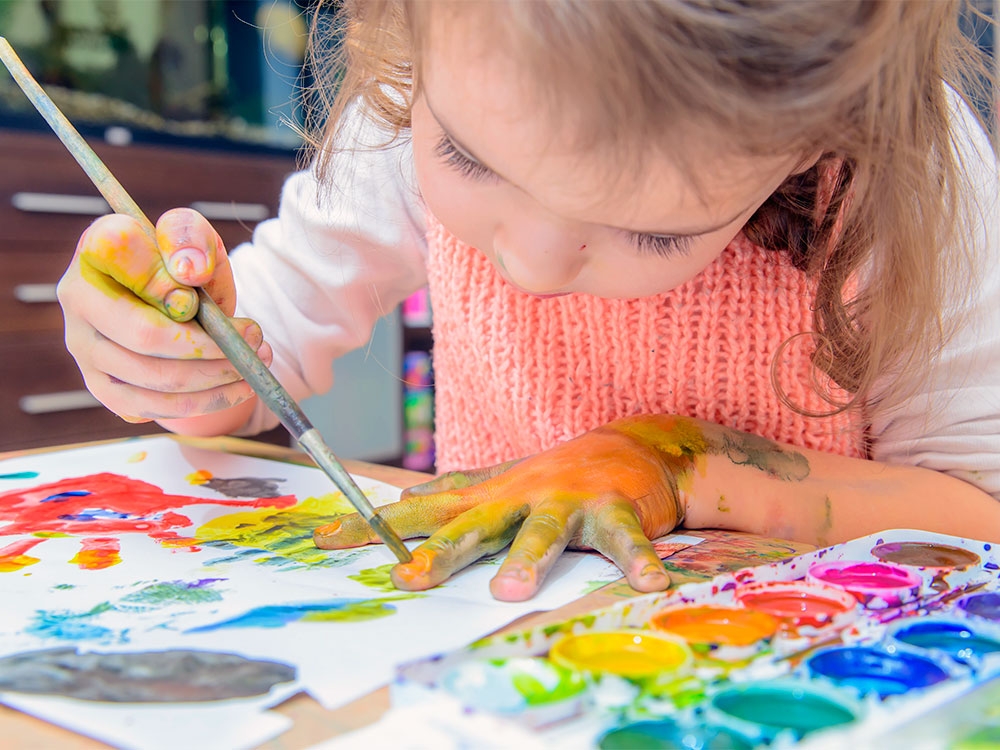
How Do Children Develop Creativity?
Watch a child with an empty cardboard box.
Not a toy.
Not a sophisticated gadget.
A box.
Within minutes it becomes something else.
A spaceship.
A castle.
A race car.
A hidden fortress.
A pirate ship crossing dangerous seas.
The transformation happens so naturally that adults barely notice it.
Children do this constantly.
A stick becomes a sword.
A blanket becomes a mountain.
A puddle becomes an ocean.
A living room becomes an entire universe.
Nobody teaches them this directly.
Nobody hands them a manual explaining how to imagine.
Creativity appears to arrive already in motion.
This observation raises a fascinating question.
How do children develop creativity?
Is it something they are born with?
Something they learn?
Something adults nurture?
Or perhaps something adults accidentally diminish?
The answer is more complex than any single explanation.
Children develop creativity through an ongoing interaction between biology, experience, curiosity, play, relationships, and environment.
Creativity is neither entirely innate nor entirely learned.
It emerges gradually.
Like language.
Like identity.
Like understanding itself.
The process begins earlier than most people realize.
And continues long after childhood ends.
Creativity Begins Before Children Understand the Word
Most children do not know the definition of creativity.
Yet they practice it constantly.
This reveals something important.
Creativity is not initially a skill.
It is a behavior.
A way of interacting with the world.
Infants explore through observation.
Touch.
Movement.
Experimentation.
Everything becomes a question.
What happens if I drop this?
What happens if I stack these objects?
What happens if I make this sound?
These actions may appear random.
They are not.
The child is conducting experiments.
Testing possibilities.
Learning relationships.
Creativity begins with exploration.
Long before it produces art, stories, inventions, or ideas.
The Brain Is Built for Discovery
Childhood is one of the most neurologically dynamic periods of human life.
The brain forms connections at astonishing speed.
Experiences shape neural pathways.
Patterns emerge.
Knowledge accumulates.
Possibilities multiply.
Young children possess an unusual advantage.
They have relatively few assumptions.
Adults often view the world through established frameworks.
Children encounter much of reality for the first time.
This novelty encourages experimentation.
A child does not automatically know what is impossible.
As a result, possibilities remain open longer.
This openness creates fertile ground for creativity.
Curiosity: The Engine Behind Creative Development
Ask a child enough questions and eventually the roles reverse.
They become the interviewer.
Why is the sky blue?
Why do birds fly?
Why do people sleep?
Why can't fish live on land?
Why?
Why?
Why?
The repetition can exhaust adults.
It reveals something remarkable.
Curiosity is operating at full capacity.
Creativity depends heavily on curiosity because curiosity expands knowledge.
Every question gathers information.
Every answer becomes material.
The larger the inventory of experiences and ideas, the more opportunities exist for creative combinations.
Curiosity fills the toolbox.
Creativity uses the tools.
Play Is Childhood's Innovation Laboratory
Adults sometimes view play as the opposite of work.
Children experience something different.
Play is work.
Important work.
Through play, children test ideas.
Explore social dynamics.
Practice problem-solving.
Experiment with possibilities.
A child building a tower learns about balance.
A child inventing imaginary worlds practices storytelling.
A child creating rules for a game explores systems thinking.
Play creates a safe environment for experimentation.
Failure carries minimal consequences.
Exploration feels rewarding.
The conditions align perfectly with creative development.
Many of the same principles driving innovation in adulthood first appear through childhood play.
Imagination Expands Through Pretend Play
Pretend play represents one of creativity's most powerful training grounds.
When children engage in imaginative scenarios, they practice mental flexibility.
A couch becomes a pirate ship.
A pencil becomes a magic wand.
An ordinary afternoon becomes an adventure.
These transformations require symbolic thinking.
The ability to see one thing while imagining another.
This capability later supports numerous creative activities:
-
Writing
-
Design
-
Problem-solving
-
Innovation
-
Artistic expression
-
Scientific discovery
Imagination is not an escape from reality.
It is practice for reshaping reality.
Children understand this instinctively.
Why Mistakes Matter
Children make mistakes constantly.
They draw outside the lines.
Build structures that collapse.
Invent games that stop making sense.
Tell stories with impossible endings.
And then they continue.
This willingness to experiment matters enormously.
Creativity requires risk.
Risk creates mistakes.
Adults often become increasingly concerned about being correct.
Children remain more interested in discovery.
The distinction influences behavior.
A child exploring possibilities generates more opportunities for creative growth than a child focused exclusively on avoiding errors.
Mistakes are not interruptions in creative development.
They are part of it.
The Role of Environment
Creativity develops most effectively in environments that encourage exploration.
Not every environment does.
Some emphasize curiosity.
Others emphasize compliance.
The difference has consequences.
Supportive environments often provide:
-
Freedom to experiment
-
Access to diverse experiences
-
Encouragement of questions
-
Psychological safety
-
Opportunities for play
-
Exposure to different perspectives
These conditions communicate an important message.
Exploration is valuable.
Children respond accordingly.
Creativity grows where curiosity feels welcome.
A Lesson I Learned Watching a Child Create
Several years ago, I watched a young child spend nearly an hour constructing an elaborate city from building blocks.
Roads connected towers.
Bridges linked neighborhoods.
Characters moved through imagined stories.
At one point the entire structure collapsed.
I expected frustration.
Instead, the child laughed.
Then immediately started rebuilding.
The second version looked completely different.
More ambitious.
More interesting.
The moment stayed with me.
Adults often view failure as evidence.
Children frequently view it as information.
The lesson was impossible to ignore.
Creative development depends partly on maintaining that relationship with experimentation.
The willingness to continue after something falls apart.
Social Interaction Fuels Creativity
Creativity is often portrayed as a solitary activity.
Childhood tells a different story.
Many creative skills emerge through interaction.
Children collaborate during games.
Negotiate rules.
Exchange ideas.
Build stories together.
These interactions expand perspective.
One child introduces an idea.
Another modifies it.
A third transforms it entirely.
The collective imagination becomes larger than any individual contribution.
Creativity frequently develops through these shared experiences.
Ideas evolve through connection.
Not isolation.
Why Exposure Matters
Children develop creativity partly through what they encounter.
Books.
Music.
Nature.
Conversations.
Art.
Science.
Travel.
Different cultures.
Different perspectives.
Each experience adds material to the imagination.
Creativity rarely emerges from emptiness.
It emerges from combination.
The more diverse the experiences, the richer the combinations become.
A child exposed to varied ideas possesses a larger inventory of possibilities.
Those possibilities eventually interact in unexpected ways.
Comparison Table: Factors That Influence Childhood Creativity
| Factor | Contribution to Creativity | Potential Limitation |
|---|---|---|
| Curiosity | Encourages exploration and learning | Can be restricted by excessive control |
| Play | Supports experimentation and imagination | Reduced by overscheduling |
| Pretend Play | Develops symbolic thinking | Declines when opportunities disappear |
| Diverse Experiences | Expands creative inputs | Limited exposure narrows possibilities |
| Psychological Safety | Encourages risk-taking | Fear inhibits exploration |
| Social Interaction | Introduces new perspectives | Excessive conformity reduces originality |
| Mistake Tolerance | Promotes experimentation | Perfectionism discourages attempts |
| Reading and Storytelling | Strengthens imagination | Limited access restricts development |
| Autonomy | Builds independent thinking | Overcontrol limits initiative |
| Encouragement | Reinforces creative behavior | Excessive evaluation can create pressure |
The pattern is clear.
Creativity develops through interaction.
No single factor explains the entire process.
Education and Creativity
Schools play a significant role in creative development.
At their best, educational environments encourage curiosity.
Questioning.
Exploration.
Critical thinking.
Creative expression.
At their worst, they prioritize correct answers so heavily that curiosity becomes secondary.
The challenge is not academic rigor.
Creativity and rigor are not enemies.
The challenge involves balance.
Children need knowledge.
They also need opportunities to apply that knowledge creatively.
Learning facts matters.
Learning what to do with those facts matters equally.
The strongest educational experiences often combine both.
Why Some Children Appear More Creative Than Others
Creativity varies naturally.
Some children display unusual imagination early.
Others express creativity differently.
The differences often reflect multiple influences:
-
Personality
-
Interests
-
Environment
-
Opportunity
-
Confidence
-
Experience
One child tells stories.
Another invents games.
Another builds structures.
Another asks unusual questions.
Creativity has many forms.
Adults sometimes overlook this because they expect creativity to look a certain way.
The reality is broader.
Far broader.
Technology and Creative Development
Technology occupies an increasingly visible role in childhood.
Its impact depends largely on usage.
Passive consumption can limit exploration.
Active creation can expand it.
A child producing videos, designing projects, creating music, or learning digital skills may engage creativity extensively.
A child consuming content continuously may engage less.
The distinction matters.
Creativity grows through participation.
Not observation alone.
Tools are rarely the determining factor.
Behavior is.
Why Boredom Can Be Useful
Modern life often treats boredom as a problem.
Children sometimes benefit from it.
Boredom creates space.
Space encourages invention.
Without immediate stimulation, children begin creating their own entertainment.
Stories emerge.
Games appear.
Imaginary worlds develop.
Creativity often enters through that opening.
The mind searches for possibilities.
And frequently finds them.
Constant stimulation can unintentionally reduce those opportunities.
Occasional boredom provides room for imagination to operate.
Confidence Shapes Creative Expression
Many children possess creative potential.
Not all express it equally.
Confidence plays a role.
When children believe their ideas have value, they contribute more freely.
When they fear criticism, they become cautious.
Creative confidence develops gradually.
Encouragement matters.
Support matters.
Constructive feedback matters.
The goal is not praise for everything.
The goal is creating an environment where exploration feels worthwhile.
Confidence supports experimentation.
Experimentation supports creativity.
The Transition Into Adolescence
As children grow older, creativity often changes.
Social awareness increases.
Peer influence strengthens.
Self-consciousness expands.
Many adolescents become more cautious about expressing unusual ideas.
The shift is understandable.
Belonging becomes important.
Risk feels different.
Creativity does not disappear.
It often becomes more selective.
Supporting creativity during this stage requires preserving opportunities for exploration while respecting increasing complexity in social dynamics.
The challenge evolves.
The need remains.
The Misunderstood Relationship Between Talent and Creativity
People frequently assume creative children possess special talent.
Sometimes they do.
Talent helps.
Creativity depends on more than talent.
Curiosity.
Persistence.
Experimentation.
Observation.
Imagination.
These qualities matter enormously.
A child with moderate talent and exceptional curiosity may become extraordinarily creative.
Talent influences possibility.
Behavior influences development.
The distinction deserves attention.
Creativity Is Not Something Children Learn Once
Perhaps the most important insight is this:
Creativity is not a destination.
Children do not reach a point where creative development becomes complete.
The process continues.
Experiences accumulate.
Perspectives expand.
Questions evolve.
Skills deepen.
Creativity grows through ongoing interaction with the world.
The foundations appear early.
The construction never fully ends.
The Real Secret Behind Childhood Creativity
When people ask how children develop creativity, they often imagine a hidden formula.
A specific method.
A secret ingredient.
The reality is both simpler and more profound.
Children develop creativity the same way they develop understanding.
Through exploration.
Curiosity.
Experimentation.
Observation.
Play.
Connection.
Failure.
Discovery.
The remarkable thing is not that children learn to become creative.
The remarkable thing is how naturally creativity appears when conditions allow it.
Give children space.
Questions.
Experiences.
Freedom to experiment.
Permission to make mistakes.
And creativity emerges almost automatically.
Not because creativity is rare.
Because creativity is one of the mind's most natural responses to possibility.
Children remind us of this constantly.
A cardboard box becomes a spaceship.
A stick becomes a sword.
An empty room becomes a universe.
Adults often call it imagination.
Children simply call it play.
And within that play, creativity quietly learns how to grow.
- Arts
- Business
- Computers
- Игры
- Health
- Главная
- Kids and Teens
- Деньги
- News
- Personal Development
- Recreation
- Regional
- Reference
- Science
- Shopping
- Society
- Sports
- Бизнес
- Деньги
- Дом
- Досуг
- Здоровье
- Игры
- Искусство
- Источники информации
- Компьютеры
- Личное развитие
- Наука
- Новости и СМИ
- Общество
- Покупки
- Спорт
- Страны и регионы
- World

 English
 French
 Spanish
 Portuguese
 Deutsch
 Turkish
 Dutch
Dutch
 Italiano
 Arabic
 Romaian
 Portuguese (Brazil)
 Greek
Greek