
How Does the On-Demand Economy Work?
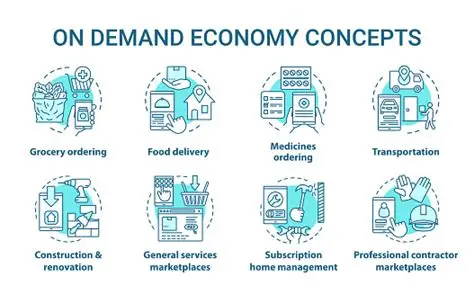
The most successful business models often begin with a simple observation.
People don't wake up hoping to buy another product.
They wake up hoping to solve a problem.
They want transportation to work.
Dinner to arrive.
A doctor to be available.
Software to function.
Education to fit into an already crowded schedule.
For decades, businesses asked customers to organize their lives around company hours, inventory limitations, and operational schedules.
The on-demand economy reversed that relationship.
Instead of asking customers to wait, businesses began asking a different question:
"How quickly can we respond when someone needs us?"
That shift transformed far more than delivery times.
It reshaped expectations.
Convenience became part of the product.
Availability became a competitive advantage.
Responsiveness became a business strategy.
The on-demand economy works because it removes friction between desire and fulfillment.
Technology certainly makes that possible.
But technology is only the mechanism.
The real innovation is designing organizations around the customer's timeline rather than the organization's.
What Is the On-Demand Economy?
The on-demand economy is a business model that enables customers to access products or services whenever they need them, usually through digital platforms that coordinate requests, payments, and fulfillment in real time.
Rather than relying on fixed schedules or lengthy purchasing processes, customers initiate interactions whenever they choose.
Businesses respond as efficiently as possible.
This model emphasizes:
- Speed
- Flexibility
- Convenience
- Accessibility
- Customer control
Those characteristics distinguish on-demand businesses from many traditional service models.
How the On-Demand Economy Works
Although every industry operates differently, most on-demand businesses follow a remarkably similar process.
Step 1: A Customer Identifies a Need
Every transaction begins with demand.
A customer needs transportation.
Professional advice.
Food delivery.
Entertainment.
Healthcare.
Education.
The need may arise unexpectedly or be carefully planned.
The timing belongs to the customer.
Step 2: A Digital Platform Receives the Request
Instead of making phone calls or visiting physical locations, customers typically submit requests through websites or mobile applications.
The platform becomes the central coordinator.
It collects information, processes payments, and identifies available providers.
Step 3: Supply Is Matched With Demand
Behind the scenes, sophisticated software evaluates available resources.
Providers.
Inventory.
Location.
Availability.
Capacity.
The platform determines the best match based on speed, quality, and efficiency.
This matching process happens almost instantly.
Step 4: Fulfillment Begins
Once a provider accepts the request, the product or service is delivered.
Depending on the industry, fulfillment may involve:
- Physical delivery
- Digital access
- Virtual consultation
- Software activation
- Appointment scheduling
- Educational enrollment
Customers receive updates throughout the process.
Transparency reduces uncertainty.
Step 5: Feedback Improves the System
After completion, customers frequently rate their experience.
Those evaluations help maintain quality while improving future recommendations.
Continuous feedback becomes part of the operating model.
Why Customers Embrace the On-Demand Economy
The appeal extends beyond speed.
Several psychological factors contribute to its popularity.
Control
Customers choose when interactions occur.
They no longer adapt to business schedules.
Convenience
Ordering, payment, communication, and tracking occur within a unified experience.
Fewer obstacles encourage greater participation.
Transparency
Digital platforms often display pricing, availability, estimated delivery times, and customer reviews before purchases occur.
Information reduces uncertainty.
Flexibility
Customers can frequently compare providers before making decisions.
Choice improves confidence.
Traditional Commerce vs. On-Demand Commerce
The differences extend well beyond technology.
| Business Characteristic | Traditional Model | On-Demand Model |
|---|---|---|
| Customer Scheduling | Business-controlled | Customer-controlled |
| Service Availability | Fixed hours | Flexible access |
| Ordering Process | Multiple steps | Streamlined digital workflow |
| Fulfillment Speed | Often delayed | Immediate or near-immediate |
| Customer Communication | Limited updates | Continuous notifications |
| Data Usage | Operational reporting | Real-time optimization |
These distinctions explain why customer expectations have changed so dramatically.
Industries Using the On-Demand Model
The model has expanded far beyond its earliest applications.
Transportation
Ride-sharing services transformed personal transportation by matching drivers and passengers almost instantly.
Retail
Consumers increasingly expect same-day delivery, curbside pickup, and flexible fulfillment options.
Healthcare
Virtual appointments, prescription management, and digital scheduling improve access to care.
Education
Learning platforms provide immediate enrollment and self-paced instruction.
Students begin learning whenever they choose.
Professional Services
Consulting, coaching, legal advice, and financial planning increasingly incorporate virtual, on-demand interactions.
Convenience broadens access.
The Role of Technology
Technology enables the on-demand economy, but it does not define it.
Several systems work together behind the scenes.
Cloud Infrastructure
Cloud computing supports continuous platform availability while allowing organizations to scale efficiently.
Digital Payments
Secure payment systems eliminate unnecessary delays during checkout.
Transactions become nearly invisible.
Artificial Intelligence
AI improves:
- Recommendations
- Scheduling
- Customer support
- Personalization
- Demand forecasting
Smarter systems improve customer experiences while increasing operational efficiency.
Data Analytics
Businesses continuously analyze customer behavior.
Patterns reveal opportunities to improve speed, quality, and resource allocation.
A Lesson I Learned About Convenience
Several years ago, I advised a membership organization that wanted to increase member engagement.
Leadership initially focused on creating more educational content.
The assumption seemed reasonable.
More resources should produce more participation.
Instead, engagement remained surprisingly flat.
When we interviewed members, a different issue emerged.
Finding existing resources required too much effort.
Navigation felt confusing.
Important materials were buried several clicks deep.
The organization simplified the experience.
Search improved.
Popular resources became easier to discover.
Personalized recommendations guided members toward relevant content.
Participation increased without creating significant amounts of new material.
That project reinforced an important insight.
Customers don't simply value more options.
They value easier access to the right option at the right moment.
Convenience often creates more value than abundance.
Benefits for Businesses
The on-demand model creates several organizational advantages.
Increased Customer Satisfaction
Reducing delays generally improves customer experiences.
Satisfied customers return more frequently.
Better Resource Allocation
Organizations can dynamically match capacity with changing demand.
Efficiency improves.
Greater Market Reach
Digital platforms remove many geographic limitations.
Businesses serve broader audiences.
Valuable Customer Insights
Continuous interactions generate useful behavioral data.
Organizations refine products based on real customer needs.
Challenges of the On-Demand Economy
Every business model introduces trade-offs.
The on-demand economy is no exception.
Operational Complexity
Fast service requires sophisticated logistics and careful coordination.
Behind every seamless experience lies considerable planning.
Rising Expectations
Customers quickly become accustomed to convenience.
Meeting those expectations consistently requires ongoing investment.
Balancing Speed With Quality
Immediate fulfillment should never compromise reliability.
Organizations that prioritize both speed and excellence tend to earn greater loyalty.
Maintaining Human Relationships
Automation simplifies processes.
Meaningful customer relationships still require empathy, responsiveness, and trust.
Technology supports people.
It does not replace them.
On-Demand Does Not Mean Disposable
One misconception deserves attention.
Some assume on-demand businesses naturally create short-term customer relationships.
That isn't necessarily true.
Many successful organizations combine on-demand convenience with recurring memberships or subscriptions.
Customers enjoy immediate access while maintaining long-term relationships.
Convenience attracts.
Consistency retains.
Together, they create remarkably durable business models.
The Future of the On-Demand Economy
Artificial intelligence will increasingly anticipate customer needs.
Predictive systems will recommend services before customers begin searching.
Automation will improve fulfillment.
Connected devices will simplify everyday purchasing decisions.
Yet despite these technological advances, the central promise remains surprisingly stable.
People want businesses that respect their time.
Organizations that consistently reduce friction will continue earning customer trust.
Convenience Builds Expectations. Trust Builds Loyalty.
The on-demand economy is often described as a technological revolution.
That description overlooks something important.
Technology merely enables responsiveness.
Customers ultimately remain loyal because organizations deliver reliable experiences repeatedly.
Every successful interaction reinforces confidence.
Every fulfilled request strengthens trust.
Without trust, convenience becomes interchangeable.
With trust, convenience becomes a competitive advantage.
The Better Question
Business leaders frequently ask:
"How does the on-demand economy work?"
Operationally, the answer is straightforward.
Customers request.
Platforms coordinate.
Providers deliver.
Technology manages the connections.
Strategically, however, another question matters far more.
"How can we remove unnecessary effort from our customers' lives?"
That question transforms business design.
Organizations stop measuring success solely by transaction speed.
They begin measuring ease.
Clarity.
Reliability.
Confidence.
Because the most successful on-demand businesses do more than respond quickly.
They create experiences that feel almost effortless.
Customers accomplish what they came to do without unnecessary obstacles.
That simplicity is not accidental.
It is carefully designed.
And when convenience consistently aligns with trust, businesses create relationships that extend well beyond a single transaction.
The on-demand economy, at its best, is not simply about delivering faster.
It is about making life easier—one interaction at a time.
- Arts
- Business
- Computers
- Juegos
- Health
- Home
- Kids and Teens
- Money
- News
- Personal Development
- Recreation
- Regional
- Reference
- Science
- Shopping
- Society
- Sports
- Бизнес
- Деньги
- Дом
- Досуг
- Здоровье
- Игры
- Искусство
- Источники информации
- Компьютеры
- Личное развитие
- Наука
- Новости и СМИ
- Общество
- Покупки
- Спорт
- Страны и регионы
- World

 English
 Russian
 French
 Portuguese
 Deutsch
 Turkish
 Dutch
Dutch
 Italiano
 Arabic
 Romaian
 Portuguese (Brazil)
 Greek
Greek