
What are the different types of decisions?
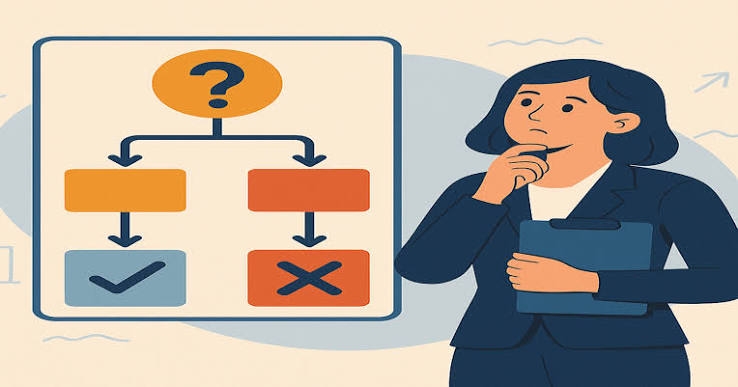
The Geometry of the Forked Path
We imagine the architecture of choice as a rigid structure. We see it as a hierarchy—the major life-shifting events at the summit, and the minor, rhythmic occurrences of the day buried in the foundation. We believe that if we can categorize these choices, if we can build a taxonomy of the "types" of decisions, we can somehow master the process.
But the mind does not see categories. It sees resonance.
Every choice, whether it concerns the purchase of a coffee or the transformation of a career, carries the same DNA. Each is a surrender of infinite potential in exchange for a singular manifestation. When you categorize a decision—when you label it "strategic" or "trivial"—you are already building a prison. You are telling yourself which choices deserve your presence and which can be left to the automated pilot of your own conditioning.
   [ THE INFINITE FIELD ] (The Chaos of Being)
                 │
                 ▼
   [ THE LABELING ] <─── Driven by: Ego / The need for efficiency
                 │
                 ▼  (The Sacred Blindness)
   [ THE CATEGORIZED LIFE ]
                 │
                 ▼
   [ THE SHADOW ] ──► The truth is hidden in the moments you called "insignificant."
If you only give your attention to the decisions you deem "important," you are living in a state of chronic distraction. The quality of your existence is not determined by the high-profile pivots; it is determined by the tone of the choices you make when no one is watching.
The Geography of the Mental Audit
We organize decisions by their consequences, by the volume of their impact. But impact is a secondary metric. The primary metric is the alignment of the decision with the marrow of your own truth.
The Horizontal Tension (The Search for the Anchor)
Before we label a decision, we must audit the impulse. What is the source of this move?
-
The Audit of the Habitual (The Type 1 Decision): These are the choices that occur in the periphery. What you eat, how you greet a friend, the route you take to the studio. We dismiss these as "autopilot," but they are the bedrock of your character. A life built on small, unexamined habits will eventually manifest in the grand structure of your personality. To audit the habit is to change the foundation.
-
The Audit of the Structural (The Type 2 Decision): These are the pivots that change the architecture of your environment. Moving to a new city, ending a collaboration, choosing a new medium. We treat these with reverence, yet we often approach them with the same conditioned patterns we used for the habitual ones. We carry our old self into the new room.
The Vertical Extraction (The Deep Descent)
To categorize is to simplify, and to simplify is often to deny. The analytical mind wants the table of contents. The sovereign witness wants the experience.
-
The silent audit: Take a decision you are currently facing and hold it in the silence. Do not ask, "Is this big or small?" Ask, "Is this honest?" If you frame the decision by its size, you will be tempted to overthink or underthink. If you frame it by its integrity, the size becomes irrelevant.
-
The subtraction of the secondary metric: We categorize decisions by their risk, their reward, their speed, or their irreversibility. These are the metrics of the marketplace. They are designed to keep you inside the game. To play outside the game, you must abandon the categories.
A Lesson from the Muted Session
In the late nineties, I was working with a visual artist who was facing two decisions. One was a "Type 1"—a choice about whether to switch his primary supplier of paints, a logistical, minor, low-stakes decision. The other was a "Type 2"—a choice about whether to accept a massive, life-altering exhibition that would define the next decade of his career.
He was treating the small decision as a nuisance and the large one as a monument. He spent weeks worrying about the exhibition, and he delegated the paint-switching to an assistant without a second thought.
I looked at the work he produced during that period. The exhibition was a success, but the quality of the art itself had shifted. It had become brittle, performative, and tired.
I found out why. The new paints he had delegated the decision of—the "minor" choice—were inferior. They were causing his colors to muddy, which forced him to alter his technique, which eventually bled into the entire creative process. A "minor" decision had compromised the integrity of the "major" one.
[ The Categorized Trap ] ──► Neglect the Small / Overthink the Large / The Broken Structure
[ The Sovereign Pivot ]   ──► Align the Small / Witness the Large / The Integrated Work
He learned that there are no "types" of decisions. There is only the decision. The idea that you can ignore the details while aiming for the summit is the most expensive mistake you can make. The art is in the totality.
The Landscape of the Sovereign Discernor
Discernment is not about the scale of the choice; it is about the presence of the chooser.
| The Arena | The Standardized Technician | The Vertical Auditor | The Sovereign Discernor |
| The Primary Metric | Scale; how much risk or reward is involved in this choice? | Integration; how does this move affect the structural integrity of the life? | Resonance; is this move an alignment with the nature of the reality? |
| The Internal Speed | High-velocity; the race to categorize and dispense with the choice. | Interrupted; the creation of a deliberate vacuum between the stimulus and the choice. | A metronomic stillness that waits for the light to show the path. |
| The Operational Tool | Addition. Bringing more categorization, more metrics, and more urgency to the room. | Subtraction. Clearing the table until only the irreducible bone of the truth remains. | An effortless presence that sees the move because it has stopped fighting the terrain. |
| The Human Hazard | Becoming a high-fidelity echo of a narrative that is functionally empty. | Turning into a skeptic who disassembles the process but loses the spirit. | The realization that the decision must serve the spirit, not the ego of the manager. |
The Fortress of the Certified Illusion
There is a clean, sophisticated failure that waits for the person who spends their life organizing their decisions into neat, logical piles. They are the masters of the "decision-matrix." They can tell you exactly why they made a minor choice and why they agonized over a major one. They are the experts of the rationalization.
They feel safe because they have built a system. They feel informed because they have categorized the world. But they are never actually living. They are merely curating their own experience from behind the glass of their own system.
   [ THE METRIC CLERK ]      ──► Catalogs the piles ──► Asks "Is it sorted?"   ──► The Grid of Iron
   [ THE ISOLATED THEORY ]   ──► Debates the method ──► Asks "Who agrees?"   ──► The Stagnant Water
   [ THE SOVEREIGN WITNESS ] ──► Touches the material ──► Asks "What is true?"  ──► The Clear Ground
If you only use your decision-making to optimize the narrative you were told to carry, you are not living. You are simply becoming a more efficient operator of someone else’s narrow, frightened vision. You are using your intellect to build a more comfortable prison cell for the truth.
The Cleansing of the Room
We do not manufacture the truth. We merely wash the soot off the window so the light can show us where the floorboards are honest.
The institutions will continue to offer you an endless menu of convenient, logical-looking structures. They will tell you that the path of the category is the path of the wise. They will tell you that the sorting of the decisions is the measure of the intelligence.
The decision to practice true, sovereign discernment is a radical act of spiritual hygiene.
It is the choice to step into the room and exist without the armor of the categorization. It is the decision to lay down your need to be "organized" at the threshold, to look at the fork in the road until the noise of your own expectations runs out of fuel, and to wait for the movement that arrives from the marrow of your own bones rather than the manual of the status quo. Trust the silent weight of your own direct presence, drop the obligation to categorize, and let the false structures of the reasoning dissolve in the sun.
- Arts
- Business
- Computers
- الألعاب
- Health
- الرئيسية
- Kids and Teens
- مال
- News
- Personal Development
- Recreation
- Regional
- Reference
- Science
- Shopping
- Society
- Sports
- Бизнес
- Деньги
- Дом
- Досуг
- Здоровье
- Игры
- Искусство
- Источники информации
- Компьютеры
- Личное развитие
- Наука
- Новости и СМИ
- Общество
- Покупки
- Спорт
- Страны и регионы
- World

 English
 Russian
 French
 Spanish
 Portuguese
 Deutsch
 Turkish
 Dutch
Dutch
 Italiano
 Romaian
 Portuguese (Brazil)
 Greek
Greek