
What is a decision tree?
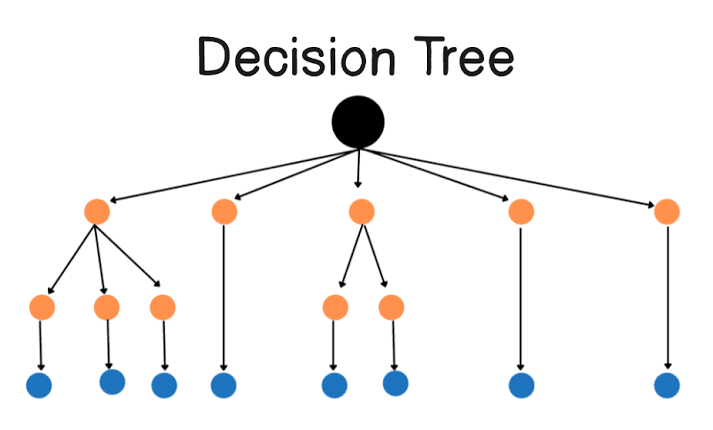
The Geometry of the Forked Path
We are obsessed with the illusion of the roadmap. We look at the complexity of our lives—the sprawling, messy, unscripted tangle of our daily movements—and we feel a desperate need to categorize it. We want to draw lines. We want to see the branches. We want to believe that if we can just map out the "if this, then that" of our existence, we will finally be in control.
This is the origin of the decision tree. It is a visual testament to our fear of the unknown.
A decision tree is a map of a ghost. It attempts to capture the living, breathing reality of a human life and freeze it into a static, binary structure. It tells you: "If you do A, B will happen; if you do C, D will follow." It suggests that the future is a series of predictable consequences that can be managed, manipulated, and mitigated if you just draw the right diagram.
But the tree is not the forest. The tree is a way of looking away from the forest so that you don't have to face the terrifying, beautiful depth of the woods.
   [ THE POINT OF ORIGIN ] (The Present Moment)
                 │
                 ▼
   [ THE BRANCHING ] <─── The ego’s attempt to calculate the safety of the outcome.
                 │
                 ▼  (The Static Prediction)
   [ THE TERMINAL NODE ]
                 │
                 ▼
   [ THE NARROW REALITY ] ──► You have arrived at a destination you built, not one you discovered.
When you use a decision tree, you are not choosing. You are merely calculating the most efficient way to survive the consequences of your own fear.
The Geography of the Mental Audit
We live in a culture that mistakes the complexity of a diagram for the depth of wisdom. We admire the people who have the most detailed trees, the ones who can show us the branching logic of their entire existence. We call them "strategists." We call them "visionaries."
But these people are usually the most alienated from their own intuition.
The Horizontal Tension (The Search for the Anchor)
Before you commit to the structure, audit the terrain. Why do you feel the need to see the branches?
-
The audit of the control: You want a decision tree because you are terrified of being wrong. You want to see the error coming before it arrives. But the error is not an event; it is a part of the process. If you are not willing to be wrong, you are not willing to be alive.
-
The friction of the counter-narrative: The decision tree assumes the world is a static set of rules. It is not. The world is a living, shifting field of resonance. Every time you make a move, the entire field changes. The tree you drew an hour ago is already obsolete.
The Vertical Extraction (The Deep Descent)
To transcend the logic of the branches, you must sink below the level of the diagram.
-
The silent audit: Stop drawing. Look at the decision. How does it feel in your chest? Does the thought of the "if this" cause a tightening of the gut? That isn't a variable in an equation. That is your own internal compass reporting the frequency of the reality.
-
The subtraction of the secondary metric: We categorize decisions by their "expected value." This is the language of the machine. It is a way of stripping the human element out of the choice so that it can be processed by a cold, binary logic. To be human is to make the choice that feels right, even when the math suggests it is wrong.
A Lesson from the Muted Session
In the winter of two thousand and three, I was working with a brilliant creative director who had built a career on the back of his "decision trees." He had a wall in his office covered in intricate, color-coded flowcharts that detailed every possible turn his projects could take. He could tell you the outcome of any variable, any pivot, any budget cut.
He was a master of the logic. He was a prisoner of the map.
I told him: "You have built the most beautiful prison I have ever seen. You have thought of everything. There is no room in this project for the truth to happen."
He was offended. He thought I was dismissing his work. I wasn't. I was acknowledging it. His work was flawless. It was also completely devoid of life. It was a sterile, optimized output of a system that had no capacity for the unexpected.
"If you don't delete the tree," I told him, "you will never hear the song. The song is not on the branch. The song is in the wind."
He struggled with it. For three days, he couldn't let go of the diagrams. He felt naked without them. He felt that he was losing his authority. But on the fourth day, he took the paper down. He stopped trying to anticipate the direction of the team. He started listening to them instead.
He didn't make a better decision based on the tree; he made a more difficult decision based on the resonance of the room. He realized that the "wrong" path, the one that wasn't on his diagram, was actually the only path that mattered.
[ The Branching Logic ] ──► Calculate Outcomes / Protect the Ego / The Dead Project
[ The Sovereign Pivot ] ──► Face the Truth / Own the Result / The Living Work
He learned that the decision tree was a way to keep the world at arm's length. He had to be willing to be lost before he could truly find the work.
The Landscape of the Sovereign Chooser
Decisiveness is the practice of moving through the world without a map. It is the ability to stand in the middle of the forest and know the path because you can feel the pulse of the terrain.
| The Arena | The Standardized Planner | The Vertical Auditor | The Sovereign Chooser |
| The Primary Metric | Branching logic; does the tree account for all the variables? | Integration; does the move maintain the integrity of the witness? | Resonance; is the move an alignment with the nature of the reality? |
| The Internal Speed | High-velocity; the desperate race to calculate the outcome. | Interrupted; the creation of a deliberate vacuum between the thought and the action. | A metronomic stillness that waits for the light to show the path. |
| The Operational Tool | Addition. Bringing more nodes, more probabilities, and more logic to the paper. | Subtraction. Clearing the table until only the irreducible choice remains in the room. | An effortless presence that sees the move because it has stopped fighting the terrain. |
| The Human Hazard | Becoming a high-fidelity echo of the system’s logic and fear. | Turning into a skeptic who disassembles the process but loses the spirit. | The realization that you must bear the weight of the move alone, without armor. |
The Fortress of the Certified Illusion
There is a clean, sophisticated failure that waits for the person who spends their life drawing the trees. They are the favorites of the boardroom, the ones who can always justify their choices with a chart. They can tell you exactly why they are doing what they are doing, citing the specific branch they are on.
They feel smart because they are "aware of the complexities." They feel safe because they have "accounted for the outcomes." But they are never actually living. They are merely curating their own experience from behind the glass of their own diagrams.
   [ THE METRIC CLERK ]      ──► Catalogs the nodes ──► Asks "Is it predicted?"  ──► The Grid of Iron
   [ THE ISOLATED THEORY ]   ──► Debates the diagram ──► Asks "Who agrees?"    ──► The Stagnant Water
   [ THE SOVEREIGN WITNESS ] ──► Touches the material ──► Asks "What is true?"   ──► The Clear Ground
If you only use your decision tree to optimize the safety of your current position, you are not choosing. You are simply becoming a more efficient operator of someone else’s narrow, frightened vision. You are using your intellect to build a more comfortable prison cell for the truth.
The Cleansing of the Room
We do not manufacture the truth. We merely wash the soot off the window so the light can show us where the floorboards are honest.
The institutions will continue to offer you an endless menu of convenient, logic-looking maps. They will tell you that the path of the diagram is the path of the wise. They will tell you that the density of your branches is the measure of your intelligence.
The decision to practice true, sovereign discernment is a radical act of spiritual hygiene.
It is the choice to step into the room and exist without the armor of the diagram. It is the decision to lay down your need to be "correct" at the threshold, to look at the fork in the road until the noise of your own expectations runs out of fuel, and to wait for the movement that arrives from the marrow of your own bones rather than the manual of the status quo. Trust the silent weight of your own direct presence, drop the obligation to draw the tree, and let the false structures of the reasoning dissolve in the sun.
- Arts
- Business
- Computers
- Jogos
- Health
- Início
- Kids and Teens
- Money
- News
- Personal Development
- Recreation
- Regional
- Reference
- Science
- Shopping
- Society
- Sports
- Бизнес
- Деньги
- Дом
- Досуг
- Здоровье
- Игры
- Искусство
- Источники информации
- Компьютеры
- Личное развитие
- Наука
- Новости и СМИ
- Общество
- Покупки
- Спорт
- Страны и регионы
- World

 English
 Russian
 French
 Spanish
 Portuguese
 Deutsch
 Turkish
 Dutch
Dutch
 Italiano
 Arabic
 Romaian
 Greek
Greek