
What Industries Use On-Demand Models?
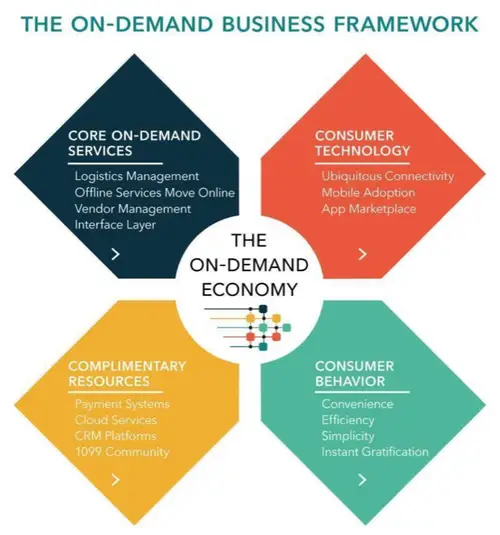
The most revealing business innovations often hide in plain sight.
You request a ride from your phone.
A physician appears on your screen for a virtual consultation.
You enroll in a professional course during your lunch break.
Dinner arrives before you've finished answering emails.
By evening, you're streaming a documentary that wasn't scheduled by a television network, but selected entirely on your own terms.
These interactions seem unrelated.
Transportation.
Healthcare.
Education.
Food.
Entertainment.
Yet they all operate according to the same underlying principle.
They respond when the customer is ready—not when the business is.
That subtle shift has become one of the defining characteristics of modern commerce.
The on-demand model has expanded far beyond technology startups and delivery services. Today, it influences nearly every sector where convenience, flexibility, and customer control create meaningful value.
The question is no longer whether an industry can adopt an on-demand approach.
The more interesting question is where the model creates the greatest advantage.
What Is an On-Demand Model?
An on-demand model enables customers to access products or services whenever they need them, typically through digital platforms that coordinate requests, payments, scheduling, and fulfillment.
Instead of requiring customers to adapt to fixed schedules, businesses design experiences around customer timing.
Technology supports the process.
Customer convenience defines it.
Although implementation differs across industries, successful on-demand organizations generally prioritize:
- Immediate or flexible access
- Streamlined digital experiences
- Transparent communication
- Customer choice
- Operational responsiveness
Those principles appear in far more industries than many people realize.
Why So Many Industries Are Adopting On-Demand Models
The rapid expansion of on-demand services reflects changing customer expectations rather than technological novelty alone.
People increasingly value experiences that reduce unnecessary effort.
They expect businesses to respect their schedules.
That expectation influences purchasing decisions across nearly every category.
Organizations adopting on-demand models often improve:
- Customer satisfaction
- Engagement
- Operational efficiency
- Resource utilization
- Long-term loyalty
The specific benefits vary by industry, but the underlying objective remains remarkably consistent.
Remove friction.
Transportation
Transportation remains one of the most recognizable examples of the on-demand economy.
Customers request rides whenever needed rather than relying exclusively on predetermined schedules.
Key advantages include:
- Flexible availability
- Real-time driver matching
- Digital payments
- Live tracking
- Route optimization
Transportation shifted from schedule-based planning to customer-directed convenience.
Food and Restaurant Services
Restaurants increasingly extend their operations through on-demand ordering and delivery.
Customers browse menus, customize meals, pay digitally, and monitor delivery progress in real time.
Convenience becomes part of the dining experience rather than simply an additional service.
Many restaurants now balance traditional dining with digital fulfillment.
Grocery and Retail
Retail has evolved significantly.
Customers increasingly expect:
- Same-day delivery
- Buy online, pick up in store
- Scheduled delivery windows
- Personalized recommendations
- Digital inventory visibility
Retailers adopting flexible fulfillment strategies often strengthen customer satisfaction while expanding purchasing options.
Healthcare
Healthcare has embraced on-demand capabilities where appropriate.
Examples include:
- Virtual consultations
- Online appointment scheduling
- Prescription renewals
- Remote monitoring
- Digital patient communication
Not every medical service can be delivered immediately.
Many routine interactions, however, have become substantially more accessible.
Education
Learning no longer depends entirely on semester calendars.
Educational organizations increasingly provide:
- Self-paced courses
- On-demand video instruction
- Digital certification programs
- Recorded workshops
- Learning libraries
Students learn according to personal schedules rather than institutional timetables.
Accessibility expands participation.
Financial Services
Banks and financial institutions increasingly offer on-demand experiences through digital platforms.
Customers now expect immediate access to:
- Account information
- Fund transfers
- Investment tools
- Financial advice
- Loan applications
The branch remains important for certain services.
Routine financial management increasingly occurs whenever customers choose.
Professional Services
Knowledge-based businesses have also embraced greater flexibility.
Consultants, attorneys, accountants, coaches, and advisors increasingly provide virtual appointments that reduce travel while improving scheduling convenience.
Customers receive expertise more quickly.
Professionals reach broader markets.
Home Services
Scheduling household services has become considerably simpler.
Customers request:
- Cleaning services
- Appliance repairs
- Landscaping
- Plumbing
- Electrical work
- Furniture assembly
Digital platforms coordinate scheduling while improving communication throughout the process.
Entertainment and Media
Few industries illustrate customer control more clearly.
Instead of adapting to programming schedules, audiences determine:
- What to watch
- When to watch
- Which device to use
- How long to engage
Content remains continuously available rather than tied to broadcast calendars.
Software and Technology
Software increasingly operates through continuous access rather than one-time purchases.
Customers receive:
- Automatic updates
- Cloud access
- Flexible scalability
- Immediate activation
- Continuous improvements
Many software providers combine on-demand accessibility with recurring subscription revenue.
Fitness and Wellness
Fitness organizations increasingly blend live instruction with flexible digital experiences.
Members participate through:
- Recorded workouts
- Virtual coaching
- Mobile training plans
- Nutrition guidance
- Meditation sessions
Health programs adapt to customer lifestyles rather than requiring fixed attendance.
Comparing Industries That Use On-Demand Models
Although implementation varies, the customer experience shares striking similarities.
| Industry | Traditional Approach | On-Demand Approach | Primary Customer Benefit |
|---|---|---|---|
| Transportation | Scheduled rides | Immediate requests | Convenience |
| Restaurants | Dine-in only | Digital ordering and delivery | Flexibility |
| Grocery | Store visits | Delivery and pickup | Time savings |
| Healthcare | Office appointments | Virtual access | Accessibility |
| Education | Scheduled classes | Self-paced learning | Convenience |
| Financial Services | Branch visits | Digital banking | Immediate access |
| Professional Services | Office meetings | Virtual consultations | Efficiency |
| Home Services | Phone scheduling | Digital booking | Simplicity |
| Entertainment | Broadcast schedules | Streaming libraries | Customer control |
| Software | One-time installation | Cloud access | Continuous availability |
Different industries.
One consistent philosophy.
Serve customers when they need you.
The Relationship Between On-Demand and Membership
Interestingly, many organizations combine on-demand delivery with recurring memberships.
Rather than purchasing individual transactions repeatedly, customers subscribe for ongoing access.
Examples include:
- Streaming platforms
- Learning communities
- Fitness memberships
- Software platforms
- Professional associations
This combination offers distinct advantages.
On-demand increases usage.
Membership strengthens relationships.
Recurring revenue supports continuous improvement.
Everyone benefits when the experience consistently delivers value.
A Lesson I Learned About Accessibility
Several years ago, I worked with an organization that believed declining engagement required creating additional educational content.
Every strategic discussion centered on expanding the library.
More webinars.
More articles.
More downloadable resources.
Yet member participation remained surprisingly stable.
When we interviewed members, a different story emerged.
The problem wasn't quantity.
It was accessibility.
Finding relevant resources required too much effort.
Navigation created friction.
Members spent more time searching than learning.
The organization simplified the experience.
Improved search functionality.
Personalized recommendations.
Clearer organization.
Usage increased almost immediately.
That experience reinforced an important lesson.
Customers often value easier access more than additional options.
Convenience multiplies existing value.
Why the On-Demand Model Works Across Industries
Different industries deliver different products.
Yet successful on-demand organizations consistently remove similar forms of friction.
They simplify:
- Discovery
- Ordering
- Scheduling
- Payment
- Communication
- Access
Reducing effort frequently improves customer satisfaction as much as expanding features.
Organizations sometimes underestimate how valuable simplicity can be.
Challenges Every Industry Faces
Adopting an on-demand model introduces meaningful responsibilities.
Rising Expectations
Convenience quickly becomes the standard.
Customers expect consistently excellent experiences.
Operational Complexity
Real-time fulfillment requires sophisticated coordination behind the scenes.
Smooth customer experiences depend upon disciplined operations.
Maintaining Quality
Faster service should never reduce reliability.
Customers value speed.
They remember consistency.
Building Long-Term Loyalty
Convenience attracts first-time users.
Relationships encourage repeat participation.
Organizations must invest in both.
The Future of On-Demand Industries
Artificial intelligence will improve personalization.
Automation will streamline fulfillment.
Predictive analytics will anticipate customer needs.
Connected technologies will simplify routine decisions.
Yet the most enduring competitive advantage may remain surprisingly human.
Respecting customers' time.
Organizations that consistently remove unnecessary effort while maintaining trust will continue strengthening customer relationships regardless of technological change.
Convenience Is Becoming Universal
Business leaders sometimes ask whether their industry is suitable for an on-demand model.
Increasingly, that question misses the larger trend.
Customers compare experiences across industries.
If ordering groceries feels effortless, they naturally wonder why scheduling healthcare remains difficult.
If streaming education works seamlessly, they question complicated software onboarding.
Every outstanding customer experience quietly raises expectations elsewhere.
Convenience travels.
The Better Question
Many organizations ask:
"What industries use on-demand models?"
The answer continues expanding.
Transportation.
Healthcare.
Retail.
Education.
Finance.
Professional services.
Fitness.
Entertainment.
Home services.
Technology.
And many others.
The more valuable question is different.
"Which parts of our customer experience still require unnecessary waiting?"
That question changes strategic thinking.
It shifts attention away from copying competitors and toward removing friction.
Because the most successful on-demand organizations are not defined by the industries they serve.
They are defined by the obstacles they eliminate.
They respect customers' schedules.
They simplify decisions.
They create confidence that products, services, expertise, or support will be available whenever needed.
That promise has proven remarkably adaptable across industries.
It is also unlikely to become less important anytime soon.
- Arts
- Business
- Computers
- Giochi
- Health
- Home
- Kids and Teens
- Money
- News
- Personal Development
- Recreation
- Regional
- Reference
- Science
- Shopping
- Society
- Sports
- Бизнес
- Деньги
- Дом
- Досуг
- Здоровье
- Игры
- Искусство
- Источники информации
- Компьютеры
- Личное развитие
- Наука
- Новости и СМИ
- Общество
- Покупки
- Спорт
- Страны и регионы
- World

 English
 Russian
 French
 Spanish
 Portuguese
 Deutsch
 Turkish
 Dutch
Dutch
 Arabic
 Romaian
 Portuguese (Brazil)
 Greek
Greek