
How do I decide between two options?
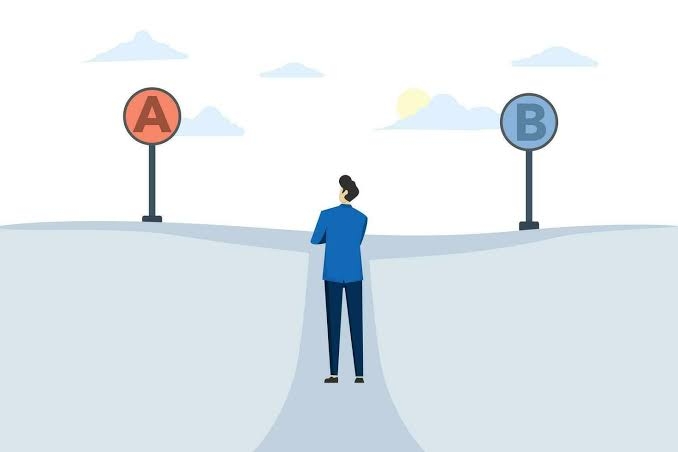
The Architecture of the Binary Trap
We sit before the crossroad, convinced that our hesitation is a symptom of a missing piece of data. We tell ourselves that if we could just unearth one more metric, refine our projection by a decimal point, or consult one more expert, the fog would lift and the path would reveal itself. We treat the binary choice—Option A versus Option B—as a logic puzzle. We assume that the ambiguity of the situation is an external phenomenon, a failure of the world to present us with sufficient clarity.
It is a profound, systemic delusion.
When you find yourself deadlocked between two alternatives, you are not failing to solve a problem. You are actively participating in a cognitive distortion. The paralysis is not coming from the scarcity of information. It is coming from the abundance of your own hidden biases. You are standing in a hall of mirrors, and you are mistaking the refraction of your own ego for the complexity of the landscape.
To decide between two options is not an act of discovery. It is an act of procedural hygiene. You do not need more information; you need a more disciplined environment in which to process what you already possess.
The Procedural Failure of the Ledger
We are obsessed with the "pros and cons" list. It is the primitive, default architecture of the human mind. We draw a line down the center of a page, we jot down the upsides, we jot down the downsides, and we wait for the visual weight of the ink to tell us the truth.
But the ledger is a theater of rationalization, not a tool of truth.
The Illusion of Equilibrium
When we are conflicted, our minds engage in a relentless, unconscious campaign to manufacture balance. If I want to choose Option A, my brain will work overtime to inflate the perceived value of A’s benefits and diminish the gravity of its risks. Simultaneously, it will perform a surgical strike on Option B, magnifying its flaws until it appears untenable.
The ledger is not an objective assessment. It is a post-hoc justification for a decision that your subconscious has often already made.
The Decoupling of Decision and Reality
I recall a client, a high-level executive tasked with choosing between two acquisition targets. The teams were deadlocked. The "pros and cons" lists were exhaustive, meticulously documented, and utterly useless. They had built a mountain of data, but they hadn't built a process. They were treating the decision as a search for the "correct" answer, ignoring the reality that both paths carried unknown, systemic risks that no spreadsheet could capture.
We didn't need more data on the acquisition targets. We needed to break the loop of their collective rationalization.
The Taxonomy of Strategic Paralysis
Before you can break the deadlock, you must categorize the distortion. We must move beyond the simple binary and toward a structural audit of our assumptions.
| The Distortion | The Behavioral Symptom | The Structural Fix |
| Loss Aversion | An obsession with the potential downside of both paths, preventing any forward motion. | Frame the decision as a "gain" shift: Which option moves me closer to the desired future? |
| Choice Overload | Paralyzing anxiety caused by an exaggerated perception of the difference between options. | Implement a "forced choice": If you had to pick one in five minutes, which would it be? |
| Status Quo Bias | Assigning an irrational premium to the existing path, despite evidence of its inadequacy. | Perform a "vanishing option" audit: What would you do if both A and B were unavailable? |
| Confirmation Bias | Actively soliciting advice only from those who are known to favor one option. | Solicit a "disconfirming inquiry": Ask a neutral party to argue for the path you least prefer. |
Designing for Strategic Humility
If we accept that the human mind is structurally ill-equipped for binary evaluation in complex environments, our role as deciders must evolve. We are not the ones who possess the truth. We are the ones who possess the procedural discipline to withstand our own ignorance.
The Power of the "Vanishing Option" Audit
When you are trapped between two choices, you are suffering from a lack of perspective. You are locked in a zero-sum game of your own design.
Try this: Imagine that both Option A and Option B have suddenly vanished. Perhaps a competitor has claimed them, or a change in the environment has rendered them impossible. What is your third option? By forcing your brain to exit the binary frame, you often uncover a superior path that was hiding in the shadow of your own fixation.
The Art of the "Red Team" Inquiry
Do not ask for "advice." Advice is social and usually filtered to protect your ego. Instead, ask for a "dismantling." Find someone who does not care about your success—someone with no stake in the outcome—and give them one task: Prove that both of my options are wrong. The goal is not to find the "better" of the two; the goal is to survive the interrogation of your own assumptions.
A Lesson in Intellectual Humility
I was once involved in a high-stakes decision regarding a major career pivot. I was caught between staying in a stable, established industry and leaping into a volatile, unproven venture. My "pros and cons" list was a masterpiece of logical, self-serving architecture. Every line item reinforced the safety of the status quo while framing the leap as a reckless, ego-driven gamble.
I was stuck. I felt the pressure, the anxiety, and the paralyzing need to be "right."
I decided to create a "Red Team" for my own life. I presented my list to a mentor who had absolutely no interest in my professional trajectory. He didn't look at the list. He didn't ask about the salary, the prestige, or the long-term projections.
He asked: "Which path makes you more responsible for the failure you are willing to own?"
It was a devastating question. It cut through the narrative of success and failure and moved directly to the nature of the risk. I realized I was trying to avoid the "wrong" choice, when the real question was which path forced me to confront the growth I was actively avoiding. I chose the path that seemed riskier, not because it was the "right" choice, but because it was the one I couldn't rationalize away.
The Provocative Conclusion: Are You Deciding, or Justifying?
The next time you are deadlocked between two alternatives, look at your process. Are you trying to determine the truth of the situation, or are you trying to assemble a compelling narrative for your own comfort? Are you asking "What is the evidence for each path?" or are you asking "How do I justify this to myself?"
If you cannot clearly articulate the specific conditions under which your current assessment would be proven wrong, you are not making a choice. You are performing a ritual of self-validation.
True strategic leadership is the art of creating doubt. It is the practice of systematically identifying where your projection blinds you, where your comfort distorts you, and where the weight of your own past commitments interferes with your present capacity. We are not, and we never will be, rational calculators. But we can be procedurally disciplined. We can build systems that account for our inherent, predictable fallibility.
The binary choice is not the truth. It is a map of your own cognitive architecture. If you don't like the look of it, don't look for a better map. Change the architecture.
- Arts
- Business
- Computers
- Jogos
- Health
- Início
- Kids and Teens
- Money
- News
- Personal Development
- Recreation
- Regional
- Reference
- Science
- Shopping
- Society
- Sports
- Бизнес
- Деньги
- Дом
- Досуг
- Здоровье
- Игры
- Искусство
- Источники информации
- Компьютеры
- Личное развитие
- Наука
- Новости и СМИ
- Общество
- Покупки
- Спорт
- Страны и регионы
- World

 English
 Russian
 French
 Spanish
 Portuguese
 Deutsch
 Turkish
 Dutch
Dutch
 Italiano
 Arabic
 Romaian
 Greek
Greek