
Who Is Responsible for Security in PaaS?
A technology executive once asked a question that instantly changed the direction of an otherwise routine cloud migration meeting.
The company had selected a Platform as a Service provider.
The engineering team was excited.
Operations leaders were relieved.
Developers anticipated faster deployments and fewer infrastructure headaches.
Everything appeared to be moving forward smoothly.
Then the executive leaned forward and asked:
“If we're moving to PaaS, whose job is security now?”
Silence.
Not because the answer was unknown.
Because everyone in the room had a different answer.
Some believed the cloud provider assumed responsibility.
Others argued security remained entirely internal.
Several people fell somewhere in the middle.
What followed was one of the most valuable discussions of the entire project.
Because hidden inside that simple question is one of the most misunderstood realities of cloud computing:
Security in Platform as a Service is shared.
Not delegated.
Not transferred.
Shared.
And understanding exactly where those responsibilities begin and end may be one of the most important factors in determining whether a cloud deployment succeeds or fails.
The Short Answer: Security in PaaS Is a Shared Responsibility
Many organizations search for a definitive answer.
A single owner.
A single accountable party.
Cloud security rarely works that way.
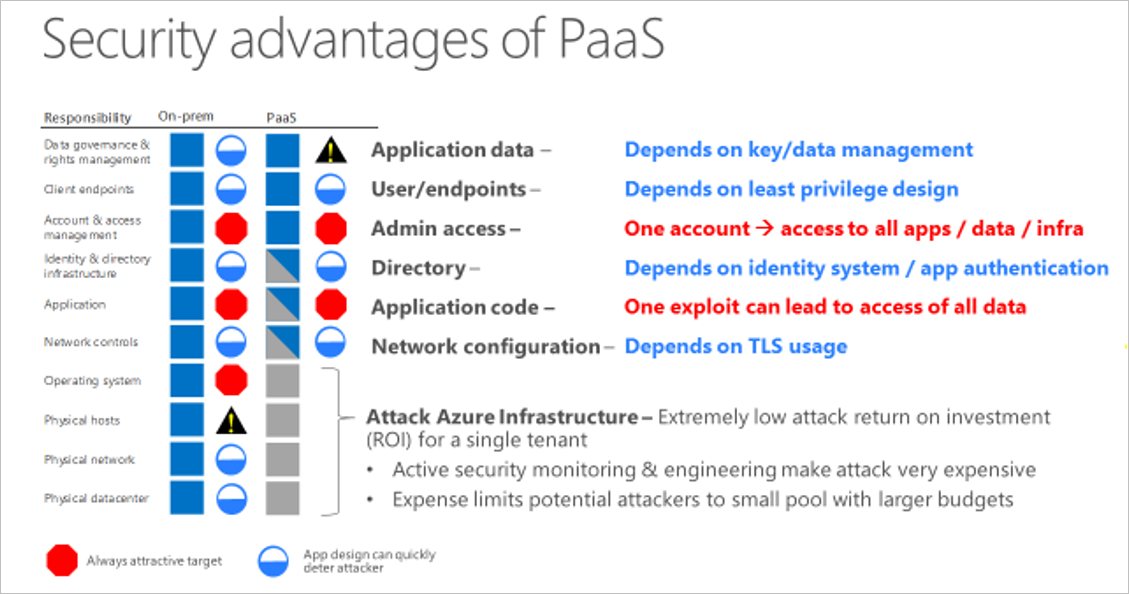
Platform as a Service providers are responsible for securing the infrastructure that powers the platform.
Customers are responsible for securing the applications, data, identities, and configurations they place on that platform.
This arrangement is commonly known as the shared responsibility model.
The concept sounds straightforward.
The execution often is not.
Because the line between platform responsibilities and customer responsibilities is not always obvious.
Why the Question Exists in the First Place
Before cloud computing became mainstream, the division of responsibility was relatively simple.
Organizations owned everything.
Servers.
Networks.
Storage systems.
Operating systems.
Applications.
Security controls.
If something went wrong, responsibility rarely required interpretation.
The organization managed the environment.
The organization owned the risk.
PaaS changed that equation.
Infrastructure management shifted to specialized providers.
Organizations gained convenience.
They also inherited a more nuanced security model.
The challenge became understanding where provider responsibilities end and customer responsibilities begin.
What the PaaS Provider Typically Secures
A useful starting point is identifying what customers no longer manage directly.
Most PaaS providers assume responsibility for the foundational layers of the environment.
These responsibilities often include:
- Physical data centers
- Server hardware
- Storage infrastructure
- Network infrastructure
- Host operating systems
- Platform runtime environments
- Infrastructure maintenance
- Platform availability
The provider secures the systems that customers cannot directly access.
This arrangement creates significant value.
Organizations no longer need teams dedicated to managing physical infrastructure.
Security expertise becomes concentrated.
Operational consistency improves.
What Customers Must Still Secure
This is where misconceptions often emerge.
Because while providers secure the platform itself, customers remain responsible for everything they build on top of it.
Typical customer responsibilities include:
- Application security
- User permissions
- Identity management
- Data governance
- API security
- Compliance requirements
- Encryption policies
- Access controls
- Configuration settings
The provider creates a secure foundation.
Customers determine how securely their applications operate within that foundation.
The distinction is critical.
The Shared Responsibility Model at a Glance
Security Responsibility Comparison
| Security Area | PaaS Provider Responsibility | Customer Responsibility |
|---|---|---|
| Physical Security | Yes | No |
| Data Center Operations | Yes | No |
| Network Infrastructure | Yes | No |
| Platform Runtime Security | Yes | No |
| Application Code Security | No | Yes |
| User Authentication | Shared | Shared |
| Access Management | Shared | Shared |
| Data Protection Policies | No | Yes |
| Compliance Governance | Shared | Shared |
| API Security | No | Yes |
| Database Permissions | No | Yes |
| Encryption Configuration | Shared | Shared |
The table illustrates why confusion persists.
Many responsibilities overlap.
Security is not a clean handoff.
It is an ongoing partnership.
Why Shared Responsibility Is Actually Beneficial
At first glance, some organizations view shared responsibility as a drawback.
They wonder why providers don't simply manage everything.
The answer is surprisingly practical.
Providers cannot fully secure what they do not control.
Only the customer knows:
- Which data is sensitive
- Which users require access
- Which business processes exist
- Which regulatory requirements apply
The provider lacks the context necessary to make those decisions.
Customers possess the context.
Providers possess the infrastructure expertise.
Combining those strengths creates a stronger security model than either side could achieve independently.
Identity Management: One of the Most Important Shared Responsibilities
Modern security increasingly revolves around identity.
Not servers.
Not networks.
People.
Who has access?
Why?
For how long?
Under what conditions?
PaaS providers typically supply tools such as:
- Multi-factor authentication
- Role-based access controls
- Single sign-on integrations
- Identity federation
- Audit logging
The organization must decide how to use them.
This distinction matters.
A provider can offer strong authentication capabilities.
It cannot decide which employee should access payroll data.
The responsibility remains with the customer.
A Lesson Learned During a Security Assessment
Several years ago, I worked with a software company conducting an external security review.
The leadership team felt confident.
Their cloud provider had an excellent reputation.
Compliance certifications were current.
Infrastructure controls appeared robust.
The assessment uncovered very few platform-related concerns.
Then auditors reviewed internal permissions.
What they found was revealing.
Several employees retained administrative access long after changing roles.
Former contractors still had active credentials.
Permissions had accumulated gradually over time.
Nothing malicious had occurred.
The issue was governance.
The provider had delivered secure infrastructure.
The organization had failed to manage access appropriately.
That experience reinforced a lesson I have seen repeatedly.
Many security failures originate not from technological weakness but from unclear ownership.
Responsibility ignored becomes risk accumulated.
Data Security: The Customer's Critical Role
One of the most persistent myths surrounding PaaS is that providers automatically secure all customer data.
Reality is more nuanced.
Providers generally secure storage systems.
Organizations secure the data itself.
Customers must determine:
- Classification policies
- Retention rules
- Access permissions
- Encryption requirements
- Data handling procedures
A secure database does not guarantee secure data management.
The distinction may seem subtle.
It is enormously important.
Application Security Remains the Customer's Responsibility
Perhaps nowhere is responsibility clearer than application security.
The provider did not write the application.
The provider did not define its logic.
The provider did not create its vulnerabilities.
Organizations remain responsible for:
- Secure coding practices
- Dependency management
- Vulnerability remediation
- Authentication workflows
- Session management
- API protection
A PaaS platform can host an application securely.
It cannot prevent developers from introducing insecure code.
Security begins long before deployment.
Compliance: A Shared but Unequal Responsibility
Regulatory compliance introduces another layer of complexity.
Frameworks such as:
- HIPAA
- GDPR
- SOC 2
- PCI DSS
- ISO 27001
often involve both provider and customer obligations.
The provider may supply:
- Security controls
- Documentation
- Certifications
- Audit support
The customer remains responsible for:
- Policies
- Procedures
- Data governance
- Operational controls
A provider can support compliance.
It cannot certify the customer's behavior.
That distinction often surprises organizations entering regulated industries.
Monitoring and Incident Response
Security is not merely prevention.
It also involves detection and response.
Modern PaaS providers typically monitor:
- Infrastructure health
- Network threats
- Platform anomalies
- Service disruptions
Organizations monitor:
- Application behavior
- User activity
- Data access patterns
- Business-specific risks
Both perspectives matter.
An infrastructure alert may reveal one type of threat.
An application alert may reveal another.
The strongest security programs combine both viewpoints.
Common Security Misunderstandings in PaaS
Several misconceptions appear repeatedly.
“The Provider Handles Everything”
This remains the most common misunderstanding.
Providers secure the platform.
Customers secure their usage of the platform.
“Compliance Means Security”
Compliance frameworks help establish standards.
They do not eliminate risk.
“Strong Infrastructure Prevents Application Vulnerabilities”
Infrastructure security and application security address different threats.
Both require attention.
“Security Is Primarily a Technical Problem”
Technology matters.
Processes matter.
Governance matters.
People matter.
Effective security requires all four.
How Security Responsibilities Evolve as Organizations Grow
Small teams often operate informally.
Permissions are broad.
Processes are lightweight.
Governance is minimal.
Growth changes those dynamics.
More employees.
More applications.
More customers.
More regulations.
Security responsibilities become increasingly specialized.
Organizations often introduce:
- Security teams
- Compliance officers
- Identity governance programs
- Access review processes
The underlying shared responsibility model remains unchanged.
The sophistication surrounding it increases.
The Future of Security in PaaS
Cloud platforms continue evolving.
Automation is expanding.
Artificial intelligence is improving threat detection.
Identity-centric security models are becoming more prominent.
Zero-trust architectures are gaining adoption.
Yet one principle appears remarkably durable.
Responsibility cannot be outsourced completely.
Technology can automate controls.
It cannot eliminate accountability.
Organizations must remain active participants in their own security posture.
That reality is unlikely to change.
Conclusion: Security in PaaS Belongs to Both Sides
So, who is responsible for security in PaaS?
The answer is both simpler and more complex than many organizations expect.
The provider is responsible for securing the platform.
The customer is responsible for securing everything they build, store, configure, and manage on that platform.
Neither responsibility exists independently.
The relationship is collaborative.
And that collaboration is precisely what makes modern cloud computing effective.
Providers contribute scale, expertise, infrastructure controls, and operational discipline.
Customers contribute business context, governance, application security, and data stewardship.
When either side neglects its responsibilities, risk increases.
When both sides execute well, the result is often stronger security than many organizations could achieve on their own.
That may be the most important insight of all.
The question is not whether the provider or the customer owns security.
The question is whether both understand the responsibilities they already have.
Because in a PaaS environment, security is not transferred.
It is shared.
And shared responsibility, when clearly understood, can become one of the strongest security models available.
- Arts
- Business
- Computers
- Spiele
- Health
- Startseite
- Kids and Teens
- Geld
- News
- Personal Development
- Recreation
- Regional
- Reference
- Science
- Shopping
- Society
- Sports
- Бизнес
- Деньги
- Дом
- Досуг
- Здоровье
- Игры
- Искусство
- Источники информации
- Компьютеры
- Личное развитие
- Наука
- Новости и СМИ
- Общество
- Покупки
- Спорт
- Страны и регионы
- World

 English
 Russian
 French
 Spanish
 Portuguese
 Turkish
 Dutch
Dutch
 Italiano
 Arabic
 Romaian
 Portuguese (Brazil)
 Greek
Greek