
What Is the Difference Between Online and Offline Retail?
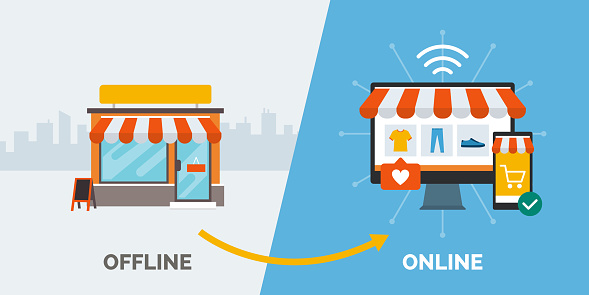
For years, people framed retail as a battle.
Online versus offline.
E-commerce versus brick-and-mortar.
Clicks versus stores.
The language itself suggested a winner and a loser.
Yet walk through a thriving shopping district on a Saturday afternoon and the narrative feels incomplete. Consumers still browse store aisles, touch products, ask questions, and leave carrying purchases. Then look at purchasing data. Consumers continue ordering from websites at midnight, comparing prices across platforms, and expecting packages to appear at their doorstep within days—or hours.
Both realities exist simultaneously.
This is why the most interesting question in retail is no longer whether online retail will replace offline retail. It has not. Nor is the question whether physical stores remain relevant. They do.
The more important question is understanding how online and offline retail differ, where each creates value, and why consumers continue moving fluidly between them.
Because despite sharing the same objective—selling products—the two retail models operate according to fundamentally different rules.
And those differences shape everything from consumer psychology to inventory management to profitability.
Retail Has Always Been About Reducing Friction
At its core, retail performs a simple function.
It helps consumers obtain products.
The challenge has always been reducing the effort required to do so.
Offline retail historically reduced friction through proximity.
Stores placed products near customers.
Consumers traveled to merchandise.
Online retail inverted the relationship.
Products became accessible without requiring physical travel.
Merchandise traveled to consumers.
That shift sounds straightforward.
Its consequences were enormous.
Defining Online and Offline Retail
Before exploring the differences, it helps to establish clear definitions.
What Is Online Retail?
Online retail refers to the sale of products through digital channels.
These include:
- E-commerce websites
- Mobile applications
- Online marketplaces
- Social commerce platforms
Transactions occur electronically.
Product discovery, evaluation, purchase, and payment happen through digital interfaces.
Physical interaction with products generally occurs after purchase.
What Is Offline Retail?
Offline retail refers to sales occurring through physical locations.
These include:
- Department stores
- Specialty retailers
- Grocery stores
- Convenience stores
- Shopping centers
Consumers visit a location, interact with merchandise, and complete purchases in person.
Product evaluation typically precedes purchase.
The distinction seems obvious.
The implications are far more complex.
The Most Fundamental Difference: Sensory Experience
Retail is often discussed through the lens of technology.
Consumers experience it through their senses.
This is where offline retail retains a significant advantage.
Physical stores allow customers to:
- Touch products
- Compare textures
- Evaluate quality
- Test functionality
- Experience scale and fit
The sensory dimension matters because consumers frequently use physical interaction to reduce uncertainty.
Can I trust this fabric?
Does this chair feel comfortable?
Is this shade of paint correct?
Physical stores answer these questions immediately.
Online retail must compensate differently.
It relies on:
- Product photography
- Video demonstrations
- Customer reviews
- Product descriptions
- Augmented reality tools
These substitutes can be highly effective.
Yet they remain substitutes.
The distinction explains why certain categories continue benefiting disproportionately from physical retail environments.
Convenience: The Online Advantage
If offline retail excels at sensory engagement, online retail excels at convenience.
Consumers can shop:
- From home
- During travel
- Late at night
- During work breaks
- Across geographic boundaries
The convenience benefit extends beyond access.
Online retail dramatically expands assortment availability.
A physical store has finite shelf space.
An online retailer faces far fewer assortment constraints.
Consumers gain access to broader product selections without geographic limitations.
This expansion of choice fundamentally altered shopping behavior.
Products no longer needed to be physically nearby to be commercially viable.
Online Versus Offline Retail Comparison
| Retail Dimension | Online Retail | Offline Retail |
|---|---|---|
| Product Access | Available from virtually anywhere | Requires physical visit |
| Sensory Experience | Limited prior to purchase | Direct product interaction |
| Assortment Size | Typically extensive | Space constrained |
| Immediate Ownership | Usually delayed | Immediate possession |
| Operating Costs | Lower store overhead | Higher physical infrastructure costs |
| Customer Service | Digital assistance and support | Face-to-face interaction |
| Personalization | Data-driven recommendations | Associate-driven recommendations |
| Convenience | Extremely high | Location dependent |
| Returns Process | Often requires shipping or drop-off | Usually immediate |
| Impulse Purchasing | Algorithm-driven | Environment-driven |
The comparison reveals something interesting.
Neither model dominates every category.
Each possesses distinct strengths.
Why Physical Stores Create Emotional Engagement
Retailers often focus on transactions.
Consumers frequently remember experiences.
Physical stores create opportunities for emotional engagement that are difficult to replicate online.
Store design matters.
Atmosphere matters.
Lighting matters.
Music matters.
Human interaction matters.
A well-designed retail environment can transform shopping into an experience rather than a task.
Luxury brands understand this particularly well.
Many invest heavily in store environments because the experience itself contributes to perceived value.
The physical environment becomes part of the product proposition.
Online retail operates differently.
The experience is mediated through screens.
Efficiency often becomes the primary objective.
Data Gives Online Retail a Different Kind of Power
While physical stores excel at sensory engagement, online retail excels at data collection.
Every interaction leaves signals.
Searches.
Clicks.
Views.
Cart additions.
Purchases.
Abandonments.
These signals generate insights.
Retailers can analyze consumer behavior at remarkable levels of detail.
Recommendations become increasingly personalized.
Marketing becomes increasingly targeted.
Product assortments become increasingly optimized.
Offline retail collects data as well.
The depth and immediacy of online behavioral data remain distinctive advantages.
The result is a different type of customer understanding.
The Inventory Challenge
One overlooked difference between online and offline retail involves inventory management.
Physical stores distribute inventory across multiple locations.
Products must be allocated carefully.
Stockouts affect individual stores.
Online retail often centralizes inventory.
This creates efficiency benefits.
Yet it also introduces fulfillment complexity.
Orders must be picked, packed, and shipped.
Returns must be processed.
Delivery expectations must be managed.
The inventory challenges differ.
Neither disappears.
They simply shift.
A Lesson I Learned Watching Consumers Shop
Several years ago, I observed consumers shopping for furniture—a category that highlights the tension between online and offline retail particularly well.
Many shoppers began online.
They researched products.
Compared specifications.
Read reviews.
Examined pricing.
Then something interesting happened.
A large percentage visited physical stores before purchasing.
They wanted confirmation.
They wanted reassurance.
They wanted to sit on the sofa, touch the fabric, and evaluate comfort.
Yet many ultimately completed the purchase online.
The lesson was revealing.
Consumers were not choosing online or offline.
They were combining them.
Each channel solved a different problem.
Research occurred online.
Validation occurred offline.
Purchase could happen in either location.
The experience reinforced a broader truth: consumers care less about channels than retailers do.
They care about outcomes.
Pricing Transparency Changes Consumer Expectations
One area where online retail dramatically altered consumer behavior involves pricing transparency.
Consumers can compare prices quickly across multiple retailers.
Information asymmetry declines.
Competitive pressure increases.
Physical retailers feel this impact directly.
Shoppers standing inside stores frequently compare prices using smartphones.
The distinction between channels becomes blurred.
Pricing decisions now occur within a more transparent environment.
Retailers must adapt accordingly.
Price alone, however, rarely determines success.
Convenience, trust, service, and experience continue influencing purchase decisions.
Customer Service Looks Different
Both online and offline retail provide customer service.
The delivery mechanisms differ substantially.
Offline retail emphasizes human interaction.
Sales associates answer questions.
Provide recommendations.
Resolve concerns immediately.
Online retail increasingly relies on:
- Chat support
- Knowledge bases
- Automated assistance
- Customer reviews
The customer experience becomes less dependent on individual employees and more dependent on system design.
Neither model is inherently superior.
The effectiveness depends on execution.
A knowledgeable sales associate can create tremendous value.
A poorly designed customer service process can create frustration regardless of channel.
The Rise of Omnichannel Retail
Perhaps the most significant development in modern retail is the growing irrelevance of channel boundaries.
Consumers increasingly expect seamless transitions.
They may:
- Browse online
- Purchase in-store
- Return through mail
- Pick up curbside
- Reorder through mobile applications
Retailers increasingly support these behaviors.
The result is omnichannel retail.
This approach recognizes that online and offline channels complement rather than replace one another.
The objective becomes integration.
Consumers no longer perceive channels as separate experiences.
Retailers cannot afford to do so either.
Why Some Categories Favor One Model
Not all product categories behave identically.
Books transitioned strongly toward online channels.
Groceries maintain substantial offline presence.
Luxury goods often benefit from physical experiences.
Consumer electronics occupy a hybrid position.
The variation reflects differences in:
- Product complexity
- Sensory requirements
- Purchase frequency
- Delivery feasibility
- Customer risk perception
Categories involving significant tactile evaluation often benefit from physical environments.
Categories emphasizing convenience often migrate more aggressively online.
Understanding these dynamics helps explain why retail evolution remains uneven.
The Economics of Retail Are Different
Online and offline retail generate revenue through similar mechanisms.
Their cost structures differ considerably.
Offline retail invests heavily in:
- Real estate
- Store operations
- Staffing
- Visual merchandising
Online retail invests heavily in:
- Technology infrastructure
- Fulfillment operations
- Logistics
- Digital marketing
Each model creates different operational priorities.
Physical stores optimize foot traffic.
Online retailers optimize conversion rates.
Both seek profitability.
The paths differ.
Conclusion: The Future Is Not Online or Offline
The debate between online and offline retail persists because it simplifies a complicated reality.
People enjoy clear winners.
Retail rarely provides them.
Online retail offers extraordinary convenience, broad assortments, and powerful personalization.
Offline retail offers sensory engagement, immediate gratification, and human connection.
Consumers value both.
That is why predictions about the disappearance of physical stores have repeatedly fallen short. It is also why e-commerce continues expanding.
The future of retail does not belong exclusively to websites.
Nor does it belong exclusively to storefronts.
It belongs to retailers that understand when consumers want convenience and when they want experience. When they seek efficiency and when they seek reassurance. When they prefer algorithms and when they prefer human interaction.
Perhaps the most important difference between online and offline retail is not technological at all.
It is psychological.
Each channel reduces a different form of consumer uncertainty.
Online retail reduces effort.
Offline retail reduces doubt.
The retailers that thrive are those that recognize both needs—and design experiences capable of satisfying them simultaneously.
- Arts
- Business
- Computers
- Spellen
- Health
- Home
- Kids and Teens
- Money
- News
- Personal Development
- Recreation
- Regional
- Reference
- Science
- Shopping
- Society
- Sports
- Бизнес
- Деньги
- Дом
- Досуг
- Здоровье
- Игры
- Искусство
- Источники информации
- Компьютеры
- Личное развитие
- Наука
- Новости и СМИ
- Общество
- Покупки
- Спорт
- Страны и регионы
- World

 English
 Russian
 French
 Spanish
 Portuguese
 Deutsch
 Turkish
 Italiano
 Arabic
 Romaian
 Portuguese (Brazil)
 Greek
Greek
