
How Do Retailers Calculate Markup?
A $20 coffee mug sits on a shelf with a $39.99 price tag.
Most shoppers glance at the number and move on. Some might wonder whether the price feels fair. A few may compare it with a competing retailer. Almost nobody stops to ask a question that retailers obsess over every day:
How did that product end up at $39.99 in the first place?
The answer is rarely arbitrary.
Behind every retail price lies a calculation, a negotiation, a prediction, and occasionally a gamble. Retailers must determine not only what customers are willing to pay but also how much they need to earn to cover costs, support operations, and generate profit. At the center of that balancing act sits one of retail’s most fundamental metrics: markup.
Yet markup is surprisingly misunderstood. Consumers often confuse it with profit. Business owners sometimes confuse it with margin. Even experienced managers occasionally use the terms interchangeably, despite the fact that they measure very different things.
That distinction matters because markup influences nearly every retail decision—from assortment planning and promotional strategy to inventory investments and competitive positioning.
The calculation itself is simple.
The implications are not.
What Is Markup in Retail?
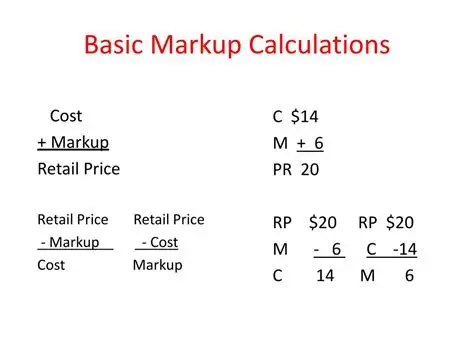
Markup is the amount a retailer adds to the cost of a product to determine its selling price.
In its simplest form:
Markup = Selling Price – Cost
Suppose a retailer purchases a product for $50 and sells it for $75.
The markup is:
$75 – $50 = $25
That additional $25 is the markup amount.
Retailers often express markup as a percentage rather than a dollar figure because percentages make comparisons easier across categories and products.
The standard formula is:
Markup Percentage = (Markup ÷ Cost) × 100
Using the example above:
($25 ÷ $50) × 100 = 50%
The retailer applied a 50% markup.
Simple enough.
Yet this straightforward formula drives billions of dollars in retail pricing decisions every year.
Why Retailers Use Markup
Retailers do not add markup simply because they want higher profits.
That explanation is too simplistic.
A retailer's selling price must account for far more than the product itself.
Consider what happens after inventory arrives:
- Employees stock shelves.
- Store rent must be paid.
- Marketing campaigns generate traffic.
- Technology systems process transactions.
- Warehouses move merchandise.
- Customer service teams resolve issues.
- Returns must be handled.
The cost of the product represents only one component of the total business equation.
Markup helps retailers recover these operating expenses while generating an acceptable return.
Without markup, retail would not be a business. It would be a distribution service.
The Basic Markup Formula
Retailers generally begin with cost.
The formula looks like this:
Selling Price = Cost + Markup
Or, when expressed as a percentage:
Selling Price = Cost × (1 + Markup Percentage)
Consider several examples.
| Product Cost | Markup % | Selling Price |
|---|---|---|
| $20 | 25% | $25 |
| $20 | 50% | $30 |
| $20 | 100% | $40 |
| $50 | 40% | $70 |
| $100 | 60% | $160 |
The table highlights an important point.
The same product cost can generate dramatically different selling prices depending on the markup strategy.
That raises a larger question.
How do retailers decide which markup percentage to use?
Markup Is About Strategy, Not Just Math
Many people imagine retailers sitting in back offices applying identical percentages across all products.
Reality is considerably messier.
Retail pricing often resembles a series of interconnected strategic decisions.
Retailers consider:
- Customer demand
- Competitive pricing
- Brand positioning
- Inventory turnover
- Category economics
- Seasonal trends
- Supplier costs
The markup percentage emerges from this broader context.
A luxury retailer and a discount retailer may purchase similar products at similar costs and still arrive at entirely different prices.
The difference is not arithmetic.
The difference is strategy.
The Difference Between Markup and Margin
Few retail concepts create more confusion than markup versus margin.
They sound similar.
They are not.
Markup Is Based on Cost
Markup measures how much is added to cost.
Formula:
Markup % = (Selling Price – Cost) ÷ Cost × 100
Margin Is Based on Selling Price
Margin measures how much profit exists within the final selling price.
Formula:
Margin % = (Selling Price – Cost) ÷ Selling Price × 100
Let's use an example.
- Cost = $50
- Selling Price = $100
Markup:
($100 – $50) ÷ $50 = 100%
Margin:
($100 – $50) ÷ $100 = 50%
Same product.
Different metric.
Different result.
This distinction matters because retailers often establish pricing decisions using markup while evaluating performance using margin.
Confusing the two can lead to costly mistakes.
Common Retail Markup Percentages by Category
Markup levels vary significantly across retail sectors.
Some categories depend on high volume and lower markups.
Others rely on exclusivity and premium pricing.
| Retail Category | Typical Markup Range |
| Grocery | 15%–30% |
| Consumer Electronics | 10%–35% |
| Sporting Goods | 30%–60% |
| Home Décor | 50%–100% |
| Apparel | 50%–150% |
| Jewelry | 100%–400% |
| Beauty Products | 40%–120% |
| Luxury Goods | 100%–500%+ |
The variation reflects differences in customer expectations and competitive dynamics.
A gallon of milk and a designer handbag operate in entirely different economic universes.
Consumers understand this intuitively, even if they never calculate the percentages.
Keystone Markup: Retail’s Historic Rule
For decades, many retailers relied on a concept known as keystone markup.
The principle was straightforward:
Double the cost.
A product purchased for $50 would sell for $100.
That creates a 100% markup and approximately a 50% gross margin.
The elegance of the rule contributed to its popularity.
But modern retail has made keystone pricing less common.
Today’s retailers operate in environments shaped by real-time pricing data, intense competition, dynamic promotions, and heightened consumer transparency.
A universal markup formula rarely survives these conditions.
Why Some Products Receive Higher Markups
One of retail’s fascinating quirks is that products with similar costs can receive dramatically different markups.
Why?
Because customers do not buy costs.
They buy value.
A scented candle may cost only a few dollars to manufacture.
Yet customers willingly pay substantially more because the purchase includes aesthetics, ambiance, packaging, branding, and emotional appeal.
This is where retail becomes particularly interesting.
The retailer is not pricing the object alone.
The retailer is pricing the perceived value surrounding the object.
That distinction often explains why certain categories consistently sustain higher markups.
The Hidden Influence of Inventory Risk
Markup is also a hedge against uncertainty.
Retailers constantly confront inventory risk.
A product that sells immediately creates one financial outcome.
A product that sits unsold for months creates another.
Higher markups often compensate for that uncertainty.
Fashion retail provides a useful example.
A retailer may initially apply a substantial markup to seasonal merchandise because future markdowns are almost inevitable.
Some products will sell at full price.
Others will eventually require discounts.
The initial markup helps absorb those future reductions.
In effect, retailers are pricing not only for today’s demand but also for tomorrow’s uncertainty.
A Lesson I Learned About Markup
Years ago, while analyzing specialty retail businesses, I became fascinated by a retailer that consistently charged prices above category norms.
At first glance, the strategy appeared risky.
Competitors offered similar products at lower prices.
Conventional wisdom suggested customers would migrate elsewhere.
Yet customers remained remarkably loyal.
When I examined the business more closely, the explanation became clear.
The retailer had invested heavily in merchandising, employee expertise, store design, and customer service. Shoppers were not comparing products alone. They were evaluating the entire experience.
The lesson stayed with me.
Markup calculations begin with mathematics, but successful pricing depends on psychology.
Retailers that understand perceived value often achieve pricing power that spreadsheets alone cannot explain.
How Discounts Affect Markup
Retailers rarely sell every item at its original price.
Promotions, markdowns, and seasonal sales frequently alter realized markup.
Consider a product:
- Cost = $40
- Original Price = $80
Initial markup:
100%
Now apply a 25% discount.
New selling price:
$60
Adjusted markup:
($60 – $40) ÷ $40 = 50%
The markup has been cut in half.
This explains why retailers monitor promotional activity so closely.
Every discount affects profitability.
Sometimes those reductions drive valuable customer traffic.
Sometimes they simply erode margins.
Determining the difference is one of retail management’s enduring challenges.
Technology Has Changed Markup Decisions
Retailers once relied heavily on historical experience and category averages.
Today they have access to far richer information.
Modern pricing systems analyze:
- Competitive prices
- Customer demand patterns
- Inventory levels
- Geographic differences
- Purchase behavior
- Promotional responsiveness
As a result, markup decisions increasingly become dynamic rather than static.
Two customers may encounter different prices at different times based on inventory conditions, demand fluctuations, or promotional strategies.
The underlying objective remains unchanged.
Retailers seek the optimal balance between customer value and financial performance.
The tools have evolved.
The challenge remains remarkably consistent.
The Most Successful Retailers Think Beyond Markup
Markup matters.
But great retailers rarely obsess over markup in isolation.
They recognize that pricing represents one element of a broader value equation.
A retailer with lower markups may outperform competitors through rapid inventory turnover.
Another may command higher markups because of exceptional brand equity.
Still another may blend moderate markups with superior customer loyalty.
Retail success emerges from the interaction of multiple variables, not from any single percentage.
This is precisely why pricing remains both an analytical discipline and a managerial art.
Conclusion: Markup Reveals How Retailers Think About Value
At first glance, markup appears to be a straightforward calculation.
Subtract cost from price. Divide. Multiply by 100.
The formula fits neatly into a spreadsheet.
Yet the reality behind markup is far more revealing.
Every markup decision reflects assumptions about customer behavior, competitive pressure, inventory risk, brand strength, and perceived value. It signals how a retailer sees its place in the marketplace and what it believes customers are truly purchasing.
That is the deeper insight.
Retailers are not merely calculating what a product costs.
They are calculating what the experience, convenience, trust, status, expertise, and emotional resonance surrounding that product are worth.
The provocative truth is that the most successful retailers often spend less time asking, “What markup should we apply?” and more time asking, “What value have we created?”
Once that question is answered convincingly, the markup calculation becomes much easier.
And perhaps that is the enduring lesson of retail economics: prices originate from costs, but markups originate from value.
- Arts
- Business
- Computers
- Spellen
- Health
- Home
- Kids and Teens
- Money
- News
- Personal Development
- Recreation
- Regional
- Reference
- Science
- Shopping
- Society
- Sports
- Бизнес
- Деньги
- Дом
- Досуг
- Здоровье
- Игры
- Искусство
- Источники информации
- Компьютеры
- Личное развитие
- Наука
- Новости и СМИ
- Общество
- Покупки
- Спорт
- Страны и регионы
- World

 English
 Russian
 French
 Spanish
 Portuguese
 Deutsch
 Turkish
 Italiano
 Arabic
 Romaian
 Portuguese (Brazil)
 Greek
Greek
