
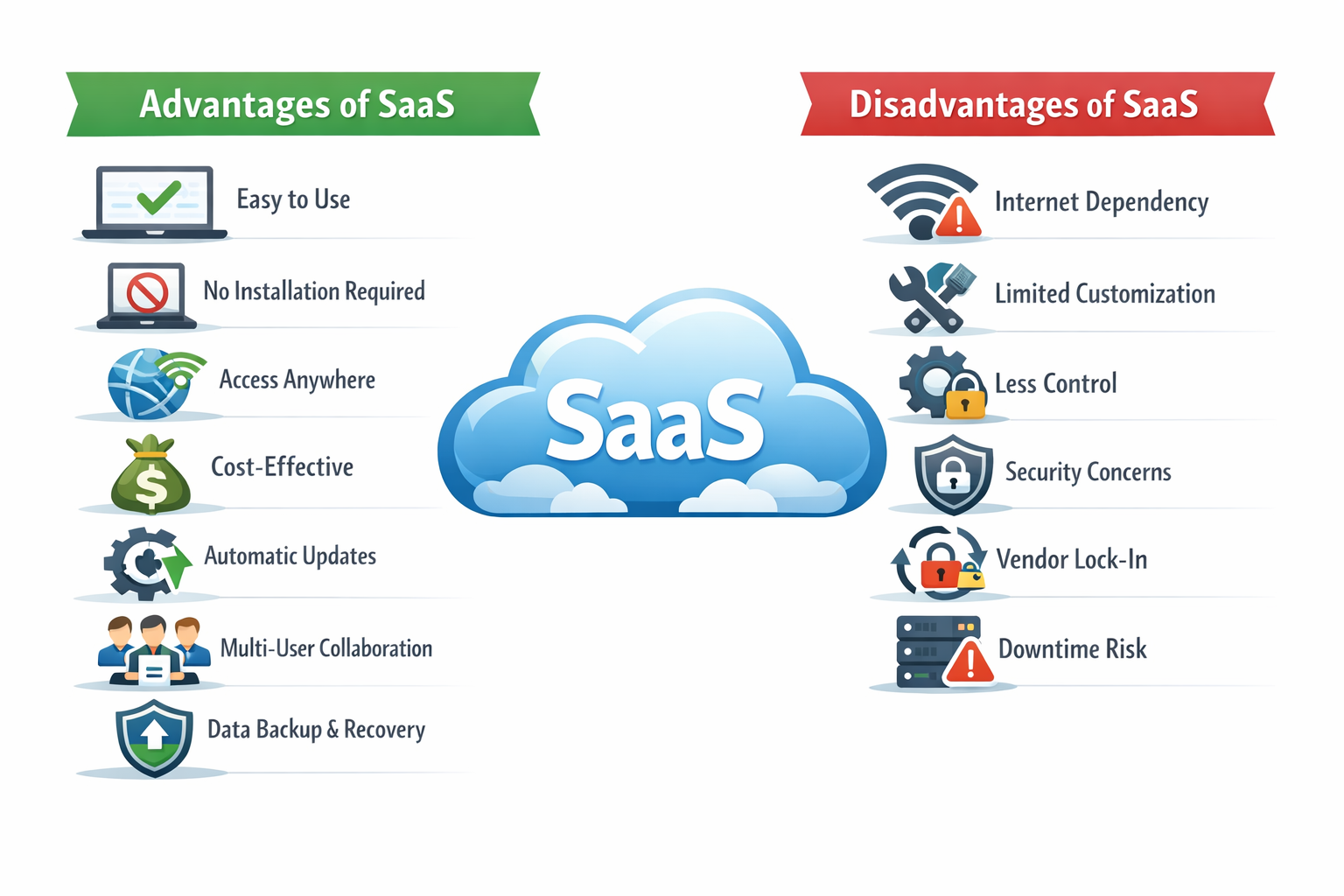
What Are the Advantages and Disadvantages of SaaS? The Tradeoff Behind Modern Software
Every technology decision begins with a promise.
Faster.
Simpler.
More efficient.
Software as a Service—better known as SaaS—arrived with a particularly attractive promise: businesses could access powerful software without the complexity traditionally associated with owning and managing it.
No servers to maintain.
No lengthy installations.
No major upgrade projects.
No massive upfront investments.
The appeal was obvious.
And the adoption numbers tell the story. Organizations of every size now rely on SaaS platforms for customer management, accounting, communication, marketing, human resources, analytics, and countless other functions.
But popularity does not mean perfection.
Every business model creates advantages and disadvantages. Every improvement introduces new tradeoffs. SaaS is no exception.
The same characteristics that make SaaS attractive—cloud delivery, recurring subscriptions, centralized management, and provider-controlled updates—can also create challenges involving cost, control, security, and dependency.
Understanding SaaS requires looking at both sides.
The benefits explain why companies adopted it.
The limitations explain why thoughtful organizations evaluate it carefully.
Because the most important question is not whether SaaS is good or bad.
The better question is whether SaaS aligns with what a specific organization needs.
Understanding the SaaS Model Before Evaluating It
SaaS allows customers to access software through the internet rather than purchasing, installing, and maintaining applications locally.
The provider manages:
- Infrastructure
- Hosting
- Updates
- Maintenance
- Security systems
- Performance monitoring
The customer accesses the service through a subscription.
This arrangement represents a significant shift from traditional software ownership.
Historically, businesses purchased software products.
With SaaS, businesses purchase ongoing access to capabilities.
That difference explains both the strengths and weaknesses of the model.
The Advantages of SaaS
The popularity of SaaS did not happen randomly.
The model offers several meaningful advantages that address longstanding business challenges.
Advantage #1: Lower Upfront Costs
One of the most attractive characteristics of SaaS is its financial structure.
Traditional software often required substantial upfront investment.
Companies purchased licenses, hardware, installation services, and support agreements before realizing value.
SaaS changed that equation.
Instead of a large initial expense, organizations typically pay recurring subscription fees.
This approach makes advanced software more accessible, particularly for smaller businesses that may lack the resources for major technology investments.
A startup can access sophisticated customer relationship management tools.
A small retailer can operate an online store platform.
A growing company can use enterprise-level collaboration software.
Capabilities that once required significant capital are now available through manageable subscription plans.
Advantage #2: Faster Deployment
Software implementation once resembled a construction project.
Planning.
Configuration.
Installation.
Testing.
Training.
Launch.
SaaS often compresses that timeline dramatically.
Because applications are already hosted and maintained by providers, organizations can frequently begin using new platforms quickly.
This speed creates strategic value.
Businesses can respond faster to changing needs.
Teams can experiment with new tools.
Companies can implement solutions without waiting months for technical preparation.
Speed alone does not guarantee success.
But unnecessary delays rarely create advantages.
Advantage #3: Automatic Updates and Continuous Improvement
Few employees miss the days of manual software upgrades.
Updates often required coordination between departments.
Compatibility issues emerged.
Productivity interruptions occurred.
SaaS simplified this process.
Providers release improvements centrally.
Customers receive updates automatically.
This creates a constantly evolving software experience.
The advantage extends beyond convenience.
Organizations benefit from ongoing innovation without repeatedly purchasing new versions.
The software improves while the business continues operating.
Advantage #4: Scalability
Growth creates complexity.
More employees.
More customers.
More transactions.
More data.
Traditional software often required organizations to anticipate future needs and invest accordingly.
SaaS provides greater flexibility.
Companies can often increase:
- User accounts
- Storage capacity
- Features
- Service levels
as requirements change.
This scalability is particularly valuable for businesses experiencing rapid growth.
Technology can expand alongside the organization rather than becoming a constraint.
Advantage #5: Accessibility and Collaboration
SaaS applications are typically accessible from multiple locations and devices.
Employees can work from offices, homes, client sites, or travel locations.
Teams can collaborate across geographic boundaries.
Information becomes available when needed.
This accessibility has transformed expectations around workplace productivity.
Software is no longer tied to a single machine or physical location.
The application follows the user.
Advantage #6: Reduced IT Burden
Managing software internally requires expertise.
Updates.
Security patches.
Infrastructure.
Backups.
Performance monitoring.
SaaS transfers much of this responsibility to the provider.
For organizations with limited IT resources, this can be a significant advantage.
Internal teams can focus less on maintenance and more on strategic technology initiatives.
The benefit is not simply cost reduction.
It is resource allocation.
SaaS Advantages and Disadvantages Comparison Table
The tradeoffs become clearer when viewed side by side.
| Category | SaaS Advantage | SaaS Disadvantage |
|---|---|---|
| Cost | Lower upfront investment and predictable pricing | Long-term subscription costs may exceed expectations |
| Deployment | Faster implementation | Migration can still require effort |
| Updates | Automatic improvements | Customers have less control over timing |
| Scalability | Easy expansion as needs change | Costs may increase as usage grows |
| Accessibility | Available from multiple locations | Requires reliable internet access |
| Maintenance | Provider manages infrastructure | Customer depends on vendor performance |
| Security | Professional security investments | Data is stored outside customer control |
| Customization | Configurable solutions available | Deep customization may be limited |
| Integration | Connects with many platforms | Complex environments may require additional tools |
| Ownership | Less technical burden | Less direct control over software |
The table reveals an important pattern.
Nearly every SaaS advantage has a corresponding tradeoff.
Convenience can reduce control.
Flexibility can increase dependency.
Lower upfront costs can create ongoing expenses.
This balance defines the SaaS conversation.
The Disadvantages of SaaS
The strengths of SaaS are compelling.
But responsible decision-making requires examining the limitations.
Disadvantage #1: Ongoing Subscription Costs
Subscription pricing is one of SaaS's greatest strengths.
It is also one of its most debated weaknesses.
Monthly payments appear manageable.
Over several years, however, costs can accumulate significantly.
Organizations must evaluate total cost of ownership carefully.
A SaaS platform that seems inexpensive initially may become costly as:
- More users are added
- Premium features become necessary
- Storage requirements increase
- Additional integrations are purchased
The subscription model provides flexibility.
But flexibility requires financial discipline.
Disadvantage #2: Vendor Dependency
One of SaaS's defining characteristics is provider management.
The provider controls infrastructure, updates, and much of the operational environment.
This creates convenience.
It also creates dependency.
Organizations must trust vendors to maintain:
- Reliability
- Security
- Performance
- Product development
If a provider experiences outages, pricing changes, or strategic shifts, customers may feel the impact.
This relationship requires careful vendor evaluation.
Disadvantage #3: Limited Control
Traditional software ownership provided greater control.
Organizations decided when to upgrade.
How to configure systems.
Where to host applications.
SaaS changes that relationship.
Providers determine update schedules.
Feature changes.
Infrastructure decisions.
For many companies, this is a worthwhile tradeoff.
For highly regulated industries or organizations with unique requirements, it may create challenges.
Disadvantage #4: Security and Privacy Concerns
Security remains one of the most discussed SaaS challenges.
Organizations store valuable information within vendor-managed systems.
Customer data.
Financial records.
Operational information.
Sensitive documents.
Leading SaaS providers invest heavily in security.
However, customers must still evaluate:
- Data protection policies
- Compliance requirements
- Access controls
- Vendor security practices
Security is not automatically solved by moving to SaaS.
It simply changes where responsibility exists.
Disadvantage #5: Internet Dependence
Because SaaS applications rely on internet connectivity, availability becomes important.
A network outage can disrupt access.
A connectivity problem can slow productivity.
For organizations operating in areas with unreliable internet infrastructure, this limitation deserves consideration.
The convenience of cloud access depends on the ability to reach the cloud.
A Lesson I Learned About SaaS Selection
Several years ago, I worked with a company evaluating whether to replace internally managed software with a SaaS platform.
The leadership team was enthusiastic.
The advantages were obvious.
Lower maintenance.
Faster deployment.
Better accessibility.
The initial recommendation seemed simple: move immediately.
Then the evaluation became more detailed.
The company discovered that one critical workflow depended on customization the SaaS platform did not support easily.
The software was excellent.
It simply was not the perfect fit.
That experience reinforced an important lesson.
The best technology choice is not always the platform with the most features or the lowest cost.
It is the platform that best aligns with the organization's actual needs.
SaaS is powerful.
But powerful does not mean universal.
When SaaS Makes the Most Sense
SaaS is often a strong choice for organizations that value:
- Speed
- Flexibility
- Lower technical overhead
- Remote accessibility
- Predictable budgeting
- Continuous improvement
Startups, growing companies, and organizations seeking operational efficiency often benefit significantly from SaaS adoption.
When SaaS May Not Be the Best Choice
SaaS may create challenges for organizations requiring:
- Extensive customization
- Complete infrastructure control
- Specialized security environments
- Offline functionality
- Highly specific workflows
In these situations, traditional software or hybrid approaches may provide better alignment.
The decision should begin with business requirements, not technology enthusiasm.
The Future Balance of SaaS
SaaS continues to evolve.
Artificial intelligence, automation, analytics, and industry-specific platforms are expanding what SaaS can accomplish.
Yet the fundamental tradeoff remains unchanged.
Customers want simplicity.
Organizations also need control.
The future of SaaS will likely involve finding better ways to deliver both.
More customization.
Greater transparency.
Stronger security.
More intelligent automation.
The winning providers will not simply offer convenience.
They will offer confidence.
Conclusion: SaaS Is Powerful Because It Trades Complexity for Convenience
The advantages and disadvantages of SaaS are deeply connected.
The same features that make SaaS attractive also create its limitations.
Cloud delivery improves accessibility but reduces direct control.
Subscription pricing lowers initial costs but creates ongoing commitments.
Provider management reduces technical burdens but increases dependency.
That is not a flaw.
It is the nature of tradeoffs.
Every business decision involves choosing which challenges are acceptable.
SaaS became popular because many organizations decided that managing infrastructure was no longer the best use of their time, money, or talent.
They preferred focusing on outcomes.
Serving customers.
Improving operations.
Growing businesses.
The most important question, then, is not whether SaaS has advantages or disadvantages.
It clearly has both.
The more important question is whether the advantages solve problems that matter more than the disadvantages create.
For millions of organizations, the answer has been yes.
And that explains why SaaS became one of the defining models of modern software.
- Arts
- Business
- Computers
- Games
- Health
- Home
- Kids and Teens
- Money
- News
- Personal Development
- Recreation
- Regional
- Reference
- Science
- Shopping
- Society
- Sports
- Бизнес
- Деньги
- Дом
- Досуг
- Здоровье
- Игры
- Искусство
- Источники информации
- Компьютеры
- Личное развитие
- Наука
- Новости и СМИ
- Общество
- Покупки
- Спорт
- Страны и регионы
- World

 Russian
 French
 Spanish
 Portuguese
 Deutsch
 Turkish
 Dutch
Dutch
 Italiano
 Arabic
 Romaian
 Portuguese (Brazil)
 Greek
Greek
