
How Do SaaS Companies Calculate Pricing? The Hidden Math Behind Every Subscription
Most customers encounter SaaS pricing at the very end of the buying journey.
After the demo.
After the feature comparisons.
After the sales calls.
Then comes the pricing page, often presented with remarkable confidence:
Starter: $29 per month
Growth: $99 per month
Enterprise: Contact Sales
The numbers appear precise. Deliberate. Rational.
Almost inevitable.
Yet behind those seemingly simple prices lies one of the most complex decisions a software company makes.
Because SaaS pricing is rarely calculated through a single formula.
It emerges from a collision of economics, psychology, competitive positioning, customer behavior, market dynamics, and strategic ambition.
This is where many outsiders misunderstand pricing.
They assume software companies calculate prices by adding costs and applying a margin.
That approach might work for manufacturing.
It rarely works for SaaS.
The most successful software companies do not begin with costs.
They begin with value.
And that distinction changes everything.
Why Calculating SaaS Pricing Is So Difficult
At first glance, software should be easy to price.
Once a product is built, serving an additional customer often costs relatively little.
A software company may spend millions creating a platform, yet the incremental cost of onboarding one more user might be only a few dollars.
This creates a fascinating challenge.
If costs do not determine price, what does?
The answer is more complicated than many executives initially expect.
Pricing becomes less about accounting and more about understanding human behavior.
Customers do not purchase software because it exists.
They purchase software because they believe it will improve something.
Revenue.
Productivity.
Efficiency.
Security.
Visibility.
Profitability.
The calculation begins there.
Not in the finance department.
But in the customer's perception of value.
The Five Core Factors SaaS Companies Use to Calculate Pricing
While pricing strategies vary, most SaaS businesses evaluate the same foundational variables.
1. Customer Value
The most important question is deceptively simple:
How much value does the product create?
Suppose a sales platform helps a company generate an additional $100,000 in annual revenue.
Charging $49 per month might appear affordable.
It might also be dramatically underpriced.
Conversely, if software saves customers only a few hours each month, premium pricing becomes harder to justify.
This is why sophisticated SaaS companies spend enormous effort quantifying customer outcomes.
They examine:
- Revenue impact
- Time savings
- Cost reductions
- Risk mitigation
- Productivity gains
The objective is not merely understanding the product.
The objective is understanding the economic consequence of using the product.
That consequence becomes the foundation of pricing.
2. Market Demand
Even extraordinary products cannot escape market realities.
Pricing exists within a competitive ecosystem.
Customers compare alternatives.
They evaluate substitutes.
They establish reference points.
As a result, SaaS companies carefully analyze demand signals.
Questions often include:
- How urgently do customers need the solution?
- How many alternatives exist?
- How differentiated is the product?
- How mature is the market?
Markets with intense competition generally exert downward pricing pressure.
Markets with distinctive value propositions often allow premium positioning.
The key insight is that value alone does not determine price.
Perceived alternatives matter too.
3. Customer Segmentation
Not every customer values software equally.
A startup with five employees differs dramatically from a Fortune 500 enterprise.
Yet both may use the same platform.
This reality forces companies to segment pricing.
Rather than asking:
"What should the product cost?"
They ask:
"What should this customer pay?"
Segmentation frequently considers:
- Company size
- Revenue
- User count
- Industry
- Usage volume
- Geographic market
This explains why many SaaS businesses offer multiple pricing tiers.
Different customers receive different levels of value.
Pricing reflects that reality.
4. Cost Structure
Contrary to popular belief, costs are not irrelevant.
They simply occupy a different role.
Software companies still incur significant expenses:
- Engineering salaries
- Infrastructure costs
- Cloud hosting
- Customer support
- Security compliance
- Marketing investments
Pricing must eventually support sustainable economics.
The distinction is important.
Cost informs the pricing floor.
Value informs the pricing ceiling.
Successful SaaS companies operate between those boundaries.
5. Growth Objectives
Pricing is often influenced by strategic priorities.
A company seeking rapid market adoption may deliberately lower prices.
A mature company focused on profitability may increase them.
Neither decision is inherently right or wrong.
Pricing becomes a reflection of organizational goals.
This is why identical products can sometimes carry dramatically different prices.
The difference lies not in functionality.
The difference lies in strategy.
The Most Common SaaS Pricing Calculation Methods
Once companies understand value, demand, costs, and customer segments, they typically rely on several pricing methodologies.
Cost-Plus Pricing
The simplest approach begins with expenses.
The company calculates delivery costs and adds a margin.
Example:
| Cost Per Customer | Markup | Final Price |
|---|---|---|
| $20 | 100% | $40 |
While straightforward, cost-plus pricing is surprisingly uncommon among leading SaaS businesses.
Why?
Because customers do not care how expensive software was to build.
They care about outcomes.
A product generating substantial business value may deserve pricing far above its cost structure.
Competitor-Based Pricing
Many SaaS companies benchmark competitors extensively.
For example:
| Product | Monthly Price |
|---|---|
| Competitor A | $49 |
| Competitor B | $79 |
| Competitor C | $99 |
This provides useful context.
Yet competitor pricing rarely serves as the final answer.
Following competitors too closely creates a race toward sameness.
And sameness is rarely a winning strategy.
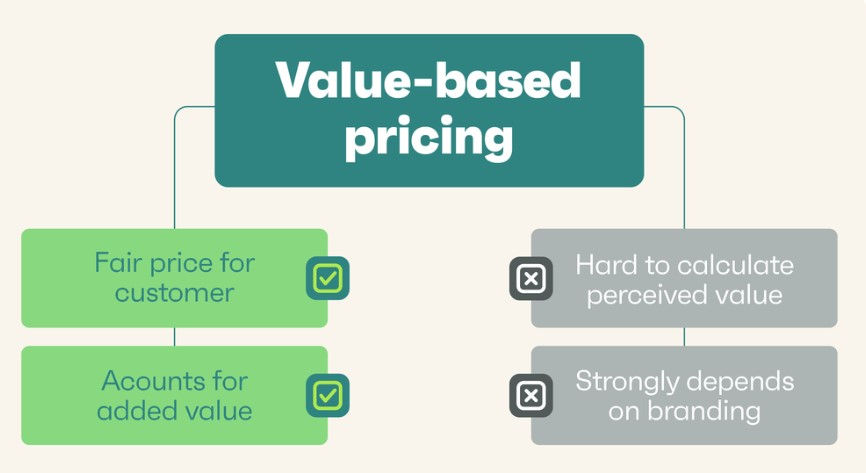
Value-Based Pricing
Value-based pricing begins with customer outcomes.
Instead of asking:
"What does this cost us?"
The company asks:
"What is this worth to customers?"
Suppose software helps reduce annual operating expenses by $50,000.
A subscription fee of $5,000 annually may feel entirely reasonable.
Value-based pricing often produces higher profitability because it aligns pricing with customer benefit rather than internal costs.
Many of today's highest-performing SaaS companies rely heavily on this approach.
Why Metrics Matter in SaaS Pricing
One of the most important pricing decisions is selecting the metric customers will pay for.
This choice determines how pricing scales over time.
Common pricing metrics include:
Per User
Customers pay according to seat count.
Example:
$20 × Number of Users
This model is easy to understand.
But it can discourage adoption.
Organizations sometimes restrict licenses to control expenses.
Usage-Based Pricing
Customers pay according to consumption.
Examples include:
- API requests
- Data storage
- Transactions processed
This model aligns revenue with customer growth.
However, it can reduce cost predictability.
Feature-Based Pricing
Pricing increases as additional functionality becomes available.
Example:
| Plan | Features |
|---|---|
| Basic | Core Features |
| Pro | Advanced Features |
| Enterprise | Premium Features |
Feature differentiation remains one of the most common SaaS pricing strategies.
Hybrid Pricing
Increasingly, companies combine multiple metrics.
A pricing structure might include:
- Subscription fee
- User-based charges
- Usage overages
Hybrid models allow businesses to capture value from multiple dimensions simultaneously.
The Role of Customer Lifetime Value
Sophisticated SaaS pricing calculations rarely focus solely on immediate revenue.
Instead, they evaluate Customer Lifetime Value (CLV).
CLV estimates how much revenue a customer generates throughout the relationship.
A simplified formula looks like this:
| Metric | Value |
|---|---|
| Average Monthly Revenue | $200 |
| Average Customer Lifespan | 36 Months |
| Customer Lifetime Value | $7,200 |
Understanding CLV helps companies determine:
- Acceptable acquisition costs
- Retention priorities
- Pricing flexibility
Pricing decisions become dramatically more strategic when viewed through a lifetime lens rather than a monthly lens.
A Lesson I Learned About Pricing Calculations
Several years ago, I participated in a workshop with a SaaS company preparing for a pricing overhaul.
The leadership team arrived armed with spreadsheets.
There were cost analyses.
Competitive benchmarks.
Forecasting models.
The numbers were impressive.
Then customer interviews began.
One enterprise client described how the software had eliminated weeks of manual reporting work each quarter.
Another explained that the platform had become essential to regulatory compliance.
Neither customer mentioned price.
They discussed outcomes.
That observation shifted the conversation.
The company's pricing model had been built primarily around internal assumptions.
Customer value had become secondary.
When the organization recalibrated pricing around measurable outcomes rather than operational costs, resistance declined significantly.
The lesson was memorable.
Pricing calculations become more accurate when companies calculate customer success before calculating revenue targets.
Why SaaS Pricing Is Part Science and Part Psychology
Pricing discussions often emphasize mathematics.
And mathematics certainly matters.
But numbers alone rarely explain purchasing behavior.
Customers evaluate prices through context.
A $99 plan appears different when positioned beside a $499 plan.
A premium price can signal confidence.
A discount can create urgency—or skepticism.
Behavioral economics influences pricing decisions as much as spreadsheets do.
This is why pricing pages receive extensive testing.
Small changes in presentation frequently alter customer behavior.
The calculation is not purely numerical.
It is psychological.
The Future of SaaS Pricing Calculations
Artificial intelligence is already reshaping pricing conversations.
Historically, companies charged for:
- Users
- Storage
- Access
- Usage
Increasingly, software performs work autonomously.
This raises a new question:
Should customers pay for activity or outcomes?
Imagine an AI platform that generates qualified sales leads.
Charging per user may become less relevant.
Charging according to business impact may become more logical.
As software becomes increasingly outcome-driven, pricing calculations may shift from measuring participation to measuring results.
That evolution is already underway.
Conclusion: SaaS Pricing Is Really a Calculation of Value
People often assume SaaS companies calculate pricing through formulas alone.
The reality is considerably more nuanced.
Costs matter.
Competitors matter.
Demand matters.
Metrics matter.
Yet none of these variables fully explains why a product costs what it costs.
At its core, SaaS pricing is an exercise in value estimation. Companies attempt to quantify what customers gain, how strongly they need it, how alternatives compare, and how pricing can support long-term growth. The process is analytical, but it is also deeply human. It requires understanding not only economics but perception, behavior, and trust.
The most effective SaaS companies recognize this distinction.
They do not merely calculate prices.
They calculate value.
And then they design pricing systems that communicate that value clearly, consistently, and convincingly.
Because in software markets crowded with similar features and familiar promises, the number on the pricing page often reveals how well a company understands its customers.
- Arts
- Business
- Computers
- Игры
- Health
- Главная
- Kids and Teens
- Деньги
- News
- Personal Development
- Recreation
- Regional
- Reference
- Science
- Shopping
- Society
- Sports
- Бизнес
- Деньги
- Дом
- Досуг
- Здоровье
- Игры
- Искусство
- Источники информации
- Компьютеры
- Личное развитие
- Наука
- Новости и СМИ
- Общество
- Покупки
- Спорт
- Страны и регионы
- World

 English
 French
 Spanish
 Portuguese
 Deutsch
 Turkish
 Dutch
Dutch
 Italiano
 Arabic
 Romaian
 Portuguese (Brazil)
 Greek
Greek
