
What is the relationship between unemployment and inflation?
What Is the Relationship Between Unemployment and Inflation?
The relationship between unemployment and inflation has been one of the most studied topics in economics. Governments, central banks, businesses, and investors closely monitor these two indicators because they significantly influence economic performance and public well-being. While unemployment measures the percentage of people willing and able to work but unable to find jobs, inflation refers to the rate at which the general price level of goods and services increases over time.
Economists have long observed that unemployment and inflation often move in opposite directions in the short run. However, this relationship is more complex than it first appears and can change depending on economic conditions. Understanding how unemployment and inflation interact helps explain why policymakers sometimes face difficult trade-offs when trying to stabilize the economy.
Understanding Unemployment
Unemployment occurs when individuals who are actively seeking work cannot find employment. It is commonly measured as the unemployment rate, which represents the percentage of the labor force without jobs.
There are several types of unemployment:
-
Frictional unemployment: Temporary unemployment while people change jobs or enter the workforce.
-
Structural unemployment: Caused by mismatches between workers' skills and employers' needs.
-
Cyclical unemployment: Results from economic downturns that reduce demand for goods and services.
-
Seasonal unemployment: Occurs due to predictable seasonal changes in certain industries.
A low unemployment rate generally signals a healthy economy, while a high unemployment rate often indicates economic weakness.
Understanding Inflation
Inflation measures how quickly prices rise over time. Moderate inflation is considered normal and even beneficial because it encourages spending and investment. However, excessive inflation reduces purchasing power, making goods and services more expensive.
Inflation is usually measured using indices such as the Consumer Price Index (CPI).
Inflation can result from several factors:
-
Increased consumer demand
-
Rising production costs
-
Supply chain disruptions
-
Expansion of the money supply
-
Higher wages that increase business expenses
The Phillips Curve: The Traditional Relationship
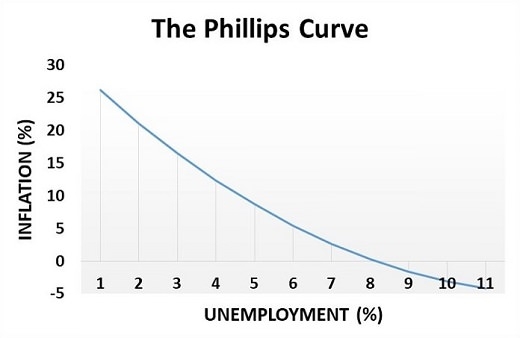
The most famous explanation of the relationship between unemployment and inflation is the Phillips Curve, developed by economist A. W. Phillips in 1958.
The Phillips Curve suggests that:
-
Low unemployment is often associated with higher inflation.
-
High unemployment is often associated with lower inflation.
The reasoning is straightforward.
When unemployment falls:
-
More people have jobs.
-
Household income increases.
-
Consumers spend more.
-
Businesses experience stronger demand.
-
Companies may raise prices.
-
Employers compete for workers by increasing wages.
-
Higher wages can increase production costs, leading to higher prices.
Conversely, when unemployment rises:
-
Consumer spending weakens.
-
Businesses sell fewer products.
-
Wage growth slows.
-
Companies have less ability to raise prices.
-
Inflation tends to decrease.
This inverse relationship became a cornerstone of economic policy during the 1960s.
A Simple Illustration
Imagine an economy with very low unemployment.
Most businesses are hiring, but there are few available workers. To attract employees, companies raise wages. Workers now have more income to spend, increasing demand for products. Businesses respond by increasing prices, creating inflation.
Now imagine the opposite situation.
High unemployment means many people have lost their jobs. Consumers reduce spending, businesses struggle to sell products, and companies avoid raising prices. Inflation slows and may even become deflation if prices begin falling.
Why the Relationship Is Not Always Stable
Although the Phillips Curve explains many economic situations, it does not always hold true.
Beginning in the 1970s, many countries experienced stagflation, a period characterized by:
-
High inflation
-
High unemployment
-
Slow economic growth
This contradicted the traditional Phillips Curve because inflation and unemployment increased simultaneously.
One major cause was rising oil prices, which sharply increased production costs across the economy. Businesses raised prices despite weak economic conditions, creating inflation even as unemployment remained high.
The Role of Expectations
Modern economists argue that inflation expectations play an important role.
If workers expect prices to rise:
-
They demand higher wages.
-
Businesses anticipate higher costs.
-
Companies raise prices in advance.
-
Inflation becomes self-reinforcing.
Because expectations influence behavior, inflation can continue even if unemployment remains relatively high.
This concept led economists to develop the Expectations-Augmented Phillips Curve, which emphasizes that people's expectations affect inflation outcomes.
The Natural Rate of Unemployment
Economists also introduced the idea of the natural rate of unemployment, sometimes called the Non-Accelerating Inflation Rate of Unemployment (NAIRU).
The natural rate represents the level of unemployment consistent with stable inflation.
If unemployment falls below this level:
-
Labor shortages emerge.
-
Wage growth accelerates.
-
Inflation may increase.
If unemployment rises above this level:
-
Wage pressures weaken.
-
Inflation tends to slow.
Importantly, the natural rate is not zero because some unemployment always exists due to people changing jobs or acquiring new skills.
Central Banks and the Trade-Off
Central banks often face a difficult balancing act between controlling inflation and supporting employment.
For example, if inflation rises too quickly, a central bank may:
-
Increase interest rates.
-
Reduce borrowing.
-
Slow consumer spending.
-
Lower business investment.
-
Reduce inflation.
However, higher interest rates can also slow economic activity and increase unemployment.
On the other hand, if unemployment becomes very high, central banks may:
-
Lower interest rates.
-
Encourage borrowing.
-
Increase spending and investment.
-
Stimulate hiring.
While these actions may reduce unemployment, they can also increase inflation if demand grows too rapidly.
Short-Run vs. Long-Run Relationship
Economists distinguish between short-run and long-run effects.
Short Run
In the short run:
-
Lower unemployment may contribute to higher inflation.
-
Higher unemployment often reduces inflation.
This is the relationship described by the traditional Phillips Curve.
Long Run
In the long run, many economists believe there is no permanent trade-off.
Attempts to keep unemployment permanently below its natural rate may simply produce continuously rising inflation without sustaining lower unemployment.
As businesses and workers adjust their expectations, unemployment tends to return to its natural level.
Real-World Examples
During Economic Recessions
During recessions:
-
Businesses reduce production.
-
Layoffs increase.
-
Unemployment rises.
-
Consumer demand weakens.
-
Inflation often falls.
Governments and central banks may respond with stimulus measures to boost employment.
During Economic Expansions
During periods of strong growth:
-
Companies hire more workers.
-
Wages rise.
-
Consumer spending increases.
-
Businesses gain pricing power.
-
Inflation may accelerate.
Policymakers monitor these trends carefully to prevent the economy from overheating.
During Supply Shocks
Unexpected events can disrupt the normal relationship.
Examples include:
-
Oil price spikes
-
Global pandemics
-
Supply chain disruptions
-
Natural disasters
These events can reduce production while increasing prices, leading to both higher unemployment and higher inflation.
Why This Relationship Matters
Understanding the relationship between unemployment and inflation helps policymakers make informed decisions.
Governments use this knowledge to:
-
Design employment programs
-
Plan fiscal policy
-
Manage economic growth
Central banks rely on unemployment and inflation data when deciding whether to raise or lower interest rates.
Businesses also monitor these indicators to plan hiring, investment, pricing, and expansion strategies.
Investors pay close attention because inflation and employment influence corporate profits, stock markets, bond yields, and overall economic confidence.
Limitations of the Relationship
Although the unemployment-inflation relationship is useful, it has several limitations:
-
Globalization affects wage pressures.
-
Technological advances improve productivity.
-
Labor market changes alter hiring patterns.
-
Government policies influence both variables.
-
Supply-side shocks can overwhelm normal demand relationships.
-
Inflation expectations change economic behavior.
Because of these factors, economists rarely rely on unemployment alone to predict inflation.
Conclusion
The relationship between unemployment and inflation is one of the central concepts in macroeconomics. Traditionally, lower unemployment has been associated with higher inflation, while higher unemployment has been linked to lower inflation. This inverse relationship is captured by the Phillips Curve and remains useful for understanding short-run economic dynamics.
However, the relationship is not fixed. Supply shocks, inflation expectations, globalization, and structural changes in the economy can weaken or even reverse the connection between unemployment and inflation. Modern economists therefore view the relationship as conditional rather than absolute.
For policymakers, balancing low unemployment with stable inflation remains one of the greatest challenges. By carefully monitoring both indicators, governments and central banks aim to promote sustainable economic growth, stable prices, and a healthy labor market that benefits businesses and households alike.
- Arts
- Business
- Computers
- Games
- Health
- Home
- Kids and Teens
- Money
- News
- Personal Development
- Recreation
- Regional
- Reference
- Science
- Shopping
- Society
- Sports
- Бизнес
- Деньги
- Дом
- Досуг
- Здоровье
- Игры
- Искусство
- Источники информации
- Компьютеры
- Личное развитие
- Наука
- Новости и СМИ
- Общество
- Покупки
- Спорт
- Страны и регионы
- World

 Russian
 French
 Spanish
 Portuguese
 Deutsch
 Turkish
 Dutch
Dutch
 Italiano
 Arabic
 Romaian
 Portuguese (Brazil)
 Greek
Greek