
What Are the Best AI SaaS Tools?
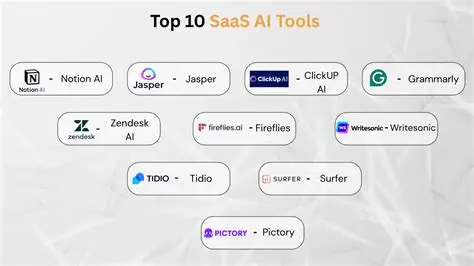
The phrase "best AI SaaS tool" sounds like there should be a winner.
There isn't.
There is no universal champion because an AI tool that is excellent for a software engineer can be almost useless to a customer-support team. A research platform may be indispensable to a product manager and irrelevant to a salesperson. A brilliant general-purpose assistant may still lose to a specialized application that understands the company's CRM, support history, documents, and internal workflows.
That is the first distinction worth making.
The best AI SaaS tool is not necessarily the smartest AI. It is the one that removes the most valuable friction from a specific workflow.
That changes how you should evaluate the market.
Instead of asking which AI tool has the longest feature list, ask which system understands the context you already work in, integrates with the software you already use, and produces an outcome you can actually measure.
The market is moving quickly in that direction. Enterprise AI is increasingly shifting from standalone assistants toward systems embedded in business workflows, while agentic software is beginning to challenge the traditional assumption that every piece of SaaS work requires a human clicking through the application.
So, what should you actually consider?
The Best AI SaaS Tools by Use Case
A useful shortlist starts with categories rather than brands.
For general-purpose work, ChatGPT and Claude are among the strongest starting points. For research, Perplexity has a distinct advantage when cited web research matters. For coding, Cursor and GitHub Copilot occupy different but increasingly overlapping positions. For workspace knowledge, Notion AI is compelling when the organization already lives inside Notion.
Then there are specialized systems.
Customer support has its own AI platforms. Marketing has its own. Automation has its own. Design has its own.
That specialization matters because context matters.
Quick Comparison
| AI SaaS tool | Primary category | Best for | Typical starting price* | Major strength | Main limitation |
|---|---|---|---|---|---|
| ChatGPT | General AI | Broad productivity, analysis, content, coding | $20/mo | Very broad capability | Can require external workflow integration |
| Claude | General AI | Long-form analysis, writing, coding | $20/mo | Strong reasoning and document work | Less useful when your workflow depends on another ecosystem |
| Perplexity | Research | Web research and cited answers | $20/mo | Search-grounded research | Not a replacement for specialized business systems |
| Cursor | Development | AI-assisted software development | $20/mo | Codebase-aware development | Primarily valuable to technical teams |
| GitHub Copilot | Development | Coding assistance inside IDEs | $10/mo | Deep developer workflow integration | Narrower than general AI assistants |
| Notion AI | Productivity | Workspace knowledge and documentation | Plan-dependent | Context inside workspace | Best when team already uses Notion |
| Jasper | Marketing | Brand-oriented content production | Plan-dependent | Marketing workflow specialization | Less compelling as a general AI assistant |
| Canva AI | Design | Visual content creation | Plan-dependent | Design + AI in one workflow | Not a substitute for advanced creative software |
| Intercom Fin | Customer support | AI-assisted customer service | Usage/plan-dependent | Support automation inside helpdesk workflows | Economics depend on support volume |
| Zapier | Automation | Connecting AI to business workflows | Plan-dependent | Broad integration ecosystem | Complex automations require careful maintenance |
*Pricing varies by plan, region, billing cycle, usage, and enterprise terms. Current public pricing for several major tools changes frequently; for example, Claude currently lists a $20 monthly Pro plan, while recent 2026 comparisons list ChatGPT Plus at $20, Perplexity Pro at $20, Cursor Pro at $20, and GitHub Copilot's individual paid plans beginning at $10.
The table is useful.
But it doesn't tell you which tool you should buy.
For that, you need to look at the work.
Best General-Purpose AI SaaS: ChatGPT and Claude
If you are buying your first AI subscription for a SaaS business, start here.
A general-purpose assistant can cover an extraordinary range of work: drafting, analysis, brainstorming, coding, document review, research, data interpretation, and planning.
The attraction is breadth.
The limitation is the same thing.
Breadth can become vagueness.
ChatGPT
ChatGPT is a strong generalist because it can sit across many functions rather than belonging to one department.
A founder can use it to analyze customer interviews.
A marketer can use it for campaign concepts.
A developer can use it for debugging.
A product manager can use it to turn messy notes into structured requirements.
That versatility makes it a sensible first tool for many small SaaS teams.
Claude
Claude is particularly interesting for teams doing substantial writing, document analysis, reasoning, and coding work. Its current product includes features for code, files, web search, research, projects, and tool connections, with a Pro plan currently listed at $20 per month when billed monthly.
The choice between the two is less important than people sometimes make it.
For many teams, the right answer is not "Which model wins?"
It is:
Which assistant fits the work your team actually performs?
Best AI SaaS Tool for Research: Perplexity
Research is different from ordinary conversation.
When you are asking a question that depends on current information, the provenance of the answer matters.
Perplexity has built its product around web-grounded answers and citations, and its current platform emphasizes web-first research, multi-model orchestration, file analysis, and APIs. Its public pricing lists Pro at $20 per month or $200 annually.
That makes it especially useful for:
- Competitive research
- Market analysis
- Product research
- Vendor comparisons
- Current-event research
- Source discovery
- Preliminary industry analysis
But there is an important boundary.
A cited AI answer is not automatically a verified fact.
The tool can make research faster.
It does not eliminate judgment.
For high-stakes claims, primary sources still deserve attention.
Best AI SaaS Tools for Developers: Cursor and GitHub Copilot
This category is moving particularly quickly because AI coding tools are no longer limited to autocomplete.
They can increasingly reason across repositories, modify multiple files, generate tests, explain code, and perform multi-step development tasks.
Cursor
Cursor is built around an AI-native coding environment and is particularly attractive when developers want the AI to understand a broader codebase rather than merely complete the next line.
Current public comparisons put its Pro plan at about $20 per month, with higher business and enterprise tiers.
GitHub Copilot
Copilot takes a different route.
Rather than replacing the developer's existing environment, it integrates AI assistance directly into common development workflows.
That distinction is strategically important.
Some developers want an AI-first editor.
Others want AI embedded into tools they already understand.
The "best" choice therefore depends partly on how much workflow disruption your team wants.
And there is a deeper issue.
AI coding tools can make developers faster while also making codebases easier to change than to understand.
That means engineering teams need stronger review, testing, security scanning, and architectural discipline—not weaker ones.
Best AI SaaS for Knowledge Management: Notion AI
Notion AI makes sense when the organization's information already lives inside Notion.
That sounds obvious.
It isn't.
Context is one of the most important advantages an AI system can have.
A general assistant may know a great deal about the world.
Your company's workspace knows things about your company.
Projects.
Decisions.
Meeting notes.
Specifications.
Policies.
Documentation.
The value of embedded AI therefore comes partly from proximity to proprietary information.
This is why the best enterprise AI systems are increasingly being judged by how well they connect models to internal data and workflows rather than by model intelligence alone.
Best AI SaaS for Customer Support
Customer support may be one of the clearest areas for specialized AI SaaS because the workflow is structured and measurable.
A support system knows:
- The customer's account
- Previous conversations
- Product documentation
- Known issues
- Subscription status
- Internal escalation procedures
AI can use that context to classify tickets, draft responses, retrieve relevant information, and in some systems resolve certain issues autonomously.
Platforms such as Intercom's Fin, Zendesk's AI capabilities, and newer AI-native support infrastructure are competing around exactly this problem. Recent 2026 industry comparisons position Intercom strongly for chat-first product-led companies and Zendesk for larger enterprise support environments.
The important metric isn't how eloquent the AI sounds.
It's resolution.
How many issues did it resolve correctly?
How often did a human have to intervene?
Did customer satisfaction rise or fall?
How much did the cost per resolution change?
That is where the ROI lives.
Best AI SaaS for Marketing: Jasper and Canva
Marketing is a crowded AI category because generation is relatively accessible.
Jasper is interesting because it focuses heavily on marketing workflows, brand consistency, and content operations.
Canva takes a different approach, integrating AI capabilities into a broader design environment.
The distinction is useful.
If your bottleneck is what to say, a marketing-oriented AI platform may be appropriate.
If the bottleneck is how to turn the idea into a visual asset, a design platform with AI may be better.
The mistake is buying both simply because both advertise AI.
A stack should solve bottlenecks.
It shouldn't collect subscriptions.
Best AI SaaS for Automation: Zapier
AI becomes substantially more useful when it can trigger actions.
That is where automation platforms enter the picture.
Instead of:
AI generates answer → Human copies answer → Human opens another application → Human performs task
you can build:
AI interprets request → Automation triggers workflow → Software performs action
Zapier is valuable in this layer because of its broad ecosystem of application integrations.
But automation creates a new responsibility.
When AI makes a mistake inside a chat window, the result may be an incorrect sentence.
When AI makes a mistake inside an automated workflow, the result can be an incorrect database record, email, notification, or transaction.
The more autonomy you add, the more you need permissions, validation, logging, and rollback.
Don't Buy the "Best" Tool. Build the Best Stack.
One of the more useful lessons I keep coming back to is that AI software rarely behaves like a winner-take-all market.
A SaaS company might use:
Claude or ChatGPT for general reasoning.
Perplexity for research.
Cursor or Copilot for engineering.
Notion AI for internal knowledge.
Intercom or Zendesk for customer support.
Zapier for automation.
That isn't redundancy.
Each tool occupies a different layer of work.
The mistake is allowing those layers to multiply without governance.
Ten AI subscriptions can easily become ten disconnected sources of company information, ten billing relationships, ten security reviews, and ten places where sensitive data might be processed.
The best AI stack is therefore not the largest one.
It is the smallest stack that covers the workflows that matter.
How Should You Evaluate an AI SaaS Tool?
Before buying, ask five questions.
1. Does it understand my context?
A generic model may be brilliant.
A context-rich application may still be more useful.
2. Does it integrate with existing systems?
An AI tool that requires constant copy-and-paste will eventually become another task.
3. Can I measure the outcome?
Look for metrics.
Hours saved.
Tickets resolved.
Code shipped.
Research time reduced.
Conversion improved.
Cost per task.
4. What happens when the AI is wrong?
Every serious buyer should ask this.
Not "Can it make mistakes?"
It will.
Ask how mistakes are detected, reviewed, corrected, and recorded.
5. What happens to my data?
For business use, data handling is not a footnote.
Understand retention, access, training policies, administrative controls, compliance features, and contractual terms before putting sensitive information into an AI service.
The Real AI SaaS Moat Is Context
The market is increasingly crowded with tools built on similar underlying models.
That makes a particular kind of differentiation more valuable.
Context.
A customer-support AI that understands the customer's subscription, product usage, previous tickets, documentation, and company policies is fundamentally different from a blank chatbot.
A sales AI that understands the CRM is different from a general writing assistant.
A coding agent that understands the entire repository is different from autocomplete.
The model supplies intelligence.
Context turns intelligence into a product.
That is why AI is pushing SaaS toward deeper integrations, proprietary data, and workflow execution.
The software increasingly needs to know not merely what the customer asked.
It needs to know what the customer is trying to accomplish.
The Provocative Conclusion
The best AI SaaS tool is not the one with the most impressive model.
It is not necessarily the cheapest.
It is not the product with the longest feature list.
And it certainly isn't the one that appears in the most comparison articles.
The best tool is the one that makes an expensive piece of work meaningfully easier.
That sounds less exciting.
It is also much more useful.
The future of SaaS may involve fewer applications that humans constantly operate and more systems that quietly coordinate work behind the scenes. Recent enterprise analysis increasingly points toward agentic software, workflow automation, and consumption-based models challenging the traditional seat-based SaaS structure.
That creates a different buying question.
Instead of asking:
"Which AI tool should we add?"
Ask:
"Which part of our business should become easier because AI exists?"
Find that task.
Measure it.
Choose the tool that understands it.
Then stop buying software merely because it has AI in the name.
The strongest AI SaaS stack may ultimately be the one customers barely notice—because the work that once required five applications, twelve clicks, and an hour of human attention simply gets done.
- Arts
- Business
- Computers
- Oyunlar
- Health
- Home
- Kids and Teens
- Money
- News
- Personal Development
- Recreation
- Regional
- Reference
- Science
- Shopping
- Society
- Sports
- Бизнес
- Деньги
- Дом
- Досуг
- Здоровье
- Игры
- Искусство
- Источники информации
- Компьютеры
- Личное развитие
- Наука
- Новости и СМИ
- Общество
- Покупки
- Спорт
- Страны и регионы
- World

 English
 Russian
 French
 Spanish
 Portuguese
 Deutsch
 Dutch
Dutch
 Italiano
 Arabic
 Romaian
 Portuguese (Brazil)
 Greek
Greek