
SaaS Business Model Explained: How Software Became a Subscription Business
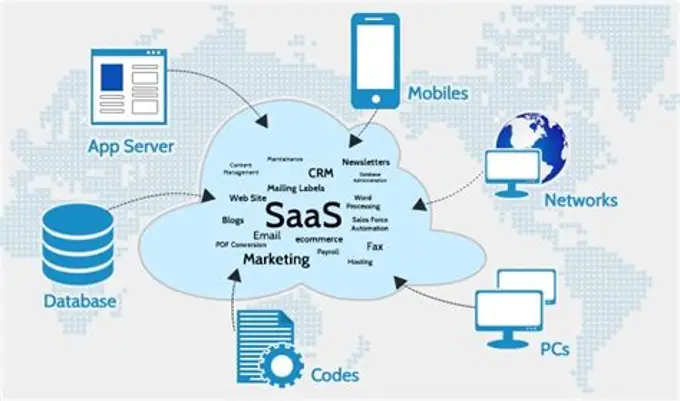
The most important thing about the SaaS business model isn't the subscription.
It is what the subscription makes possible.
A company can sell software once, collect a large payment, and move on. Or it can build a service that customers depend on every day, charge continuously, improve the product continuously, and make retention as important as acquisition.
That second approach is SaaS.
Software as a service changed the economics of software by turning a product into an ongoing relationship. The customer isn't simply buying code. The customer is buying access, updates, infrastructure, support, security, integrations, and increasingly, intelligence.
That distinction explains why SaaS companies obsess over metrics that sound more like relationship statistics than software statistics: churn, retention, lifetime value, recurring revenue, expansion.
The software is what gets sold.
The relationship is what gets monetized.
What Is the SaaS Business Model?
The SaaS business model is a way of selling software in which customers access a centrally hosted application, typically over the internet, and pay for ongoing use rather than purchasing a perpetual license.
The vendor operates the infrastructure.
The customer consumes the service.
Revenue may come from monthly or annual subscriptions, usage-based charges, per-user fees, tiered plans, transaction fees, or a hybrid of these models.
This is important because “SaaS” describes both a technology-delivery model and a commercial model.
The technology is hosted and delivered as a service.
The business model determines how the provider captures value from that service.
Traditional software vs. SaaS
The difference becomes clearer when the two models sit side by side.
| Dimension | Traditional Licensed Software | SaaS Business Model |
|---|---|---|
| Payment | Often upfront license | Recurring subscription or usage |
| Hosting | Customer or third party | Usually vendor-managed cloud |
| Updates | Periodic installations | Continuous or managed updates |
| Infrastructure | Often customer responsibility | Primarily vendor responsibility |
| Revenue recognition | More front-loaded | Recurring over customer lifetime |
| Customer relationship | Transaction-oriented | Ongoing |
| Retention importance | Moderate | Critical |
| Expansion | New licenses/upgrades | Seats, features, usage, tiers |
| Switching costs | Often implementation-based | Data, workflow, integrations, training |
| Vendor priority | New sales | Acquisition + retention + expansion |
This table explains something that is frequently misunderstood.
SaaS doesn't eliminate the cost of software.
It changes when the economics occur.
How SaaS Companies Make Money
There isn't one SaaS pricing model.
There are several.
Per-user pricing
This is one of the most familiar approaches.
A company might charge $X per employee per month. As the customer adds employees, the SaaS vendor's revenue increases.
The logic is simple:
More users → more subscriptions → more recurring revenue.
But per-seat pricing has a weakness. If software becomes more automated, customers may need fewer human users.
That makes seat-based pricing less attractive for certain AI products.
Tiered pricing
SaaS companies often offer several plans.
For example:
- Basic
- Professional
- Business
- Enterprise
Each tier adds capabilities, limits, administrative controls, storage, integrations, or support.
Tiering allows a vendor to capture different levels of willingness to pay without creating an entirely different product for each customer.
Usage-based pricing
Here the customer pays according to consumption.
Possible units include:
- API calls
- transactions
- data processed
- storage
- minutes
- messages
- compute
- automated tasks
This model aligns revenue more directly with usage.
It also makes the customer's bill less predictable.
That tradeoff matters.
Hybrid pricing
Many sophisticated SaaS businesses combine approaches.
A customer might pay a platform fee, per-user charges, and additional usage fees.
AI is accelerating this trend because AI workloads often have costs that correlate with actual computational usage rather than simply the number of employees with accounts.
The Core Economics of SaaS
The SaaS business model looks attractive partly because revenue can recur.
But recurring revenue is not automatically profitable revenue.
A company still has to acquire customers, serve them, support them, host the product, secure the infrastructure, develop new features, and retain those customers.
That creates several critical economic metrics.
ARR and MRR
Annual recurring revenue (ARR) measures the annualized value of recurring subscriptions.
Monthly recurring revenue (MRR) measures recurring revenue on a monthly basis.
Neither should be confused with total revenue.
A company can have substantial recurring revenue and still generate poor economics if customers leave quickly or acquisition costs are excessive.
Churn
Churn measures customers or revenue lost over time.
A SaaS company can acquire hundreds of new customers and still struggle if existing customers leave at a high rate.
This is why SaaS has an unusual mathematical character.
Growth isn't simply:
new customers = growth.
It is closer to:
new revenue + expansion − lost revenue = net recurring growth.
The denominator matters.
Customer acquisition cost
Customer acquisition cost, or CAC, measures how much a company spends to acquire customers.
Sales salaries, advertising, commissions, marketing programs, events, and other acquisition expenses can all contribute.
A SaaS company therefore has to answer a deceptively difficult question:
How much can we spend today to acquire revenue that may arrive over several years?
That is the central investment logic behind many SaaS businesses.
Customer Lifetime Value Changes Everything
Suppose a customer pays a SaaS provider $1,000 per month.
That customer is worth very little if it cancels after one month.
If the customer stays for five years, expands usage, and purchases additional products, the economics look dramatically different.
This is the logic behind customer lifetime value (LTV).
LTV isn't merely a finance metric.
It changes how a SaaS company thinks about product development.
A feature that costs money to build may be worthwhile if it reduces churn.
A customer-success team may appear expensive until it prevents high-value customers from leaving.
An integration may not generate immediate revenue but may make the product harder to replace.
The most valuable SaaS features are therefore not always the ones that generate the fastest sales.
Some protect the relationship.
Expansion Revenue: The Quiet Engine of SaaS
One of the most powerful characteristics of SaaS is that an existing customer can become more valuable without the vendor finding an entirely new customer.
Imagine a company starts with 50 users.
Then it grows to 200.
It adds premium features.
It connects another department.
It increases usage.
The original customer now generates several times the revenue of the initial contract.
This is expansion revenue.
It can come from:
- More seats
- Higher pricing tiers
- Additional products
- Greater usage
- New departments
- Additional geographic markets
- Premium support
- Advanced security features
This is why SaaS companies care so intensely about net revenue retention.
A strong product can grow inside an account before the sales team ever has to find another company to sell.
Why SaaS Companies Care So Much About Retention
A traditional software transaction can end when the check clears.
A SaaS transaction begins there.
That creates an unusual economic pressure.
The vendor has to earn the customer's business repeatedly.
The product must remain useful.
Support must remain acceptable.
Pricing must remain defensible.
Security must remain credible.
And the customer's alternative cannot become dramatically more attractive.
This is where SaaS creates a powerful alignment between product quality and business economics.
Not a perfect alignment. Vendors can still make bad decisions.
But the recurring model makes dissatisfaction economically visible.
If customers leave, recurring revenue disappears.
The SaaS Flywheel: Acquisition, Retention, Expansion
The business model can be reduced to three fundamental movements.
1. Acquire
Find customers and convince them to start using the product.
2. Retain
Give those customers sufficient value that they continue paying.
3. Expand
Increase the value of existing accounts through additional users, products, features, or usage.
The strongest SaaS companies make all three work simultaneously.
A company that acquires customers brilliantly but cannot retain them has a leaky business.
A company with excellent retention but weak acquisition may struggle to scale.
A company with both but no expansion leaves substantial economic potential unused.
SaaS and the Cost of Growth
There is another side to the subscription model that gets less attention.
Growth can be expensive.
A SaaS company may hire salespeople years before those employees generate their maximum economic contribution. It may spend heavily on marketing. It may provide free trials. It may invest in customer onboarding.
And then there is research and development.
Software companies don't merely maintain their products. They are expected to improve them.
This produces a fundamental tension:
Invest now or optimize now?
Aggressive investment can accelerate growth while damaging near-term profitability.
Aggressive cost-cutting can improve margins while weakening product development and future growth.
SaaS financial strategy is therefore a balancing act between present economics and future recurring revenue.
The First-Person Lesson: A Subscription Is Not the Value Proposition
One lesson I keep returning to when analyzing SaaS businesses is that recurring billing can disguise a weak product.
A monthly charge may recur automatically, but that doesn't mean the underlying value recurs.
The customer notices.
Perhaps the software is still being used because migration would be painful. Maybe employees complain about it but nobody wants to own the replacement project. Perhaps the contract renewal simply became another item in procurement's calendar.
Those situations can temporarily preserve revenue.
They do not create a healthy SaaS business.
The strongest SaaS products produce a different feeling: the customer would actively notice if the service disappeared.
That is a much more meaningful form of retention.
The lesson is simple:
Recurring revenue is an accounting characteristic. Recurring value is a product characteristic.
Confusing the two can produce dangerously optimistic business models.
SaaS vs. Other Software Business Models
The SaaS model is powerful, but it isn't appropriate for every software product.
| Business Model | Payment Pattern | Hosting | Revenue Profile | Best Fit |
|---|---|---|---|---|
| SaaS subscription | Recurring | Vendor | Predictable recurring | Business applications |
| Usage-based SaaS | Consumption | Vendor | Variable recurring | APIs, infrastructure, AI |
| Perpetual license | Often upfront | Customer/vendor | More transactional | Specialized software |
| Freemium | Free + conversion | Vendor | Conversion-driven | Consumer and product-led SaaS |
| Open source | Often free + services | Varies | Support/cloud/commercial | Developer infrastructure |
| Marketplace | Transaction fee | Platform | Transactional | Two-sided platforms |
| Services | Project/retainer | Provider | Labor-based | Consulting/custom development |
The distinctions matter because revenue predictability, gross margins, customer acquisition, and scalability vary substantially across these models.
Product-Led Growth and SaaS
SaaS also created a different approach to selling software: product-led growth.
Instead of relying entirely on salespeople to demonstrate value, companies allow prospective customers to experience the product directly.
Free plans.
Trials.
Self-service signup.
Interactive onboarding.
The product itself becomes part of the sales process.
That doesn't eliminate enterprise sales. Large organizations often require procurement, security reviews, legal negotiations, and implementation services.
But the basic idea remains powerful:
Let the customer experience value before asking for a large commitment.
AI Is Forcing SaaS to Rethink Pricing
AI may be the biggest challenge yet to conventional SaaS economics.
Traditional SaaS frequently charges for access.
AI can charge for work.
That difference is substantial.
If an AI agent completes 500 tasks that previously required employee labor, pricing based purely on the number of human users may become increasingly difficult to justify.
Vendors may instead charge for outcomes, usage, automated actions, or combinations of seats and consumption.
This could make SaaS billing more closely resemble cloud infrastructure—or even professional services.
The irony is hard to miss.
Software began by being sold as a product.
SaaS turned it into a service.
AI may turn parts of SaaS into labor.
The Provocative Question Behind the SaaS Model
The SaaS business model is often praised for predictability.
But predictability is not the same thing as permanence.
A customer can cancel.
A competitor can emerge.
An open-source alternative can become good enough.
An AI system can radically change how much software a company needs.
The real strength of SaaS isn't the subscription invoice. It is the accumulated relationship between product, workflow, data, users, integrations, and outcomes.
That is what makes a SaaS company durable.
And it points toward a more uncomfortable question for the next generation of software businesses:
If customers increasingly expect software to produce outcomes rather than provide tools, will the SaaS business model still be built around selling access—or will the winners increasingly charge for the work the software performs?
That question reaches beyond pricing.
It challenges the basic unit of software economics.
For decades, we paid for copies.
Then we paid for seats.
Now we're increasingly paying for usage.
The next step may be paying for results.
If that happens, the SaaS business model won't disappear.
It will become something more demanding.
Software will have to prove, continuously and measurably, that it is worth keeping.
And that may be the most important feature of the subscription model after all.
- Arts
- Business
- Computers
- Juegos
- Health
- Home
- Kids and Teens
- Money
- News
- Personal Development
- Recreation
- Regional
- Reference
- Science
- Shopping
- Society
- Sports
- Бизнес
- Деньги
- Дом
- Досуг
- Здоровье
- Игры
- Искусство
- Источники информации
- Компьютеры
- Личное развитие
- Наука
- Новости и СМИ
- Общество
- Покупки
- Спорт
- Страны и регионы
- World

 English
 Russian
 French
 Portuguese
 Deutsch
 Turkish
 Dutch
Dutch
 Italiano
 Arabic
 Romaian
 Portuguese (Brazil)
 Greek
Greek