
What Is the Difference Between Sponsorship and Advertising?
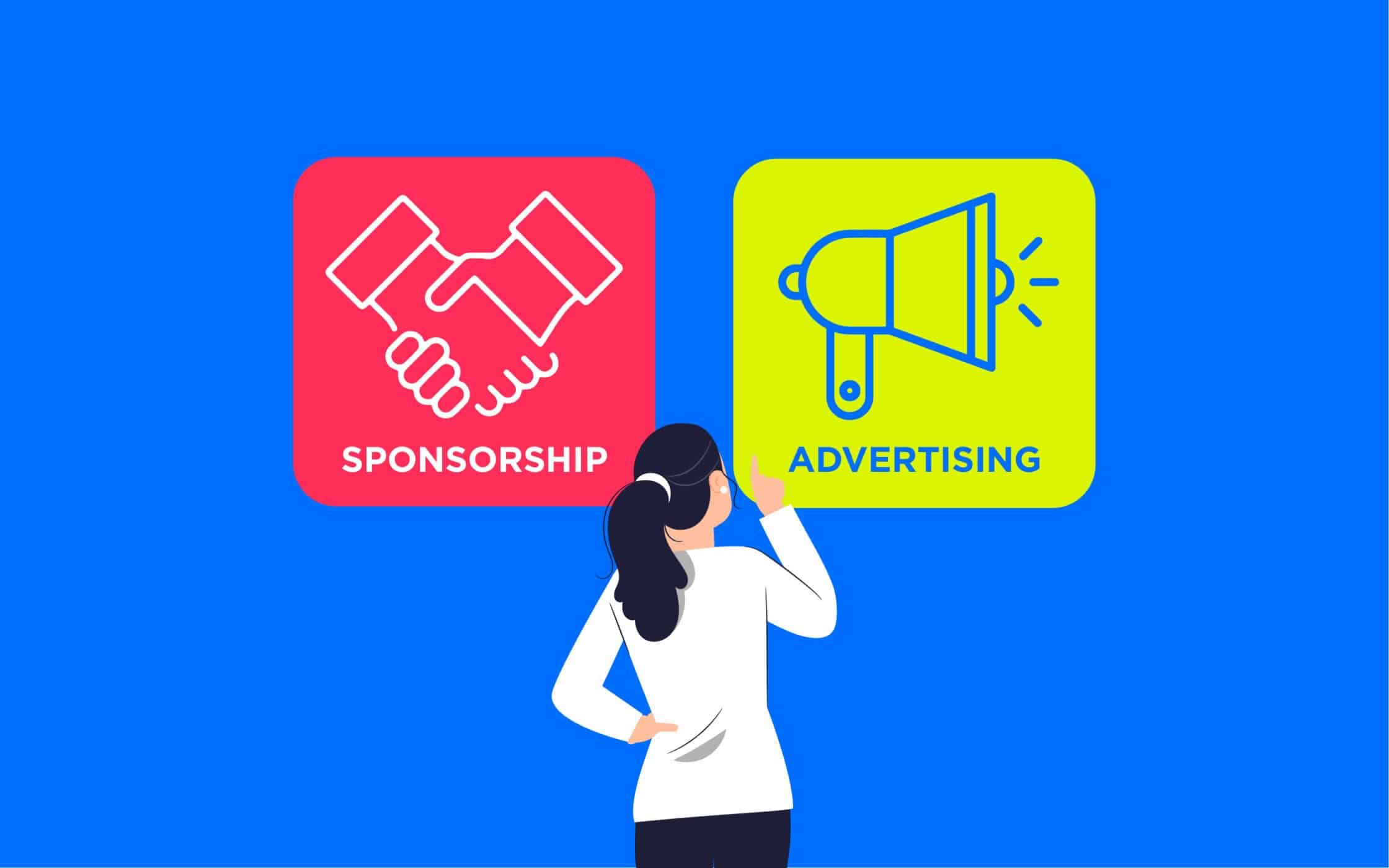
A logo on a stadium wall. A 30-second television spot. A branded concert stage. A sponsored podcast episode.
To the casual observer, they can look like variations of the same transaction: a company pays money, a brand appears, and an audience sees it.
That interpretation misses the important part.
Advertising buys attention. Sponsorship buys association.
The distinction sounds small. Strategically, it is enormous.
Advertising typically gives a marketer control over the message, placement, timing, and frequency of exposure. Sponsorship places the brand alongside something that already has meaning for an audience—a team, event, property, cause, entertainment franchise, creator, or cultural moment. The sponsor is not simply purchasing media space. It is attempting to borrow, reinforce, or participate in the equity surrounding that property.
That is why a sponsorship can be enormously valuable even when the brand receives fewer seconds of exposure than it would through conventional advertising.
And it is also why sponsorships can fail spectacularly.
Advertising and Sponsorship Start With Different Transactions
The cleanest way to understand the distinction is to ask a simple question:
What exactly is the marketer buying?
With advertising, the answer is generally media exposure.
A company purchases access to an audience through a media channel. It might buy television impressions, search placements, social-media inventory, display ads, print space, audio spots, or out-of-home placements.
The advertiser controls the creative. The media owner controls the inventory.
Sponsorship works differently.
A sponsor acquires rights associated with a property. Those rights might include naming rights, signage, hospitality, product integration, category exclusivity, content opportunities, tickets, experiential access, social-media exposure, or permission to use the property's name and intellectual property in marketing.
The sponsored property has its own identity before the brand arrives.
That matters.
When a company sponsors a professional sports team, it does not create the team's emotional meaning from scratch. Fans already have opinions, memories, loyalties, rivalries, and rituals attached to that team. The sponsor enters an existing relationship.
Advertising says, in effect, "Look at this message."
Sponsorship more often says, "Look at what we are connected to."
A Side-by-Side Comparison
| Dimension | Advertising | Sponsorship |
|---|---|---|
| Primary purchase | Media exposure | Rights and association with a property |
| Message control | Usually very high | Shared or indirect |
| Audience relationship | Often transactional | Can be relational |
| Brand association | Created primarily by the advertisement | Influenced by the sponsored property |
| Typical assets | TV, digital, print, audio, search, OOH | Events, teams, leagues, creators, causes, venues |
| Creative flexibility | High | Constrained by property and agreement |
| Exposure frequency | Often precisely purchased | Depends on property activity and activation |
| Measurement | Impressions, reach, clicks, conversions, brand lift | Exposure plus association, engagement, attendance, hospitality, brand lift |
| Emotional leverage | Depends heavily on creative | Can inherit existing audience affinity |
| Risk | Creative or media inefficiency | Reputation and partner risk |
| Exclusivity | Usually purchased by placement | Often negotiated by category |
| Activation required | Not necessarily | Frequently essential |
| Relationship duration | Often campaign-based | Frequently multi-period |
| Core strategic question | "How efficiently can we reach people?" | "What should our brand be associated with?" |
The table reveals something marketers sometimes overlook: sponsorship is not merely advertising with a larger check.
It is a different type of asset.
Why Sponsorship Can Be More Powerful Than an Ad
Consider two scenarios.
A consumer sees an advertisement for a sports drink claiming that the product helps active people perform at their best.
Then imagine the same consumer watching their favorite team walk onto the field beneath a stadium banner carrying that sports drink's name. The brand is visible before the game begins, during breaks, across social content, in interviews, on signage, and perhaps through an in-person sampling experience.
The second strategy does not necessarily communicate more product information.
It can communicate more meaning.
This is sponsorship's central attraction.
The brand can become associated with characteristics already attached to the property: excitement, excellence, community, prestige, adventure, youth, tradition, authenticity, or social purpose.
But there is a catch.
The association is not entirely under the marketer's control.
An advertiser can rewrite a headline.
A sponsor cannot rewrite the history of the team it supports.
That asymmetry is one of the most important differences between the two disciplines.
Advertising Gives You the Microphone. Sponsorship Gives You a Seat at the Table.
This is how I would frame the strategic difference.
Advertising is fundamentally a communication vehicle. Sponsorship is fundamentally a relationship vehicle.
That does not mean sponsorship lacks communication. Far from it. Major sponsorships are often surrounded by enormous advertising and content programs.
In fact, the strongest sponsorships frequently use advertising to amplify the sponsorship.
A brand sponsors an event.
Then it advertises the partnership.
Then it creates social content around it.
Then it invites customers.
Then it gives employees access.
Then it builds promotions around the property.
Then it measures whether perceptions changed.
The sponsorship becomes the strategic platform; advertising becomes one of the tools used to exploit it.
This is why evaluating sponsorship purely by logo visibility can produce a distorted conclusion.
A logo is an asset.
It is not necessarily the strategy.
Sponsorship Requires Activation
One of the most persistent mistakes in sponsorship marketing is assuming that purchasing the rights is the same thing as marketing the partnership.
It isn't.
Suppose a company spends $2 million securing sponsorship rights and then spends almost nothing making consumers understand or experience the relationship.
The company may own valuable rights that produce little commercial impact.
Activation turns an abstract association into something people can encounter.
Imagine a bank sponsoring a major music festival. A logo on the festival website creates awareness. A branded financial lounge where customers can charge their phones, receive exclusive content, meet artists, and access premium experiences creates participation.
The difference is not cosmetic.
The first creates exposure.
The second creates an experience that can give the sponsorship a reason to exist in the consumer's life.
This is also where sponsorship and advertising often converge. Advertising can tell people about the experience. Sponsorship supplies the underlying platform.
The Risk Is Different, Too
Advertising has plenty of risks: poor creative, ineffective targeting, excessive frequency, weak media placement, and rising acquisition costs.
Sponsorship introduces another category of vulnerability.
The partner can change.
A celebrity can become controversial. A team can lose repeatedly. An event can suffer a logistical disaster. A social cause can become politically contentious. A league can experience a scandal.
Suddenly, the brand association that looked attractive during negotiations looks considerably less comfortable.
This makes due diligence unusually important.
A sponsor is not simply evaluating audience size. It is evaluating reputational adjacency.
Who owns the property?
Who controls it?
What happens if the property violates agreed standards?
What are the termination provisions?
What categories are protected?
What competitors can participate?
What rights does the sponsor actually receive?
Those questions can matter more than the size of the logo.
So Which Is Better?
That is the wrong question.
The better question is: What problem are you trying to solve?
If the objective is immediate reach, precise targeting, frequency, or a tightly controlled product message, advertising may be the more efficient instrument.
If the objective is to strengthen brand meaning, enter a community, create experiences, deepen relationships, or associate the brand with a distinctive cultural property, sponsorship may offer advantages that a conventional advertisement cannot reproduce.
And sometimes the answer is both.
A company might use advertising to generate broad awareness while using sponsorship to give that awareness emotional context.
Think of advertising as controlled speech.
Think of sponsorship as strategic proximity.
Neither is inherently superior. Their value depends on what the brand needs the audience to do—or believe—next.
The Measurement Problem
This distinction creates a measurement challenge.
Advertising has relatively mature metrics. Marketers can track impressions, reach, frequency, clicks, conversions, viewability, cost per acquisition, and incremental sales.
Sponsorship measurement is messier.
A serious evaluation may need to consider:
- Media exposure
- Audience reach
- Brand awareness
- Brand consideration
- Changes in brand associations
- Event attendance
- Customer acquisition
- Hospitality outcomes
- Content engagement
- Social conversation
- Lead generation
- Sales
- Renewal rates
- Employee engagement
- Incremental brand equity
The difficulty is that not every sponsorship benefit appears immediately in a sales dashboard.
A hospitality program may strengthen relationships with high-value customers. A community sponsorship may improve local legitimacy. A long-term sports partnership may gradually alter what consumers associate with a brand.
That does not mean measurement should become vague.
Quite the opposite.
The less directly attributable the outcome, the more disciplined the measurement framework needs to be.
The Lesson Marketers Should Remember
If I had to reduce the entire sponsorship-versus-advertising debate to one strategic lesson, it would be this:
Do not confuse visibility with value.
A sponsorship can generate millions of impressions and still fail to give consumers a compelling reason to care.
An advertisement can reach fewer people and generate an extraordinary response because the message, audience, and moment align perfectly.
The question is not whether people saw the brand.
The question is what the exposure meant.
That is the dividing line.
Advertising generally asks consumers to evaluate a proposition: Here is our product. Here is what it does. Here is why you should consider it.
Sponsorship can make a more subtle proposition: This is what we choose to stand beside.
That second statement can be surprisingly powerful.
It can also be surprisingly dangerous.
Sponsorship Is Not Advertising With a Logo Attached
The temptation to collapse the two disciplines is understandable. Both require budgets. Both seek audiences. Both generate exposure. Both can influence brand perception.
But their strategic engines are different.
Advertising creates a controlled message and distributes it through purchased media.
Sponsorship acquires a relationship with an existing property and attempts to translate that relationship into brand value.
The distinction matters because consumers don't experience brands as spreadsheets of impressions. They experience them through context.
A commercial is one context.
A championship game is another.
A concert is another.
A community event is another.
A creator's audience is another.
A cause is another.
The smartest marketers understand that the context surrounding a brand can be as consequential as the message the brand delivers.
And that leaves us with a more provocative question than "Should we advertise or sponsor?"
What does our brand need to be associated with that an advertisement alone cannot give us?
If the answer is nothing, buy the media.
If the answer is a community, an experience, a passion, a reputation, or a relationship, sponsorship deserves a harder look.
Because the most valuable thing a brand can buy is not always another impression.
Sometimes it is a place in people's minds—and a reason for that place to matter.
- Arts
- Business
- Computers
- Games
- Health
- Home
- Kids and Teens
- Money
- News
- Personal Development
- Recreation
- Regional
- Reference
- Science
- Shopping
- Society
- Sports
- Бизнес
- Деньги
- Дом
- Досуг
- Здоровье
- Игры
- Искусство
- Источники информации
- Компьютеры
- Личное развитие
- Наука
- Новости и СМИ
- Общество
- Покупки
- Спорт
- Страны и регионы
- World

 Russian
 French
 Spanish
 Portuguese
 Deutsch
 Turkish
 Dutch
Dutch
 Italiano
 Arabic
 Romaian
 Portuguese (Brazil)
 Greek
Greek