
Should I Use Different Sponsorship Packages?
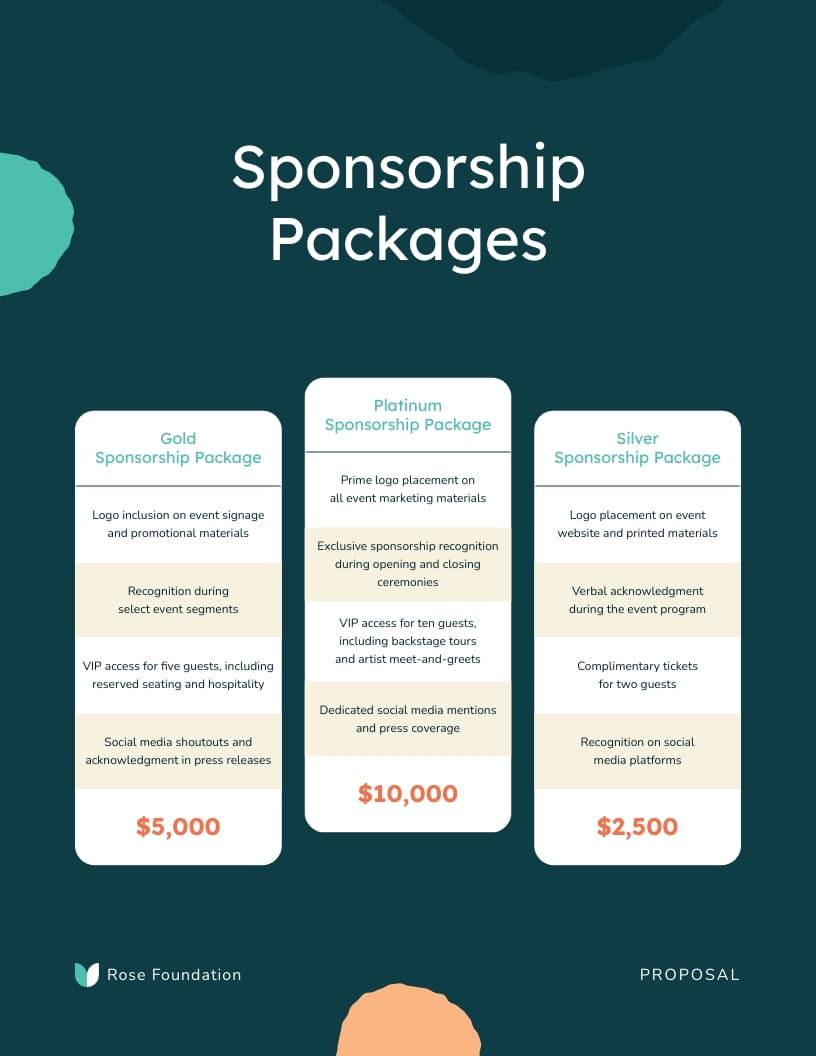
You have a sponsor interested in your opportunity.
Great.
Now comes the question that can quietly determine whether the conversation moves forward or stops cold:
Should you offer different sponsorship packages?
At first, the answer seems obvious.
Of course. Create a Gold package. A Silver package. A Bronze package. Add a few benefits. Assign prices. Put everything into a polished chart.
Done.
Except sponsorship is rarely that simple.
A company considering a $5,000 investment may have entirely different goals from a company considering $50,000. One sponsor may care about brand visibility. Another may want access to your audience. A third may want employee engagement, community impact, lead generation, product sampling, or content opportunities.
So the real question is not simply whether you should use different sponsorship packages.
It is this:
Do your packages make it easier for sponsors to see the value of working with you—or do they force sponsors into choices that do not match what they actually need?
That distinction matters.
Because sponsorship packages can be incredibly useful.
They can also become a trap.
The Short Answer: Yes, Use Different Packages—But Do Not Stop There
For most organizations, events, nonprofits, and media properties, offering multiple sponsorship packages is a smart strategy.
Different packages provide structure.
They help prospects understand available investment levels. They make your opportunity easier to explain internally. They create a starting point for negotiation. They can also prevent every sponsorship conversation from beginning with the same uncomfortable question:
“So, what exactly are you looking for?”
But standardized packages should be viewed as options, not limits.
That is where many sponsorship seekers go wrong.
They create four sponsorship levels and assume every company must fit neatly into one of them.
Gold.
Silver.
Bronze.
Maybe Platinum for the company willing to write the biggest check.
The packages look organized. The chart is attractive. The benefits are carefully distributed.
Yet the sponsor says no.
Why?
Because the sponsor was never looking for “Gold.”
The sponsor was looking for a solution to a business objective.
That may sound like a subtle difference.
It is not.
It changes the entire sponsorship conversation.
Why Different Sponsorship Packages Work
A strong package structure solves several practical problems.
First, it gives prospects a clear overview of the opportunity.
Corporate decision-makers often want to understand the range of investment quickly. A package menu can show them what is possible without requiring a 90-minute presentation.
Second, packages create a natural price architecture.
Without structure, sponsors may struggle to understand what different investment levels represent. A thoughtfully designed package ladder helps establish context.
Third, packages can make your sales process more efficient.
You do not have to build every proposal from a blank page.
That is important.
Time matters. Resources matter. Your team may be managing dozens of sponsor conversations simultaneously. Having a strong package framework allows you to begin with a proven structure and then adapt when necessary.
Here is the key word:
Adapt.
Not force.
The Numbers Behind a Tiered Package Strategy
Different sponsorship levels can serve different types of companies and investment objectives. The following comparison shows how a package structure might work for an event or organization with multiple sponsor opportunities.
| Sponsorship Level | Typical Investment | Primary Sponsor Goal | Example Benefits | Customization Potential |
|---|---|---|---|---|
| Presenting Sponsor | $50,000+ | Category leadership and deep brand integration | Naming association, premium activation, executive access, major visibility | Very high |
| Platinum Sponsor | $25,000–$49,999 | Significant audience engagement | Large-scale branding, activation space, premium hospitality | High |
| Gold Sponsor | $10,000–$24,999 | Brand awareness and targeted exposure | Prominent signage, digital promotion, event presence | Moderate to high |
| Silver Sponsor | $5,000–$9,999 | Cost-effective market visibility | Select branding, event mentions, limited activation | Moderate |
| Community Sponsor | Under $5,000 | Local support and brand association | Logo recognition, basic visibility, acknowledgment | Limited but useful |
| Custom Partnership | Varies | Specific business objective | Tailored benefits based on sponsor goals | Extremely high |
The numbers themselves will vary depending on your audience, market, event size, brand value, and available assets.
The principle does not.
Different investment levels should correspond to meaningful differences in value.
That sounds obvious.
You would be surprised how often it is ignored.
The Problem With the Traditional Gold, Silver, and Bronze Model
Let me say something that may be unpopular:
Gold, Silver, and Bronze are not sponsorship strategies.
They are labels.
That does not mean you cannot use them. They are familiar. Easy to understand. Convenient.
But a label does not explain value.
Imagine receiving a proposal that says:
Gold Sponsor — $20,000
- Large logo
- Six social media posts
- Event signage
- Ten VIP tickets
- Website recognition
Then you see:
Silver Sponsor — $10,000
- Medium logo
- Three social media posts
- Event signage
- Five VIP tickets
- Website recognition
What is the sponsor actually buying?
A larger logo?
Three additional social posts?
Five more tickets?
This is where packages can become transactional instead of strategic.
A sponsorship should not simply be a shopping cart filled with promotional items.
A sponsor is not necessarily looking for “more stuff.”
They may be looking for better access.
More qualified engagement.
A stronger association with a cause.
A chance to demonstrate expertise.
A way to reach a difficult audience.
An opportunity to create an experience that advertising alone cannot deliver.
Those objectives require more thought than changing the size of a logo.
Build Packages Around Value, Not Just Visibility
One of the most useful shifts you can make is to stop asking:
“What benefits should go into each package?”
Instead, ask:
“What business value can this partnership create?”
That question can completely reshape your sponsorship inventory.
Suppose a technology company wants to reach small-business owners.
Your event attracts 8,000 entrepreneurs.
You could offer them:
- A logo on signage
- A booth
- Social media posts
Or you could create a more strategic opportunity:
- An educational workshop sponsored by the company
- A branded resource center
- An opt-in lead-generation experience
- A custom content series
- Executive introductions to selected attendees
- Post-event audience insights
Which opportunity is more valuable?
It depends on the sponsor's goals.
And that is precisely the point.
My Lesson Learned: When Packages Almost Cost Me the Deal
I learned this lesson through experience.
Earlier in my sponsorship work, I believed that a well-designed package structure was the answer to almost every sponsor conversation.
I had options.
I had prices.
I had benefits carefully organized by level.
I was prepared.
Then I spoke with a prospective sponsor whose needs did not fit any package.
At first, I tried to find the closest match.
Maybe this package?
Maybe that one?
Perhaps we could add one benefit and remove another.
The conversation became increasingly awkward because I was trying to fit the company into my structure rather than understanding what the company was trying to accomplish.
Eventually, I stopped.
I asked a better question:
“What would make this partnership successful for your company?”
The answer changed everything.
The sponsor did not care about several benefits I had assumed would be important. But they cared deeply about something I had barely emphasized: direct engagement with a specific segment of the audience.
That became the foundation of the conversation.
The lesson was clear.
Packages are useful because they provide a starting point. They become dangerous when they prevent you from listening.
That experience changed how I approached sponsorship proposals.
I still believe in structure.
I simply do not believe structure should replace strategy.
How Many Sponsorship Packages Should You Offer?
For most opportunities, three to five primary sponsorship levels is enough.
More choices are not always better.
Consider what happens when a prospective sponsor sees eight different packages:
- Platinum
- Gold Plus
- Gold
- Silver Plus
- Silver
- Bronze Plus
- Bronze
- Community
The prospect now has more work to do.
What is the real difference between Gold and Gold Plus?
Why does Silver Plus exist?
Which level is actually right for the company?
Confusion creates friction.
And friction can slow down decisions.
A simple structure often works better:
- Premium or Presenting
- Major Partner
- Supporting Partner
- Community Partner
Or, if your opportunity calls for traditional labels:
- Platinum
- Gold
- Silver
- Bronze
The labels matter less than the logic behind them.
Each level should offer a distinct value proposition.
Not just a smaller version of the level above it.
When You Should Customize a Sponsorship Package
Customization makes sense when a sponsor has:
- A clearly defined marketing objective
- A unique audience target
- A larger potential investment
- Specific activation requirements
- Geographic needs
- Category exclusivity concerns
- Measurable performance expectations
- Long-term partnership goals
For example, imagine a financial services company wants to support financial literacy.
Your organization has educational programming.
Instead of forcing the company into a standard package, you might create a custom sponsorship around a financial education series.
The company receives meaningful alignment.
Your audience receives useful programming.
Your organization receives financial support.
That is stronger than simply selling the company a bigger logo.
Customization is not about giving away extra benefits for free.
It is about designing a partnership with greater strategic value.
But Do Not Customize Everything
Here is the other side of the argument.
Some organizations hear the word “customization” and immediately begin reinventing every sponsorship proposal.
That can become expensive.
Slow.
Inconsistent.
And exhausting.
You do not need to create a completely new opportunity for every company.
A better approach is to develop a modular sponsorship structure.
Create a core set of assets.
Then identify elements that can be adjusted.
For example, your sponsorship menu might include:
Core Assets
These are available within established package levels:
- Brand visibility
- Event recognition
- Digital promotion
- Hospitality
- Basic activation opportunities
Flexible Assets
These can be customized:
- Content partnerships
- Educational programming
- Audience engagement
- Lead generation
- Employee involvement
- Product experiences
- Research or data opportunities
- Cause marketing initiatives
This gives you efficiency without rigidity.
A strong system with room to move.
Should Every Sponsor See Every Package?
Not necessarily.
This is an important strategic decision.
If you have done your research, you may already know that a particular company is unlikely to consider your entry-level sponsorship.
You may also know that another company has a limited local marketing budget.
Why send both companies the exact same proposal?
A better approach is to tailor the presentation.
That does not mean hiding information or manipulating the prospect.
It means being relevant.
If a major corporation has the potential for a substantial partnership, lead with the opportunities most closely aligned with its objectives.
If a small local business wants community visibility, show options that make financial sense for that business.
The proposal should feel like a thoughtful business conversation.
Not a restaurant menu.
How to Know If Your Packages Are Working
You do not have to guess.
Track the results.
Ask yourself:
- Which packages sell most frequently?
- Which packages generate the most revenue?
- Which benefits do sponsors value?
- Which benefits are consistently ignored?
- Where do negotiations usually begin?
- How often do sponsors request customization?
- Which packages are easiest for sponsors to renew?
- Are sponsors achieving the outcomes they expected?
This information can reveal something important.
Sometimes the package you think is your strongest offering is not the one sponsors value most.
Perhaps your Gold package sells constantly because the investment level is accessible.
Perhaps your premium package rarely sells because the benefits are too focused on visibility and not enough on activation.
Perhaps sponsors repeatedly ask for the same custom feature.
That is a signal.
Listen to it.
Your sponsorship packages should evolve as your audience, assets, and sponsor expectations evolve.
The Most Powerful Package May Not Be a Package at All
This may sound contradictory after everything we have discussed.
But sometimes the strongest sponsorship opportunity begins with no package.
It begins with a conversation.
You learn about the sponsor's goals.
You understand their target audience.
You ask what success would look like.
Then you identify the assets and opportunities you can bring to the table.
That conversation can lead to something much more valuable than a standard tier.
A partnership.
There is a difference.
A package says:
“Here is what we are selling.”
A partnership says:
“Let's explore what we can accomplish together.”
You need both approaches.
Packages make sponsorship accessible.
Partnerships make sponsorship powerful.
The Best Strategy: Structure First, Conversation Second, Customization When It Matters
So, should you use different sponsorship packages?
Yes.
Absolutely.
But use them intelligently.
Create three to five clearly differentiated options. Make sure each level offers meaningful value. Build benefits around sponsor objectives rather than simply increasing logo size and social media mentions.
Then leave room for conversation.
Research every serious prospect.
Understand what matters to them.
Ask questions.
Listen carefully.
And when the opportunity justifies it, customize the partnership.
The biggest mistake is not using packages.
The biggest mistake is believing that your packages are more important than your sponsor.
Because a sponsorship package is a tool.
It is not the relationship.
It is a framework.
It is not the strategy.
And here is the provocative question every sponsorship professional should consider:
If you removed the price levels and logos from your sponsorship packages, would a prospective company still understand why partnering with you could help its business?
If the answer is no, you may not have a sponsorship strategy.
You may simply have a list of things for sale.
The companies most worth pursuing are not looking for another list.
They are looking for opportunities that make business sense.
Build your packages to open that door.
Then be prepared to walk through it with a conversation that goes far beyond Gold, Silver, and Bronze.
- Arts
- Business
- Computers
- Spiele
- Health
- Startseite
- Kids and Teens
- Geld
- News
- Personal Development
- Recreation
- Regional
- Reference
- Science
- Shopping
- Society
- Sports
- Бизнес
- Деньги
- Дом
- Досуг
- Здоровье
- Игры
- Искусство
- Источники информации
- Компьютеры
- Личное развитие
- Наука
- Новости и СМИ
- Общество
- Покупки
- Спорт
- Страны и регионы
- World

 English
 Russian
 French
 Spanish
 Portuguese
 Turkish
 Dutch
Dutch
 Italiano
 Arabic
 Romaian
 Portuguese (Brazil)
 Greek
Greek