
What Should Be Included in a Sponsorship Package?
A prospective sponsor is interested.
That is the good news.
Then comes the question that can expose whether you have built a genuine business opportunity—or simply assembled a collection of promotional items:
“What exactly do we get?”
You open your sponsorship package.
There are logos.
Lots of logos.
There are banners, social media mentions, website listings, tickets, booth space, and perhaps a few VIP invitations.
The document looks impressive.
But will it persuade a company to invest?
Not necessarily.
Because a sponsorship package is not supposed to be a catalog of everything you can offer. It should be a carefully organized explanation of why a partnership has value.
That means deciding what belongs in the package.
And just as importantly, what does not.
A sponsor does not need to know every detail about your organization before deciding whether the opportunity deserves further discussion. A busy marketing executive is trying to understand something much more practical:
- Who will this partnership help us reach?
- Why is that audience valuable?
- What can our company actually do?
- What do we receive?
- How much does it cost?
- Why should we believe this opportunity can deliver results?
If your sponsorship package answers those questions clearly, you are already ahead of many organizations competing for corporate dollars.
The Core Purpose of a Sponsorship Package
Before deciding what to include, it helps to understand what the document is designed to do.
A sponsorship package should make a corporate decision-maker understand the opportunity quickly.
It should communicate:
- What the opportunity is
- Who the audience is
- Why the audience matters
- What assets and benefits are available
- What level of investment is required
- What makes the partnership credible
- How the sponsor can take the next step
That sounds straightforward.
Yet many sponsorship packages become cluttered because organizations confuse information with persuasion.
They add another page.
Another benefit.
Another paragraph about their history.
Another list of accomplishments.
And eventually, the sponsor is left wondering:
“What is the actual opportunity here?”
Your package should not make the reader search for the answer.
1. A Strong Overview of the Sponsorship Opportunity
Start with the big picture.
What are you asking a company to support?
This could be:
- An event
- A nonprofit organization
- A conference
- A sports program
- A community initiative
- A media platform
- A podcast
- An educational program
- A festival
- A digital community
The overview should explain the opportunity in clear language.
Include the information necessary to establish context:
- What the initiative is
- When and where it takes place, if relevant
- Its purpose
- Its scale
- Its history or track record
- What makes it distinctive
But resist the temptation to begin with a long organizational biography.
A sponsorship package should focus on the future opportunity, not spend five pages celebrating the past.
Your history matters when it builds confidence.
Your accomplishments matter when they demonstrate credibility.
Everything else should earn its place.
2. Audience Data That Matters to Sponsors
This is one of the most important sections of any sponsorship package.
Sponsors invest because they want access.
Access to consumers.
Access to business decision-makers.
Access to communities.
Access to industries.
Access to employees.
Access to audiences they cannot easily reach through other channels.
So tell them who those people are.
Useful audience information might include:
- Total audience size
- Event attendance
- Geographic reach
- Age ranges
- Gender distribution, where relevant and appropriate
- Income or purchasing influence
- Job titles
- Industries
- Consumer interests
- Digital reach
- Email subscribers
- Social engagement
- Repeat attendance
The most valuable data is not always the biggest number.
That is worth repeating.
The most valuable data is not always the biggest number.
A company may be more interested in reaching 2,000 highly qualified prospects than 50,000 people with little connection to its products or services.
Specificity creates relevance.
Instead of saying:
“Thousands of professionals attend our event.”
Consider:
“More than 4,500 attendees participate annually, including business owners, senior managers, and purchasing decision-makers from more than 20 industries.”
Now the sponsor has something to evaluate.
3. A Clear Explanation of Sponsor Benefits
This is the section people usually expect.
And yes, benefits belong in the package.
But they should be organized carefully.
Common sponsorship benefits include:
- Logo placement
- Event signage
- Website recognition
- Social media promotion
- Email marketing mentions
- Exhibit space
- Speaking opportunities
- Product demonstrations
- Content sponsorship
- VIP tickets
- Hospitality
- Media exposure
- Category exclusivity
- Employee participation
- Branded experiences
The mistake is not offering these benefits.
The mistake is presenting them without context.
A benefit is more persuasive when the sponsor understands what it can accomplish.
For example:
Basic description:
Logo placement on event signage.
More strategic description:
Prominent event signage designed to provide repeated brand visibility throughout high-traffic attendee areas.
The asset may be the same.
The value is easier to understand.
That is the difference between listing inventory and communicating an opportunity.
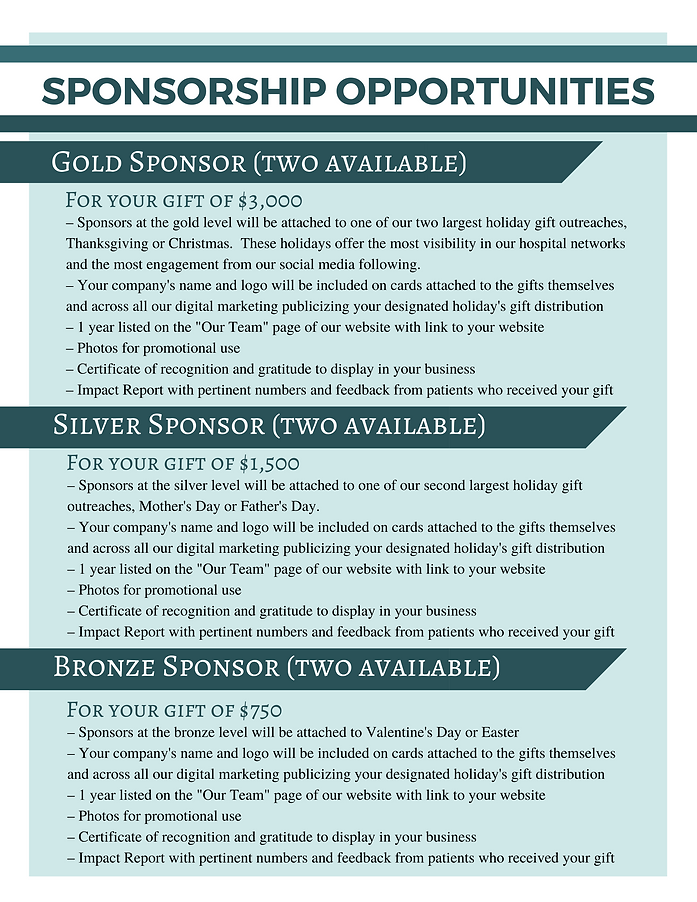
4. Sponsorship Levels and Investment Options
Most sponsorship packages should include multiple investment levels.
Why?
Because companies have different budgets.
Different goals.
Different capacities.
Different reasons for sponsoring.
A typical structure might include three to five levels.
For example:
- Presenting Partner
- Platinum Partner
- Gold Partner
- Silver Partner
- Community Partner
The names themselves are not the strategy.
The value behind them is.
Each level should offer meaningful differences in access, visibility, activation, or exclusivity.
Do not simply create a higher package by increasing the size of the logo and adding three social media posts.
A premium sponsorship should often provide something deeper.
Perhaps:
- Category exclusivity
- A custom activation
- Executive access
- Content integration
- Naming association
- Premium audience engagement
- Greater strategic alignment
The sponsor should understand why one level is worth more than another.
A Practical Comparison of Sponsorship Package Components
The following framework shows how sponsorship benefits can be organized across different investment levels.
| Package Component | Community Level | Silver Level | Gold Level | Premium Level |
|---|---|---|---|---|
| Investment Range | Lower | Moderate | Significant | High |
| Brand Recognition | Basic | Expanded | Prominent | Extensive |
| Event Signage | Limited | Standard | Premium | Major placement |
| Digital Promotion | Basic acknowledgment | Multiple mentions | Featured campaigns | Integrated campaigns |
| Event Access | General | Enhanced | VIP access | Executive/VIP access |
| Exhibit Opportunity | Optional | Standard | Premium location | Custom activation |
| Content Opportunities | Limited | Occasional | Featured | Strategic integration |
| Category Exclusivity | Rare | Selective | Available | Often included |
| Audience Engagement | Passive | Moderate | Strong | Customized |
| Customization | Limited | Some flexibility | Significant | Extensive |
This table is a framework—not a universal formula.
Your packages should reflect your actual assets.
Do not promise benefits because another organization includes them.
And never add benefits simply to make a package look longer.
5. Audience Engagement and Activation Opportunities
Modern sponsors often want more than visibility.
They want participation.
This is where activation opportunities become valuable.
An activation gives the sponsor a chance to engage the audience directly.
That might include:
- A branded experience
- A product demonstration
- A workshop
- A contest
- A sponsored lounge
- A sampling opportunity
- An interactive installation
- An educational program
- A networking experience
- A content partnership
The question is:
What can the sponsor actually do with the relationship?
That matters.
A logo can be seen.
An experience can create a memory.
A conversation can create a relationship.
The strongest sponsorship packages often include both passive exposure and active engagement.
6. Evidence That Your Opportunity Is Credible
A sponsor is making an investment.
That means risk is part of the decision.
Your package should help reduce that uncertainty.
Include relevant proof such as:
- Past attendance figures
- Audience growth
- Media coverage
- Sponsor testimonials
- Previous campaign results
- Renewal rates
- Engagement statistics
- Awards or recognition
- Case studies
You do not need to include everything.
Choose evidence that supports the business case.
If your audience has grown from 2,000 to 8,000 over several years, that may be meaningful.
If sponsors have renewed their partnerships, that may be meaningful.
If a past activation generated strong participation, that may be meaningful.
Proof builds confidence.
But be careful with vague statements.
“We are the leading event in our industry” is a claim.
“Attendance has increased 38% over the past three years” is evidence.
Sponsors notice the difference.
7. A Description of the Sponsor's Rights
This is an area that is sometimes overlooked.
Sponsors need to understand what they are actually allowed to call themselves.
Can they say they are the:
- Official sponsor?
- Presenting sponsor?
- Exclusive partner?
- Category sponsor?
- Official provider?
Can they use your event logo in their marketing?
Can they promote the relationship publicly?
These rights have value.
Especially for companies that want to integrate the sponsorship into broader marketing campaigns.
The more clearly these rights are defined, the easier it becomes for both sides to understand the relationship.
8. A Customization Option
Here is an important truth:
Not every sponsor will fit neatly into a standard package.
And that is perfectly acceptable.
Your sponsorship package should communicate structure without suggesting that flexibility is impossible.
You might include language explaining that custom opportunities are available for companies seeking:
- Specific audience segments
- Unique activation concepts
- Multi-year partnerships
- Category exclusivity
- Content integration
- Employee engagement
- Community initiatives
- Customized business objectives
You do not need to design every custom package before a sponsor asks.
The point is to leave the door open.
A package is a starting point.
Not a cage.
My Lesson Learned: The Package That Was Too Busy to Sell
I learned a valuable lesson after spending a great deal of time creating what I believed was a comprehensive sponsorship package.
I had included almost everything.
Benefits.
Statistics.
Organizational information.
Testimonials.
Event details.
Promotional opportunities.
Different sponsorship levels.
The package was substantial.
I thought that was a strength.
Then I looked at it from the perspective of a corporate decision-maker.
The strongest information was buried.
The audience data appeared too late.
The investment options were surrounded by so many details that they were difficult to compare.
And some of the benefits I had carefully listed were not especially important to the sponsor.
That was the moment I realized something:
A sponsorship package is not a test of how much information you can provide.
It is a test of how clearly you can communicate value.
I started asking harder questions about every page.
Does this information help the sponsor make a decision?
Does it establish credibility?
Does it explain value?
Does it make the opportunity more relevant?
If the answer was no, I removed it.
The package became shorter.
It also became stronger.
That was an important lesson.
More pages do not automatically create more persuasion.
9. Investment Information That Is Easy to Understand
Sponsors need clarity.
Do not make them guess how much a partnership costs.
If your organization uses standard packages, clearly display:
- Package name
- Investment level
- Major benefits
- Available options
- Important limitations
You may choose to include “starting at” pricing for highly customizable opportunities.
That can work well when the final partnership depends on several variables.
But avoid unnecessary mystery.
A sponsor who cannot understand the investment level may simply move on.
10. Clear Next Steps and Contact Information
This sounds basic.
It is also frequently weak.
A sponsorship package should tell the prospective sponsor what to do next.
Who should they contact?
What is the next conversation?
Can opportunities be customized?
Are certain sponsorship categories limited?
When does the organization need a decision?
Give the reader direction.
You might invite them to:
- Schedule a sponsorship discussion
- Request a custom proposal
- Reserve a sponsorship level
- Discuss activation ideas
- Review audience data in greater detail
The package should not end with a dead stop.
It should lead somewhere.
What You Should Leave Out of a Sponsorship Package
This may be just as important as knowing what to include.
Consider removing or reducing:
Excessive Organizational History
Include enough to establish credibility.
Do not turn the package into a history book.
Long Lists of Unimportant Benefits
Every benefit should have a reason to exist.
Generic Language
Phrases such as “unprecedented exposure” or “amazing visibility” mean very little without evidence.
Irrelevant Statistics
More data is not always better data.
Complicated Pricing Structures
Sponsors should not need a calculator to understand your packages.
Benefits You Cannot Deliver
This should be obvious.
It is still worth saying.
Never promise more than you can provide.
A disappointed sponsor is not a successful partnership.
The Best Sponsorship Packages Answer a Bigger Question
A sponsor may ask:
“What do we get?”
But beneath that question is another one:
“Why is this worth it?”
Your package should answer both.
That means combining practical details with strategic thinking.
Tell the sponsor:
- What the opportunity is
- Who they can reach
- What benefits they receive
- What investment is required
- How they can engage
- Why your organization is credible
- How success can be discussed or measured
- What happens next
But do not stop there.
Connect the pieces.
Show how the audience, assets, and activation opportunities can work together.
That is where a sponsorship package becomes more than a document.
It becomes a business case.
The Provocative Question Every Sponsorship Seeker Should Ask
Before sending your next sponsorship package, remove your organization's name from the cover and ask yourself:
Would a company still understand why this opportunity could help its business?
If the answer is no, the package may be too focused on you.
Sponsors do not invest because you need funding.
They invest because they see value.
They see access.
They see alignment.
They see opportunity.
Your sponsorship package should make that value difficult to miss.
Not through exaggerated claims.
Not through endless lists of benefits.
Not through twenty pages of logos and promises.
Through relevance.
Clarity.
Evidence.
And a genuine understanding of what corporate partners need.
Because the strongest sponsorship package does not say:
“Look at everything we can give you.”
It says something far more powerful:
“Here is what we could accomplish together—and here is why it matters.”
- Arts
- Business
- Computers
- Giochi
- Health
- Home
- Kids and Teens
- Money
- News
- Personal Development
- Recreation
- Regional
- Reference
- Science
- Shopping
- Society
- Sports
- Бизнес
- Деньги
- Дом
- Досуг
- Здоровье
- Игры
- Искусство
- Источники информации
- Компьютеры
- Личное развитие
- Наука
- Новости и СМИ
- Общество
- Покупки
- Спорт
- Страны и регионы
- World

 English
 Russian
 French
 Spanish
 Portuguese
 Deutsch
 Turkish
 Dutch
Dutch
 Arabic
 Romaian
 Portuguese (Brazil)
 Greek
Greek