
What Is a User Story?
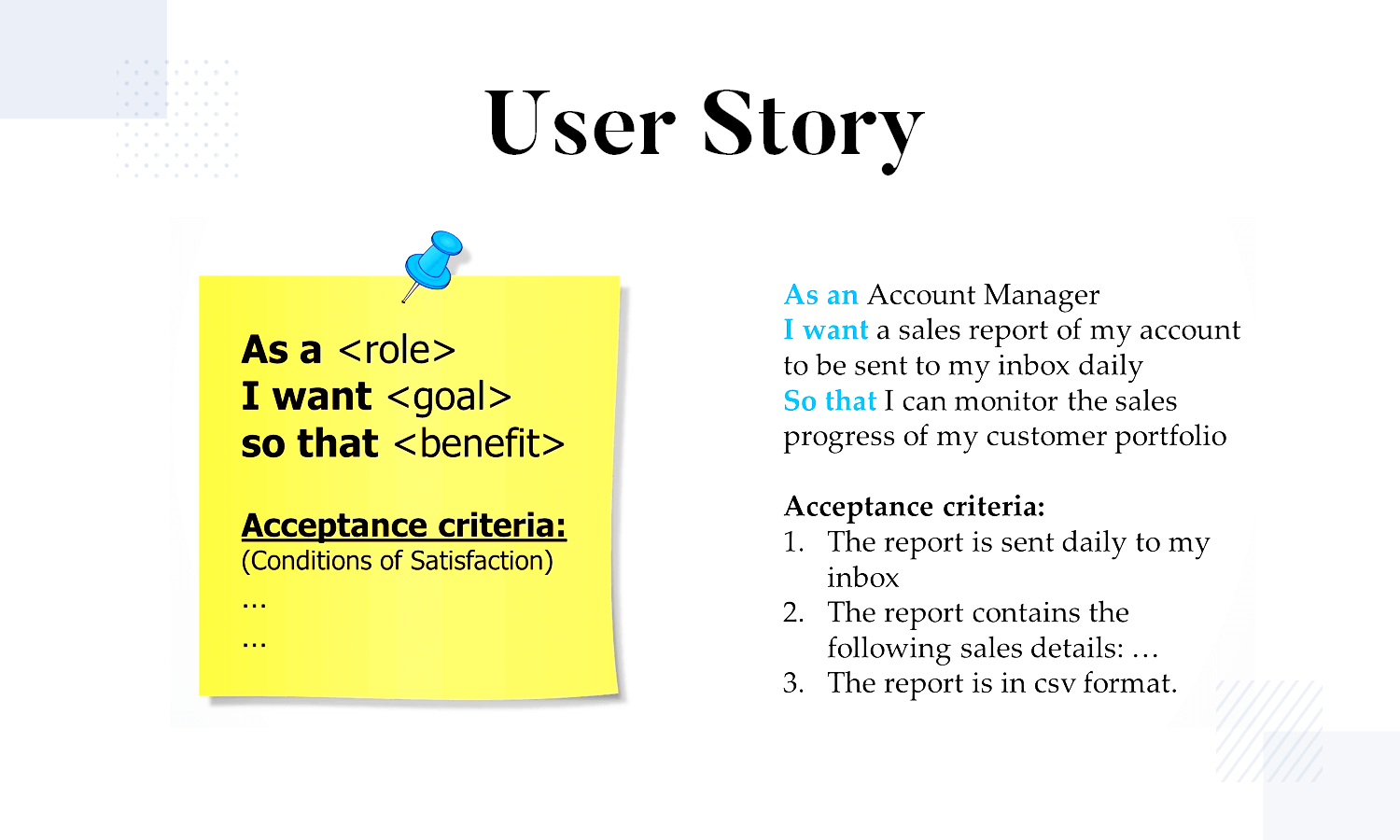
In product development, especially in Agile and Scrum methodologies, the term user story plays a central role. At first glance, it sounds like a simple narrative, but in practice, it is a powerful tool for capturing user needs, guiding development priorities, and keeping teams aligned with customer value.
A user story is a short, simple description of a feature or functionality told from the perspective of the end user. It answers the fundamental question: What does the user want, and why?
1. The Definition of a User Story
A user story is not a detailed specification or a lengthy requirement document. Instead, it’s a lightweight, human-centric way of describing desired functionality. The classic format often used is:
-
As a [type of user], I want [some goal] so that [some reason].
Example:
-
As a frequent traveler, I want to save my passport details securely so that I don’t have to enter them every time I book a flight.
This simple sentence communicates:
-
Who the user is,
-
What they want, and
-
Why it matters.
2. Why User Stories Matter
User stories are valuable because they:
-
Keep the focus on users – Instead of just building features, the team builds solutions that meet user needs.
-
Encourage collaboration – Stories are conversation starters, not final documents. Developers, designers, and stakeholders discuss and refine them together.
-
Support incremental development – Stories break down work into manageable, testable pieces.
-
Provide flexibility – Requirements can evolve as the team learns more, without being locked into rigid specifications.
3. Key Characteristics of a Good User Story
Agile practitioners often use the INVEST acronym to describe what makes a user story effective:
-
Independent – It should stand alone without being dependent on another story.
-
Negotiable – Not a fixed contract; open to discussion.
-
Valuable – It should provide clear benefit to the user.
-
Estimable – The team must be able to estimate the effort required.
-
Small – It should be manageable within a sprint or iteration.
-
Testable – There must be a way to confirm when it is complete.
4. User Stories vs. Traditional Requirements
Traditional requirements often focus on what the system should do, in technical detail. For example:
-
“The system shall store up to 10 credit card numbers per user profile, encrypted with AES-256.”
While precise, this type of requirement is developer-focused rather than user-focused.
By contrast, a user story might say:
-
“As a shopper, I want to save multiple payment methods so I can checkout faster.”
Notice how the story keeps the focus on user goals, leaving implementation details for discussion.
5. User Stories in Agile and Scrum
In Agile frameworks, user stories are placed in a product backlog (a prioritized list of work). During sprint planning, teams select stories to deliver within a sprint.
Each story often comes with:
-
Acceptance Criteria – Conditions that must be true for the story to be considered complete.
-
Story Points – An estimate of effort/complexity, not hours.
-
Tasks – Stories may be broken down into smaller tasks for developers and designers.
6. Examples of User Stories
-
As a new user, I want to sign up with my Google account so that I can register quickly.
-
As a customer, I want to receive email notifications when my order ships so I can track delivery.
-
As an admin, I want to generate monthly sales reports so that I can analyze performance.
Each of these stories communicates value and guides the development of features that matter to end users.
7. Common Mistakes with User Stories
-
Being too vague – “As a user, I want the system to be easy to use.” (Too broad; not actionable.)
-
Being too detailed – Turning the story into a technical spec defeats the purpose.
-
Forgetting the “why” – If the benefit isn’t clear, the story may not deliver value.
-
Stories too large – Sometimes called “epics,” oversized stories should be broken down.
-
Writing stories in isolation – They should always be refined collaboratively with the team.
8. Beyond Stories: Epics and Themes
-
Epic – A large body of work that can be split into multiple stories. Example: “As a user, I want to manage my account.”
-
Theme – A grouping of related stories under a broader objective. Example: a “Payments” theme might include stories about saving cards, using PayPal, and checking out.
9. The Role of User Stories in User-Centered Design
User stories bridge the gap between design thinking and software development. They align the team’s daily work with real human needs. When combined with personas, journey maps, and usability testing, they ensure that the product evolves in ways that delight users.
10. Conclusion
A user story is much more than a sentence in a backlog—it’s a communication tool that brings the voice of the customer into the development process. By focusing on who the user is, what they want, and why it matters, teams stay aligned on delivering meaningful value.
Good user stories are small, testable, and user-centric. When done well, they transform how teams collaborate, prioritize, and innovate—ensuring that products don’t just function, but genuinely solve problems for the people who use them.
- Arts
- Business
- Computers
- Παιχνίδια
- Health
- Κεντρική Σελίδα
- Kids and Teens
- Money
- News
- Personal Development
- Recreation
- Regional
- Reference
- Science
- Shopping
- Society
- Sports
- Бизнес
- Деньги
- Дом
- Досуг
- Здоровье
- Игры
- Искусство
- Источники информации
- Компьютеры
- Личное развитие
- Наука
- Новости и СМИ
- Общество
- Покупки
- Спорт
- Страны и регионы
- World

 English
 Russian
 French
 Spanish
 Portuguese
 Deutsch
 Turkish
 Dutch
Dutch
 Italiano
 Arabic
 Romaian
 Portuguese (Brazil)