
What Causes Inflation?
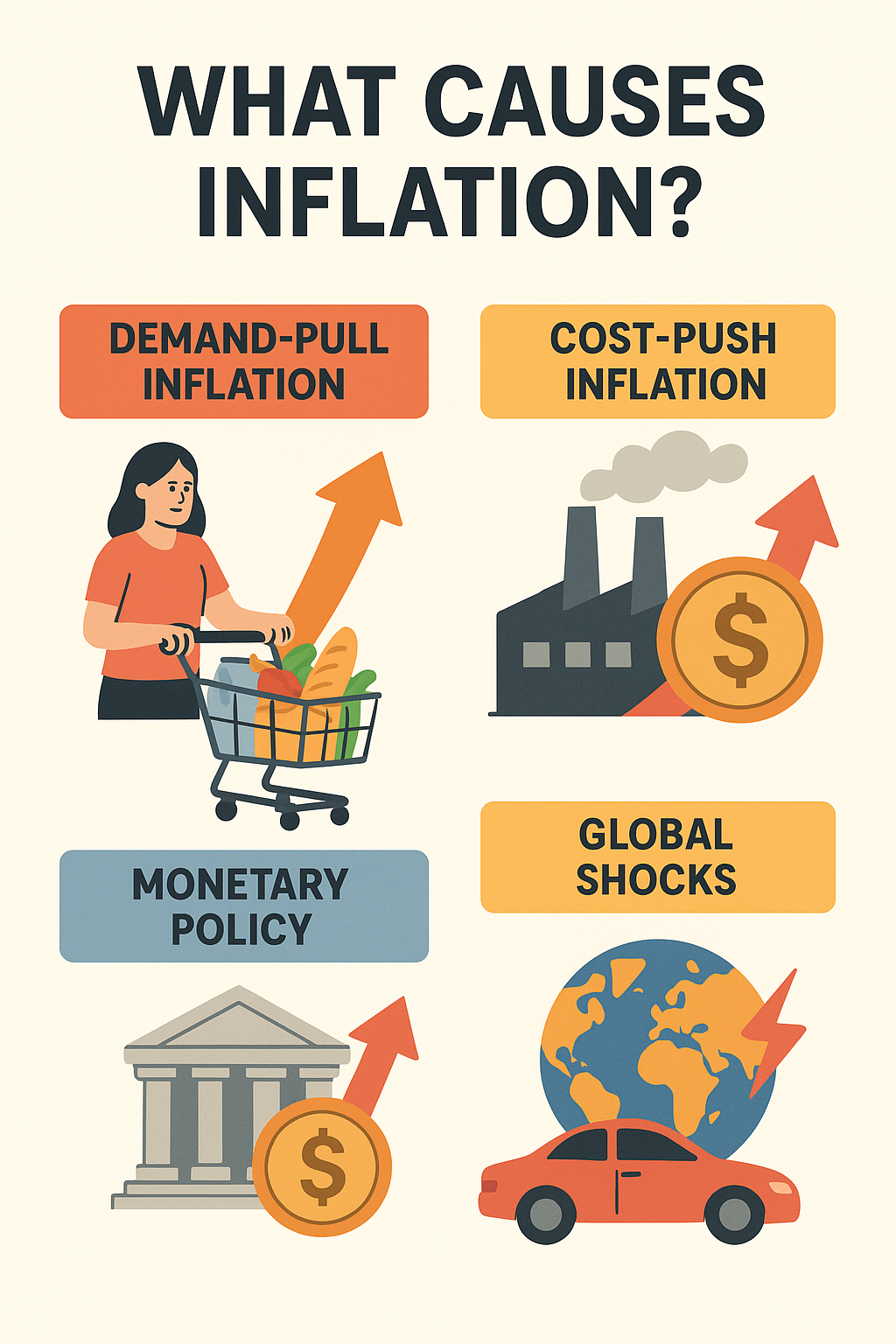
What Causes Inflation?
Inflation—the general rise in the price level of goods and services over time—is one of the most closely watched economic indicators. It affects households, businesses, and governments alike, influencing the cost of living, purchasing power, and investment decisions. While moderate inflation is considered normal in a growing economy, high or unpredictable inflation can destabilize markets and erode savings. But what actually causes inflation? Economists generally point to several interrelated factors.
1. Demand-Pull Inflation
This occurs when demand for goods and services outpaces supply. In a growing economy, consumers have more income, businesses expand, and governments may increase spending. If production cannot keep up with rising demand, businesses raise prices. A classic example is a booming economy with low unemployment, where consumer spending surges and pushes prices higher.
2. Cost-Push Inflation
Inflation can also be driven by rising production costs. When wages increase significantly, or when the price of raw materials (such as oil, metals, or agricultural products) climbs, businesses often pass these costs on to consumers in the form of higher prices. Supply chain disruptions—like those seen during the COVID-19 pandemic—can exacerbate cost pressures and push inflation upward.
3. Built-In Inflation
Sometimes referred to as the “wage-price spiral,” built-in inflation happens when workers demand higher wages to keep up with rising living costs. If employers grant these wage increases, they may raise prices to maintain profit margins. This creates a feedback loop where higher wages lead to higher prices, which in turn leads to demands for even higher wages.
4. Monetary Policy and Money Supply
The role of central banks, such as the U.S. Federal Reserve or the European Central Bank, is crucial. According to the monetarist view, “too much money chasing too few goods” leads to inflation. When central banks keep interest rates too low for too long or inject large amounts of money into the economy, the increased money supply can fuel inflation—especially if economic output does not grow at the same pace.
5. External Factors and Global Shocks
Inflation is not always homegrown. External shocks, such as geopolitical conflicts, trade restrictions, or fluctuations in exchange rates, can push prices higher. For example, a sudden rise in global oil prices raises transportation and production costs across many sectors. Similarly, a weakening national currency makes imports more expensive, contributing to inflation.
6. Expectations of Future Inflation
Finally, psychology matters. If businesses and consumers expect inflation to rise, they may act in ways that bring it about. Companies might preemptively raise prices, and workers may push for higher wages. These expectations can embed inflationary pressures into the economy even before actual cost or demand changes occur.
Conclusion
Inflation is rarely caused by a single factor. Instead, it typically arises from a combination of demand-side pressures, supply constraints, monetary conditions, and global influences. Policymakers walk a fine line: they must keep inflation in check without stifling economic growth. For individuals and businesses, understanding what drives inflation can help in making smarter financial and investment decisions in an ever-changing economic landscape.
Would you like me to make this more beginner-friendly with everyday examples (like groceries, gas, and housing), or keep it formal and economics-focused like this?
- Arts
- Business
- Computers
- Παιχνίδια
- Health
- Κεντρική Σελίδα
- Kids and Teens
- Money
- News
- Personal Development
- Recreation
- Regional
- Reference
- Science
- Shopping
- Society
- Sports
- Бизнес
- Деньги
- Дом
- Досуг
- Здоровье
- Игры
- Искусство
- Источники информации
- Компьютеры
- Личное развитие
- Наука
- Новости и СМИ
- Общество
- Покупки
- Спорт
- Страны и регионы
- World

 English
 Russian
 French
 Spanish
 Portuguese
 Deutsch
 Turkish
 Dutch
Dutch
 Italiano
 Arabic
 Romaian
 Portuguese (Brazil)
