
What is the purpose of comparative economics?
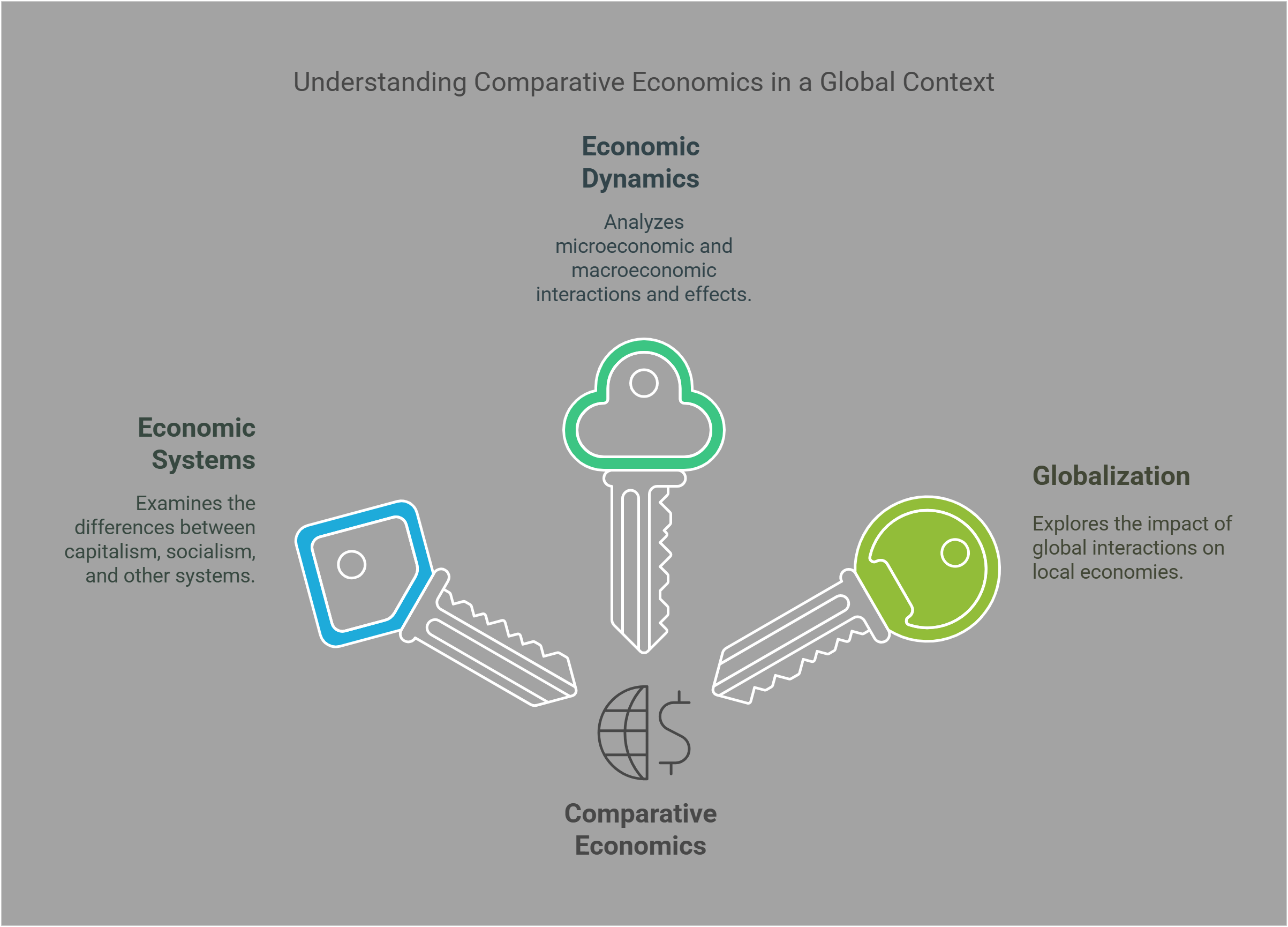
Comparative economics is the branch of economics that studies how different economic systems work, how they produce outcomes for people and firms, and why those outcomes differ across countries and over time. Its central purpose is not simply to label systems as “good” or “bad,” but to understand how alternative institutional arrangements shape real economic performance and social well-being.
This article explains what comparative economics is and, more importantly, why it exists.
Understanding economic systems, not just markets
Most introductory economics focuses on how markets function under certain assumptions. Comparative economics takes a wider view. It compares entire economic systems—such as market economies, centrally planned economies, and mixed systems—by looking at their rules, institutions, and incentives.
An economic system is not only about prices and supply and demand. It includes:
-
property rights
-
the role of the state
-
how firms are owned and governed
-
how resources are allocated
-
how income and power are distributed
The purpose of comparative economics is to explain how these institutional differences shape economic behavior and outcomes.
In short, it studies how rules and structures matter.
1. Explaining why countries perform differently
One of the main purposes of comparative economics is to explain why countries with similar resources or technology can experience very different levels of growth, productivity, and living standards.
For example, two countries may have:
-
similar labor forces,
-
similar access to global markets,
-
and similar education levels,
yet show very different economic results. Comparative economics looks beyond simple market forces and focuses on deeper institutional features such as:
-
the legal system,
-
political stability,
-
regulatory quality,
-
and ownership structures.
Rather than assuming that all economies work in roughly the same way, comparative economics treats institutional diversity as a core explanatory factor.
2. Comparing alternative ways of organizing an economy
Another central purpose is to compare different ways of organizing economic activity.
Historically, this comparison was often framed as a contrast between capitalism and socialism. Classic thinkers such as Adam Smith and Karl Marx developed very different views on how economies should be structured and whose interests they should serve.
Later, economists such as Friedrich Hayek emphasized the role of decentralized markets and information in coordinating economic activity.
Comparative economics does not exist to defend any single ideology. Instead, its purpose is to examine how different systems actually function in practice, including:
-
market-based economies,
-
centrally planned economies,
-
and hybrid or mixed systems.
It asks questions such as:
-
How are investment decisions made?
-
How flexible are firms and labor markets?
-
How easily can new businesses enter the market?
-
How are public services financed and delivered?
3. Understanding institutional change and economic transition
A particularly important purpose of comparative economics is to analyze economic transitions—periods when countries move from one system to another.
Examples include transitions from:
-
central planning to market coordination,
-
state ownership to private ownership,
-
or highly regulated economies to more open and competitive ones.
Comparative economics studies how reform strategies, sequencing of policies, and political constraints influence outcomes such as:
-
unemployment,
-
inflation,
-
inequality,
-
and long-term growth.
This helps economists understand why some reforms succeed while others stall or create severe social costs. The field therefore plays a key role in evaluating real-world reform experiences rather than idealized models.
4. Identifying trade-offs, not perfect systems
A crucial purpose of comparative economics is to make trade-offs visible.
Every economic system faces unavoidable tensions, such as:
-
efficiency versus equity,
-
innovation versus stability,
-
flexibility versus social protection.
Comparative economics does not search for a universally “best” system. Instead, it examines how different institutional arrangements handle these trade-offs.
For example, one system may achieve:
-
faster job creation,
-
but weaker job security.
Another system may provide:
-
stronger social insurance,
-
but lower labor market mobility.
By comparing multiple systems side by side, comparative economics clarifies that economic outcomes depend on societal priorities as well as technical efficiency.
5. Improving economic policy design
Another major purpose is to support better policy making.
Governments rarely design policies in isolation. They often look to other countries for examples of:
-
pension systems,
-
health care financing,
-
industrial policy,
-
or competition regulation.
Comparative economics provides the analytical tools needed to judge whether a policy that works in one institutional context is likely to work in another.
International organizations such as the World Bank, the International Monetary Fund, and the Organisation for Economic Co-operation and Development rely heavily on cross-country comparisons when advising governments.
Without comparative analysis, policy borrowing becomes superficial and risky. The purpose of comparative economics is to move beyond imitation and toward informed adaptation.
6. Broadening the meaning of economic success
Traditional economic analysis often focuses on output growth and productivity. Comparative economics expands the concept of performance to include social and institutional outcomes.
It investigates how different systems affect:
-
income inequality,
-
access to education and health care,
-
social mobility,
-
and economic security.
The work of economists such as Amartya Sen helped reinforce the idea that development and economic success should be evaluated in terms of human well-being and capabilities, not only income.
One of the purposes of comparative economics is therefore normative as well as analytical: it encourages societies to reflect on what they want their economic system to achieve.
7. Testing economic theory in real institutional settings
Comparative economics also plays an important methodological role. It tests general economic theories against diverse institutional environments.
Many economic models assume:
-
well-defined property rights,
-
stable legal enforcement,
-
competitive markets,
-
and transparent information.
Comparative research shows how predictions change when these conditions are weak, absent, or organized differently.
By studying economies with different institutional frameworks, comparative economics helps identify:
-
which theoretical results are robust,
-
and which depend heavily on specific assumptions.
Its purpose is therefore to make economic theory more realistic and more sensitive to institutional context.
8. Helping societies choose among feasible alternatives
A final, practical purpose of comparative economics is to help societies understand their realistic options.
Policy debates often present extreme alternatives: complete state control or pure free markets. In reality, most countries operate mixed systems with varying degrees of public and private involvement.
Comparative economics maps this diversity and shows that:
-
institutional arrangements are not fixed,
-
multiple models can coexist,
-
and gradual reforms are often more feasible than radical redesigns.
By studying how other societies have organized taxation, social protection, business regulation, and public services, comparative economics supports informed public debate about reform paths that are politically and socially sustainable.
Conclusion
The purpose of comparative economics is to understand how different economic systems work, why they produce different outcomes, and what trade-offs they embody. It explains cross-country differences in performance, evaluates economic transitions, tests economic theories in real institutional environments, and supports better policy design.
Most importantly, comparative economics reminds us that economic outcomes are shaped not only by markets and technology, but by social choices about institutions, governance, and collective priorities. By comparing systems rather than assuming a single universal model, it provides a deeper and more realistic foundation for thinking about economic development and reform.
- Arts
- Business
- Computers
- Spiele
- Health
- Startseite
- Kids and Teens
- Geld
- News
- Personal Development
- Recreation
- Regional
- Reference
- Science
- Shopping
- Society
- Sports
- Бизнес
- Деньги
- Дом
- Досуг
- Здоровье
- Игры
- Искусство
- Источники информации
- Компьютеры
- Личное развитие
- Наука
- Новости и СМИ
- Общество
- Покупки
- Спорт
- Страны и регионы
- World

 English
 Russian
 French
 Spanish
 Portuguese
 Turkish
 Dutch
Dutch
 Italiano
 Arabic
 Romaian
 Portuguese (Brazil)
 Greek
Greek